The Solar Wind
The space between the planets may seem empty, but it isn't.
At every moment, the Sun is releasing a continuous stream of electrically charged particles into space. This flow travels outward in every direction, passing Earth and the other planets before eventually extending far beyond the orbit of Pluto.
It is called the solar wind.
Unlike a solar flare or coronal mass ejection, the solar wind isn't normally a single explosive event.
It is always present.
Earth is immersed in it continuously.
The solar wind carries particles, energy and the Sun's magnetic field throughout the Solar System, creating an enormous region of solar influence known as the heliosphere.
Most of the time we don't notice it. Earth's magnetic field and atmosphere provide substantial protection from the stream of charged particles flowing past our planet.
But changes in the solar wind can disturb Earth's magnetic environment, contribute to auroras, affect the upper atmosphere and influence technologies operating in space.
The solar wind therefore provides a continuous physical connection between the Sun and Earth.
Warning: Do not look directly at the sun without appropriate eye protection
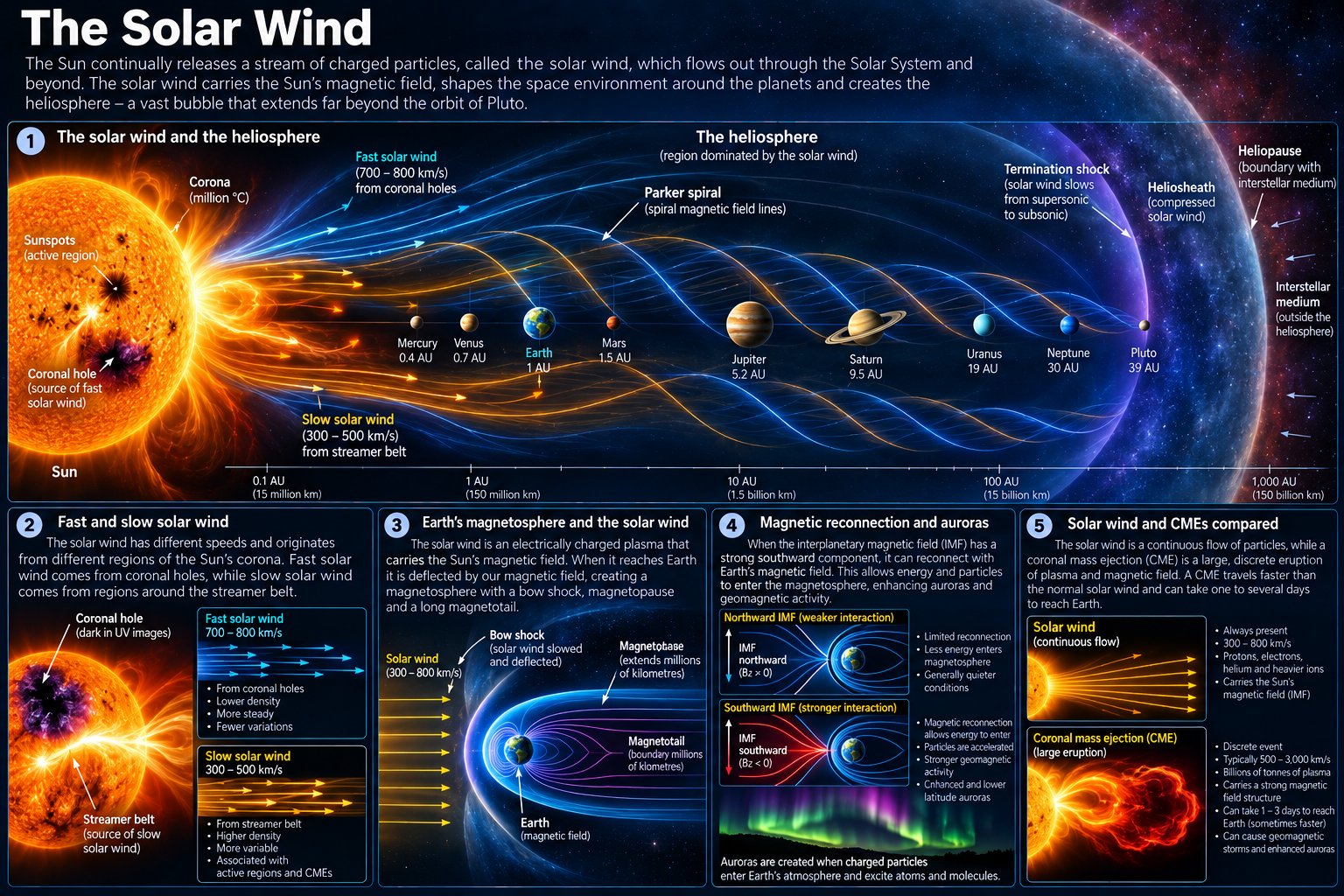
What the solar wind is made of
The solar wind is a flow of plasma — gas so hot that its atoms have been split into positively charged ions and negatively charged electrons. The bulk of it consists of protons and electrons, with a smaller fraction of heavier nuclei such as helium.
Although it is incredibly tenuous — far more rarefied than any vacuum produced in a laboratory on Earth — the solar wind moves remarkably fast. Near Earth it typically flows at roughly:
400 kilometres per second
Fast streams can exceed 700 kilometres per second, while slow, dense wind may drift along at less than half that speed. Even the slow solar wind would cross the distance from the Sun to Earth — about 150 million kilometres — in only a few days.
Because plasma is electrically conducting, the solar wind carries the Sun's magnetic field out with it. The field lines are drawn outward by the flow and, as the Sun rotates beneath it, they are twisted into a vast spiral — a shape sometimes compared to water streaming from a rotating garden sprinkler.
How the solar wind was discovered
The first clue came from comets. When a comet approaches the Sun, its ice vaporises and forms a glowing coma and tails. Astronomers noticed that comet tails do not simply trail behind the comet's motion — ion tails point almost directly away from the Sun, whatever direction the comet is travelling.
In the 1950s, the German astronomer Ludwig Biermann argued that only a continuous outflow of charged particles from the Sun could push comet tails into that alignment. Soon afterwards, the American physicist Eugene Parkershowed theoretically that the Sun's super-hot outer atmosphere must expand steadily into space, and gave the flow its name: the solar wind.
The idea was controversial at first. Direct confirmation came in 1962, when NASA's Mariner 2 spacecraft, en route to Venus, measured a ceaseless stream of charged particles blowing past it — a flow that has never stopped in the more than sixty years of measurements since.
Where the solar wind comes from
The solar wind is born in the corona, the Sun's outer atmosphere. The corona is extraordinarily hot — over a million degrees, far hotter than the visible surface beneath it — and its particles move so fast that the Sun's gravity cannot hold them all. They escape steadily into space.
The wind arrives at Earth in two main varieties. Slow solar wind, flowing at roughly 300 to 400 kilometres per second, streams from regions where the corona is hot, dense and magnetically complicated — often near active regions and the closed magnetic loops of the corona.
Fast solar wind, at 700 kilometres per second or more, pours out of coronal holes — regions where the Sun's magnetic field opens directly into space instead of looping back to the surface. Coronal holes are most common around solar minimum, when the Sun's large-scale field is at its simplest, and they can persist for many solar rotations, spraying fast wind across space like a rotating lawn sprinkler.
The heliosphere
As the solar wind blows outward in all directions, it inflates a gigantic bubble of solar influence: the heliosphere. Inside it, space is filled with the Sun's plasma and magnetic field. Outside it lies the thin gas between the stars.
The heliosphere extends far beyond the planets. Its boundary — the heliopause, where the solar wind finally slows to a stop against the interstellar medium — lies more than 100 times farther from the Sun than Earth is. The two Voyager spacecraft crossed it in the 2010s and 2020s, becoming the first human-made objects to enter interstellar space.
The heliosphere also shields the Solar System. It helps deflect a portion of the galactic cosmic rays that would otherwise sweep through the inner Solar System, and its strength rises and falls with the solar cycle.
Meeting Earth's magnetosphere
Earth carries its own magnetic field, generated deep in its molten iron outer core. That field carves out a protective cavity in the solar wind called the magnetosphere.
On the day side, the incoming solar wind rams into the magnetosphere and compresses it; on the night side, the flow stretches it into a long tail extending far beyond the Moon. The wind's supersonic flow is slowed at a standing shock wave called the bow shock, before sliding around the magnetopause — the outer boundary of Earth's magnetic domain.
Most of the solar wind is deflected harmlessly around this magnetic shield. But not all of it. Through a process called magnetic reconnection, solar-wind field lines that point southward can link with Earth's field and transfer particles and energy into the magnetosphere — the same process, on a gentler scale, that powers solar flares on the Sun.
That transferred energy drives convection and currents within the magnetosphere, stores up in the stretched tail, and is periodically released back towards Earth — the mechanism behind geomagnetic storms and substorms.
The solar wind and auroras
Auroras are the solar wind made visible. Charged particles accelerated within the disturbed magnetosphere spiral down Earth's magnetic field lines into the upper atmosphere near the poles. There they collide with atoms and molecules of oxygen and nitrogen, which glow in response — green and red from oxygen, blues and purples from nitrogen.
Because particles are guided by the field lines that converge on the polar regions, auroras normally form rings around the magnetic poles — the auroral ovals. On a quiet night the ovals stay close to the poles, and the auroras are modest.
When the solar wind blows harder — or carries a strong southward magnetic field of its own — the magnetosphere absorbs more energy, the ovals expand, and the auroras brighten and surge. This is why strong auroras can sometimes be visible much farther from the poles than usual.
Fast wind, slow wind and recurring storms
Because fast and slow wind travel at different speeds, fast streams leaving the Sun later can catch up with slower, denser wind ahead of them. Where they collide, they pile into a compressed, turbulent region called a co-rotating interaction region.
When such a region sweeps past Earth, it can rattle the magnetosphere and spark geomagnetic activity — often without any flare or coronal mass ejection at all. Because the coronal holes that produce fast wind rotate with the Sun, these disturbances can recur every 27 days or so, repeating with each solar rotation while the hole lasts.
This is one reason space weather isn't only about dramatic eruptions. Much of it is the steady rhythm of the wind itself — fast streams, sector boundaries where the spiral magnetic field flips direction, and the gusts and lulls that follow the Sun's rotation.
Effects on technology
The solar wind is always blowing, and technologies operating in space or through the upper atmosphere live inside it. Disturbances carried by the wind can:
- increase atmospheric drag on satellites by heating and thickening the outer atmosphere;
- degrade satellite surfaces and electronics through continual particle bombardment and charging;
- disturb radio communication and satellite navigation signals that pass through the ionosphere;
- induce currents in long conductors on Earth — pipelines, railway lines and power networks — during geomagnetic storms.
For these reasons, space-weather forecasters monitor the solar wind continuously, treating it as the everyday weather of the space around Earth.
The solar wind and the solar cycle
The solar wind never switches off, but its character changes with the solar cycle. Around solar minimum, the Sun's large-scale magnetic field is simpler, and long-lived coronal holes near the equator send recurrent fast streams past Earth. Around solar maximum, the field is tangled and complex, the wind is gustier on average, and the biggest disturbances come from coronal mass ejections ploughing through it.
The heliosphere breathes with the cycle too. When the Sun is active, the inflated magnetic bubble screens out more galactic cosmic rays; when the Sun is quiet, more of them reach the inner Solar System. Cosmic-ray detectors on Earth therefore record a slow, opposite rhythm to the sunspot number.
How the solar wind is monitored
Spacecraft stationed at the Sun–Earth L1 point, roughly 1.5 million kilometres sunward of Earth, sit permanently in the solar wind, measuring its speed, density, temperature and — crucially — the direction of its magnetic field before it arrives at our planet. Depending on the wind's speed, these measurements give forecasters anywhere from a few tens of minutes to about an hour of warning.
Other observatories watch the source. Telescopes image the corona and its coronal holes, and dedicated missions study the wind close to its origin. NASA's Parker Solar Probe, named for the physicist who predicted the solar wind, has flown closer to the Sun than any spacecraft before it, passing through the corona itself to measure the birth of the wind where it is still accelerating.
An important safety point
The solar wind itself cannot be seen with the eye, and observing the Sun is never required to appreciate its effects. But if you are observing the Sun for sunspots or active regions, never look directly at it without purpose-designed, certified solar filters. Looking at the Sun unprotected can cause permanent eye damage, including blindness — often without any pain, because the retina has no pain receptors.
Safe alternatives exist. A pinhole projector shows the Sun as a projected image without ever requiring you to look at the Sun itself. For direct viewing, use only certified solar viewing glasses (compliant with the ISO 12312-2 standard) or a purpose-designed solar filter fitted to the front of a telescope. See our Safe Solar Observing guide for full details.
A star that touches every planet
The solar wind shows that the Sun's influence is not confined to light and heat. Its atmosphere physically flows outward, past every planet, filling an enormous bubble that defines the environment of the whole Solar System.
Earth sits inside that flow, protected by its magnetic field but not untouched by it. The steady wind shapes the magnetosphere; its gusts and storms drive auroras, disturb the upper atmosphere and challenge the technologies that modern life depends on.
Understanding the solar wind therefore means understanding the Sun not as a distant lamp, but as a star in physical contact with its planets — one whose atmosphere reaches us every day, and whose changes are felt here within days of leaving the solar surface.
When the wind blows strong and its magnetic field points the right way, the magnetosphere absorbs that energy and the auroral ovals swell. This is why strong auroras can sometimes be visible much farther from the poles than usual.
High-speed solar-wind streams
Fast solar wind emerging from a coronal hole can catch up with slower solar wind released earlier. Because both streams contain plasma and magnetic fields, they don't simply pass through one another. Instead, the interaction can create compressed regions containing enhanced density and magnetic field strength.
When these structures recur because of solar rotation, they are known as corotating interaction regions, or CIRs. When a CIR reaches Earth, it can produce geomagnetic activity. This is particularly important during parts of the solar cycle when large, persistent coronal holes are present.
Solar wind versus a CME
The solar wind and a coronal mass ejection both involve plasma travelling outward from the Sun, but they shouldn't be confused. The solar wind is continuous. A CME is an eruption. The ordinary solar wind flows all the time. A CME is a large, transient disturbance containing an enhanced quantity of plasma and magnetic field.
An analogy is weather on Earth. The solar wind is somewhat like the atmosphere's normal circulation. A CME is more like a major storm system moving through it. The analogy isn't exact, but it highlights the important distinction between a persistent background flow and a discrete event.
What happens when a CME travels through the solar wind?
A fast CME doesn't travel through empty space. It moves through the existing solar wind. If the CME travels faster than the plasma ahead of it, it can drive a shock wave. Material can become compressed ahead of the eruption. The CME can also interact with high-speed streams, slower solar wind or even previous CMEs.
These interactions can change its speed, direction, shape and magnetic structure. This is one reason predicting exactly when a CME will reach Earth — and precisely what effects it will produce — can be difficult.
The solar cycle changes the solar wind
The structure of the solar wind varies through the approximately 11-year solar cycle. Around solar minimum, the Sun's large-scale magnetic field is relatively organised. Large coronal holes tend to occur around the solar poles, and the structure of fast and slow solar wind is comparatively orderly.
As activity increases towards solar maximum, the Sun's magnetic field becomes far more complicated. Coronal holes and active regions appear at a wider range of latitudes. CMEs become more frequent. The solar wind throughout the heliosphere consequently becomes more variable and disturbed.
So the solar cycle isn't simply a cycle in sunspot numbers. It changes the environment throughout the Solar System.
Does the solar wind blow on the Moon?
Yes. Unlike Earth, the Moon doesn't possess a strong global magnetic field or a substantial atmosphere. Its surface is therefore exposed much more directly to the solar wind. Solar-wind particles continually strike the lunar surface. Over extremely long periods, this contributes to a collection of processes known as space weathering, which alter the optical and physical properties of surface material. Solar-wind particles can also become implanted in lunar soil.
This direct interaction is very different from the situation on Earth, where the magnetosphere and atmosphere provide substantial shielding.
What about Mars?
Mars also lacks a strong global magnetic field like Earth's. It does have localised crustal magnetic fields, but much of the planet's upper atmosphere interacts more directly with the solar wind. Spacecraft observations have shown that solar-wind interactions contribute to the loss of particles from the Martian atmosphere into space.
This process is particularly interesting because ancient Mars appears to have possessed a much thicker atmosphere and a very different surface environment. Studying the solar wind therefore helps planetary scientists understand not only the present Solar System but also how planetary environments evolve over billions of years.
And Venus?
Venus provides another interesting comparison. It has a very thick atmosphere but no Earth-like internally generated global magnetic field. The solar wind interacts directly with its upper atmosphere and ionosphere, producing an induced magnetosphere. Earth, Venus and Mars therefore demonstrate three different ways in which planets can interact with the same solar wind. Studying these differences helps scientists understand how magnetic fields and atmospheres influence planetary evolution.
The solar wind and comets
The influence of the solar wind can even be seen in comets. A comet approaching the Sun can develop two prominent tails. One contains dust. The other, known as the ion tail or plasma tail, consists of ionised gas. The solar wind and the interplanetary magnetic field interact with this ionised material, causing the plasma tail to extend generally away from the Sun.
This means a comet's plasma tail doesn't simply trail behind it like the wake of a boat. Its direction is strongly controlled by the Sun. A comet can therefore provide a visible indication of the solar environment through which it is travelling.
The solar wind helps shield the Solar System
The heliosphere doesn't only carry solar particles outward. Its magnetic environment also influences energetic particles arriving from outside the Solar System. These high-energy particles are known as galactic cosmic rays. The solar wind and heliospheric magnetic field help modulate how easily they reach the inner Solar System.
During periods of high solar activity, the Sun's magnetic environment generally provides stronger modulation. Near Earth, galactic cosmic-ray intensity therefore tends to be lower around solar maximum and higher around solar minimum. This is one of the more surprising ways in which solar activity affects conditions throughout the heliosphere.
How was the solar wind discovered?
The idea of particles travelling outward from the Sun developed gradually. Observations of comet tails provided early clues that something from the Sun was influencing material in interplanetary space. In the 1950s, physicist Eugene Parker developed a theoretical model showing that the Sun's hot corona should continually expand outward as a supersonic flow.
The idea was initially controversial. But spacecraft soon provided direct measurements of the predicted particle stream. The existence of the solar wind was confirmed. Parker's prediction transformed our understanding of interplanetary space. It wasn't an empty vacuum through which isolated planets travelled. It was an environment filled with plasma and magnetic fields originating from the Sun.
Parker Solar Probe
Decades after Eugene Parker predicted the solar wind, NASA named a spacecraft after him. Parker Solar Probe was launched in 2018 to investigate the Sun's corona and solar wind at unprecedentedly close distances. The spacecraft repeatedly passes extremely close to the Sun, using Venus flybys to reshape its orbit. Its measurements allow scientists to examine the region where the solar wind is accelerated and investigate some of the fundamental questions surrounding the Sun's corona.
In 2021, scientists announced that Parker Solar Probe had passed through the Sun's Alfvén critical surface, entering the solar corona in a physical sense. For the first time, a spacecraft had flown through the Sun's outer atmosphere.
Why is the corona so hot?
One of the major unresolved questions in solar physics concerns the extraordinary temperature of the corona. The visible photosphere is around 5,500°C. Yet the corona above it reaches temperatures of more than a million degrees. Normally we expect temperature to fall as we move farther from a heat source. The Sun's atmosphere does the opposite.
Scientists know that magnetic processes are central to transferring energy into the corona, with waves, turbulence and magnetic reconnection all playing important roles. Exactly how these processes combine to heat the corona and accelerate the solar wind remains an active area of research. The solar wind is therefore not simply something we have discovered and completely explained. It remains at the centre of modern solar physics.
How do we monitor the solar wind?
Several spacecraft continuously measure conditions in interplanetary space. Particularly useful spacecraft operate near the Sun–Earth L1 point, approximately:
1.5 million kilometres from Earth
in the direction of the Sun. From there they can measure the solar wind before it reaches Earth's magnetosphere. Important measurements include solar-wind speed, particle density, temperature, magnetic-field strength and magnetic-field direction. These measurements are extremely useful for space-weather forecasting.
How much warning do we get?
A spacecraft near L1 is much closer to Earth than to the Sun. By the time a solar-wind disturbance reaches it, most of the journey from the Sun is already complete. At typical solar-wind speeds, measurements at L1 may provide approximately:
tens of minutes to around an hour
of warning before the same conditions reach Earth. This is particularly important for determining the magnetic orientation of an approaching disturbance. A CME may have been observed leaving the Sun one or more days earlier. But measurements near L1 can reveal whether its magnetic field has the strongly southward component that can produce a more substantial geomagnetic response.
Solar wind measurements
Space-weather reports often contain values that can initially seem rather abstract. You might see:
- Speed: 450 km/s
- Density: 6 particles/cm³
- Bz: −8 nT
These values describe very different properties. Speed tells us how quickly the plasma is moving. Density tells us approximately how many particles occupy a given volume. Bz describes the north-south component of the interplanetary magnetic field. A negative Bz indicates a southward component. When the solar wind is fast and the magnetic field remains strongly southward, conditions can become particularly favourable for enhanced geomagnetic activity.
Is the solar wind dangerous to people on Earth?
Under ordinary circumstances, no. Earth's magnetosphere and atmosphere provide substantial protection. Solar-wind particles don't simply travel through the atmosphere and strike people at ground level. The situation is different in space. Spacecraft and astronauts operate in an environment where solar and cosmic radiation require much greater consideration.
Solar energetic particle events associated with eruptions are generally a more immediate radiation concern than the ordinary solar wind itself. This is one reason understanding solar activity is particularly important as human exploration moves farther beyond low Earth orbit.
Can we feel the solar wind?
Not as a physical breeze. Despite travelling hundreds of kilometres per second, the solar wind at Earth's orbit is extraordinarily tenuous. There are only a few particles per cubic centimetre under typical conditions. The atmosphere around you contains vastly more particles.
If Earth's magnetic protection somehow disappeared, the solar wind still wouldn't feel like a terrestrial wind blowing against your skin. Its importance comes from the fact that it is an electrically charged plasma carrying magnetic fields, not from ordinary aerodynamic pressure.
A journey through the heliosphere
Imagine following a small parcel of solar-wind plasma. It begins in the Sun's million-degree corona. Magnetic fields and thermal processes accelerate it outward. It passes the region where the solar wind becomes faster than characteristic plasma-wave speeds and continues into interplanetary space.
Because the Sun is rotating beneath it, the magnetic field carried by the plasma forms part of the Parker spiral. After several days, our parcel reaches Earth's orbit. Most of it is diverted around Earth's magnetosphere. Depending on the orientation of its magnetic field, some of its energy may enter the magnetosphere through magnetic reconnection. That energy may ultimately contribute to an auroral display in Earth's upper atmosphere.
But most of the solar wind continues onwards. It passes the orbit of Mars. Then Jupiter. Then Saturn, Uranus and Neptune. Far beyond the major planets it begins to slow as it interacts increasingly with the interstellar environment.
Eventually it crosses the termination shock, passes through the heliosheath and approaches the heliopause. The plasma that began in the atmosphere of our Sun has helped create a bubble extending across an enormous region of space. That is the scale of the solar wind.
The Sun reaches far beyond its visible surface
When we look at the Sun, its bright visible disc appears to have a clear edge. That edge can create the impression that the Sun ends at the photosphere. Physically, it doesn't. Its atmosphere extends far beyond the visible surface. Its corona reaches outward into space. Its plasma becomes the solar wind. Its magnetic field is carried through the planetary system. And the resulting heliosphere extends far beyond the most distant major planet.
Earth therefore doesn't orbit the Sun in empty space. It orbits inside an environment created by the Sun. That environment changes as the Sun rotates. It changes as coronal holes appear and disappear. It is disturbed by solar flares and coronal mass ejections. And its overall structure evolves throughout the solar cycle.
The solar wind connects all of these phenomena. Sunspots reveal the Sun's magnetic activity. The solar cycle shows how that activity changes over years. Solar flares and CMEs demonstrate how magnetic energy can be released explosively. The solar wind shows that the Sun's influence is also continuous.
Every second of every day, material from the Sun flows past Earth and continues towards the outer Solar System. We cannot see that flow with our eyes. We cannot feel it as a breeze. But when it interacts with Earth's magnetic field, it can illuminate the polar skies with auroras. And when spacecraft measure it directly, they reveal something fundamental about our astronomical environment: we live not merely near the Sun, but inside the vast magnetic atmosphere of an active star.
Find out more
Continue exploring the Sun on the Understanding the Sun page, or learn how the Moon, Sun and Earth align in What Causes a Solar Eclipse?.
More Sun reading
Read about the rhythm that changes the solar wind's character over the years in Understanding the Solar Cycle, about the explosive eruptions that plough through the wind in Solar Flares and Coronal Mass Ejections, and about the dark markings that trace the Sun's magnetism in What Are Sunspots?, browse more articles about the science of the Sun on the Solar Science Articles page, or check today's sun position on the Sun Summary page.