What Causes a Solar Eclipse?
Every so often, something extraordinary happens in the daytime sky. The Sun, which has shone steadily since morning, begins to dim. A strange, cold twilight settles across the landscape. Shadows sharpen. Birds fall silent and may go to roost, and the temperature drops. Then, for a few breathtaking minutes, the Sun vanishes altogether, replaced by a black disc ringed by a pale, ghostly glow.
That event is a total solar eclipse, and it is one of the most remarkable sights in nature. But what actually causes it? The answer is a piece of celestial geometry so precise that it seems almost designed — and yet it arises entirely from the ordinary motions of the Sun, the Moon and the Earth.
Warning: Do not look directly at the sun without appropriate eye protection
Three bodies in a line
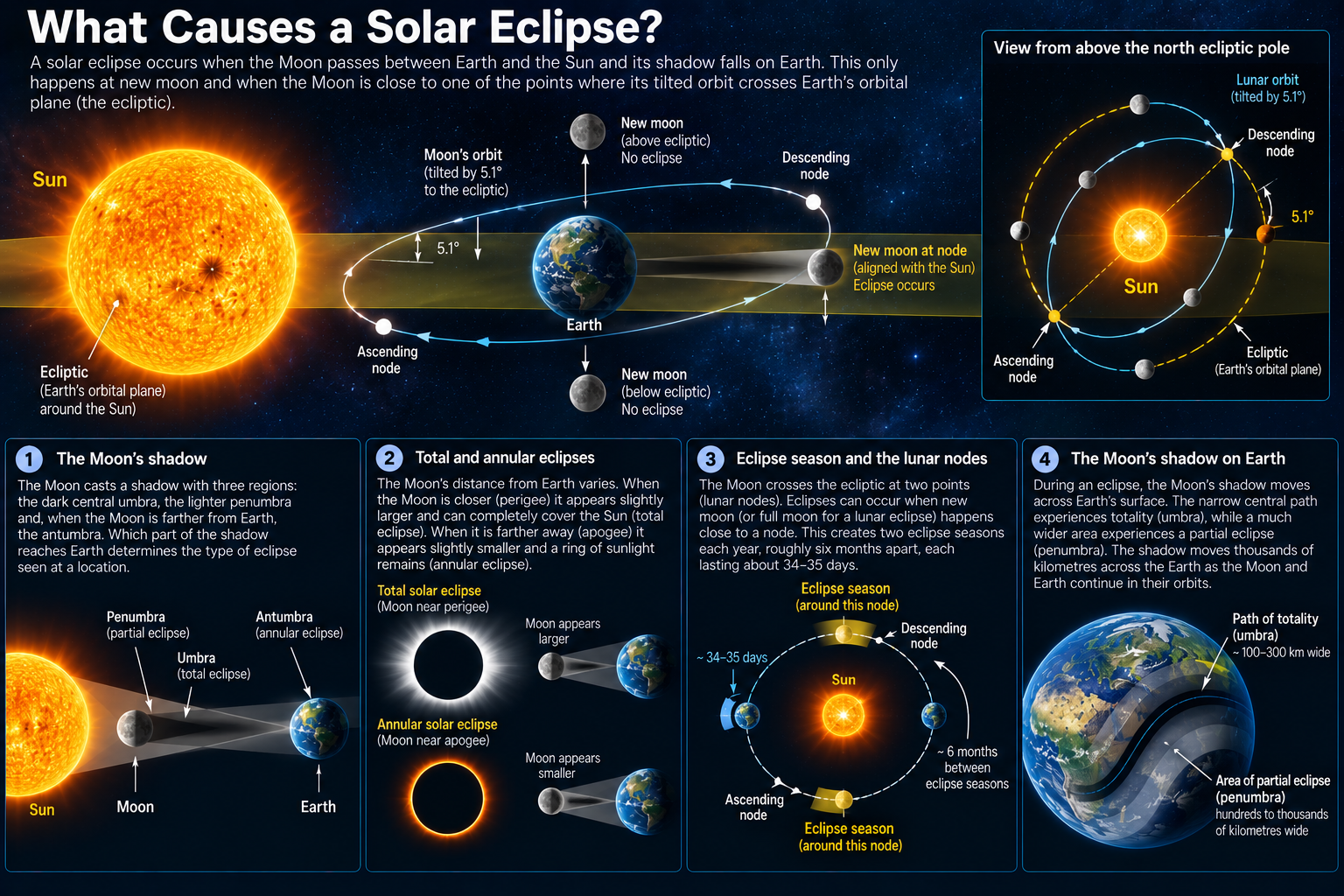
A solar eclipse is, at its heart, a shadow. It happens when the Moon passes directly between the Sun and the Earth, casting its shadow onto our planet. For a few minutes, observers inside that shadow see the Moon silhouette the Sun, partly or wholly blocking its light.
This can only happen at one phase of the Moon: new moon, when the Moon sits on the same side of Earth as the Sun and its unlit face is turned towards us. At new moon, the Moon is in the right general position to cast its shadow in our direction.
The essential alignment is therefore:
Sun → Moon → Earth
The Sun is enormous — roughly 400 times wider than the Moon — but it is also roughly 400 times farther away. By a striking coincidence, the two appear almost exactly the same size in our sky. That is why the Moon, although tiny by cosmic standards, can cover the Sun so completely.
Why eclipses do not happen every month
There is a new moon every month, so if the alignment were perfect every time, we would see a solar eclipse every month as well. Plainly we do not. The reason is that the Moon's orbit around Earth is not in quite the same plane as Earth's orbit around the Sun.
Earth travels around the Sun in a flat path called the ecliptic plane. The Moon, in turn, travels around Earth in its own orbit, but that orbit is tilted by about:
5 degrees
That small tilt is enough to carry the Moon usually above or below the Sun at new moon, so its shadow misses Earth entirely and passes harmlessly into space. Most new moons produce no eclipse at all.
The nodes and the eclipse season
The Moon's tilted orbit crosses the ecliptic plane at two points called the nodes. These crossing points are where the two orbital planes intersect. An eclipse can occur only when the Moon is at, or very near, one of these nodes at new moon — that is, when the Sun, Moon and Earth are genuinely lined up in three dimensions, not just roughly.
Because the nodes slowly drift around the Moon's orbit, the periods when they align with the Sun come around roughly twice a year. These windows, each lasting a few weeks, are called eclipse seasons. Any new moon that falls within an eclipse season will produce some kind of solar eclipse somewhere on Earth.
This is why solar eclipses, while not monthly, still occur in predictable clusters: typically between two and five each year, though most are partial or annular and visible only from a limited part of the world.
The structure of the Moon's shadow
To understand the different kinds of solar eclipse, it helps to picture the Moon's shadow. That shadow has two main parts, and sometimes three.
- Umbra — the dark central cone of full shadow. From anywhere inside the umbra, the Moon completely blocks the Sun's bright face.
- Penumbra — the lighter outer shadow where the Moon only partly covers the Sun. Observers in the penumbra see a partial eclipse.
- Antumbra — a third zone that appears when the umbra is too short to reach Earth's surface. From inside the antumbra, the Moon appears slightly smaller than the Sun, leaving a bright ring of sunlight around it.
Which part of the shadow falls on you determines which kind of eclipse you experience.
The four kinds of solar eclipse
Depending on the alignment and on the Moon's distance from Earth, a solar eclipse falls into one of four types.
Total eclipse
When the Moon is close enough to Earth and perfectly aligned, the umbra sweeps across a narrow strip of the surface. Observers inside this strip, called the path of totality, see the Moon completely cover the Sun. Daylight gives way to an eerie twilight, and the Sun's faint outer atmosphere — the corona — becomes visible around the black lunar disc. Totality lasts only a few minutes at most at any single place.
Partial eclipse
When only the penumbra reaches Earth, or when an observer is outside the path of totality, the Moon covers just a portion of the Sun. The Sun appears as a crescent or a bitten disc. Partial eclipses are far more widely visible than total ones, but they never reveal the corona.
Annular eclipse
The Moon's orbit around Earth is not a perfect circle, so its apparent size changes. When the Moon is near the farther part of its orbit, it appears too small to cover the Sun completely. The umbra falls short, and the antumbra reaches Earth instead. Observers in its path see a bright ring of sunlight surrounding the dark Moon — a glowing ring of fire. Because the Sun is never fully covered, an annular eclipse is never safe to view without protection.
Hybrid eclipse
In rare cases, the curvature of the Earth means the same eclipse is total along part of its path and annular along another part. These hybrid or mixed eclipses are the rarest of all, shifting between the two forms as the shadow sweeps across the globe.
A coincidence of size and distance
Total solar eclipses are possible only because of a remarkable coincidence. The Sun is about 400 times wider than the Moon, but it is also about 400 times farther away. The two therefore have nearly the same angular size in our sky — roughly half a degree across.
Because the apparent sizes are so closely matched, the Moon can cover the Sun almost exactly, hiding the blinding photosphere while leaving the much fainter corona exposed. If the Moon were smaller, or farther away, total eclipses would be impossible. If it were larger, or closer, totality would last longer but the corona would be hidden.
This balance is not permanent. The Moon is very slowly drifting away from Earth, so in the distant future it will appear too small to cover the Sun completely, and total solar eclipses will cease. For now, though, we live in a brief window of geological time in which they are possible.
The saros cycle
Eclipses do not occur at random. They follow patterns that ancient astronomers recognised long before the geometry was understood. The most important of these is the saros, a period of about:
18 years, 11 days and 8 hours
After one saros, the Sun, Moon and Earth return to almost exactly the same relative geometry, and a very similar eclipse occurs again. Each saros produces a family of eclipses, with the extra eight hours meaning the shadow falls on a part of Earth rotated about a third of the way around the globe.
This is why eclipse predictions can be made centuries in advance: the underlying cycles are regular and well understood, even if the precise path of any single eclipse depends on fine details of the Moon's orbit.
What makes totality so remarkable
A total solar eclipse is unlike any other natural event. As the last sliver of the Sun disappears, the sky darkens to a deep twilight, and the Sun's corona — a pearly, streamered halo normally hidden by the glare of the photosphere — springs into view around the black Moon.
In the final moments before totality, the last sunlight pouring through valleys on the Moon's edge breaks into a string of bright beads, known as Baily's beads. As the final bead remains, it briefly forms a dazzling single point of light — the diamond ring — before winking out as totality begins. The same effects reappear in reverse as totality ends.
During totality, and only during totality, it is safe to view the eclipse with the naked eye. The moment any part of the Sun's bright surface reappears, eye protection becomes essential again.
An important safety point
Apart from the few minutes of a total eclipse, looking at the Sun without certified protection is dangerous. The Sun's light is so intense that it can burn the retina — the light-sensitive layer at the back of the eye — without any feeling of pain, because the retina has no pain receptors. Damage can be permanent and may occur in seconds.
This danger applies throughout the partial phases of any eclipse, and during every part of an annular or partial eclipse. Even when 99 per cent of the Sun is covered, the remaining sliver is still bright enough to injure the eye. That is because the photosphere is so intensely bright that even a small exposed portion dominates the sky.
Use only certified solar viewing glasses (compliant with the ISO 12312-2 standard) or a purpose-designed solar filter fitted to the front of a telescope, or project the Sun's image with a pinhole projector. See our Safe Solar Observing guide for full details.
A shadow, and a coincidence
A solar eclipse, then, is simply the Moon's shadow falling on the Earth. It requires the Sun, Moon and Earth to line up at new moon, with the Moon near one of the nodes of its tilted orbit. The kind of eclipse that results — total, partial, annular or hybrid — depends on how precisely they align and on how far the Moon is from Earth at the time.
What lifts it from a routine shadow into something unforgettable is the coincidence that the Sun and Moon appear almost exactly the same size in our sky. That single fact is what makes totality possible, what reveals the corona, and what turns an ordinary crossing of orbits into one of nature's greatest spectacles.
Why isn't a 99% partial eclipse almost the same as totality?
This is one of the most important things to understand about solar eclipses. If 99% of the Sun is covered, the remaining 1% of the photosphere is still extraordinarily bright.
The sky becomes darker and the environment can look unusual, but the solar corona doesn't become visible in the way it does during totality. Only when the photosphere is completely covered does the dramatic transition occur.
Astronomically and visually, the difference between:
99% partial
and
100% total
is therefore much greater than the numbers might suggest.
The corona is always there
During totality, the Moon doesn't create the Sun's corona. The corona surrounds the Sun all the time. Normally we cannot see it with the unaided eye because the photosphere is overwhelmingly brighter and Earth's atmosphere scatters sunlight across the sky.
During totality, the Moon acts as a natural occulting disc. It blocks the photosphere while leaving the surrounding corona visible. This is why total solar eclipses historically provided such valuable opportunities for studying the Sun's outer atmosphere.
Modern coronagraphs and spacecraft can create similar observing conditions artificially, but a total eclipse remains a remarkable natural demonstration of the structure of the Sun.
Baily's beads
Immediately before and after totality, sunlight can shine through valleys and low regions along the Moon's rugged edge. Instead of a perfectly smooth line of light, separate brilliant points can appear. These are known as:
Baily's beads
They are named after astronomer Francis Baily, who described the phenomenon prominently in the 19th century, although it had been observed previously.
The beads reveal something easy to forget when looking at the Moon from Earth: its edge isn't smooth. Mountains, valleys and craters create an irregular lunar profile.
The diamond-ring effect
As almost all of the photosphere disappears, a final brilliant region of sunlight may remain alongside the emerging corona. The combination resembles a bright diamond attached to a luminous ring. This is known as the:
diamond-ring effect
A similar effect can appear as totality ends. It occurs during the transition between the partial and total phases and is one of the most recognisable features of a total solar eclipse.
It is also a critical point for eye safety because direct photospheric sunlight is visible.
How long can totality last?
Totality at a particular location normally lasts only a few minutes. The theoretical maximum is a little over:
7½ minutes
Most total eclipses have shorter maximum durations. The duration depends upon several factors, including:
- the Moon's distance from Earth
- Earth's distance from the Sun
- the observer's position relative to the centre of the shadow
- and the speed of the shadow across Earth's surface
Observers near the centreline generally experience longer totality than those near the edges of the path.
What is a hybrid solar eclipse?
Occasionally, an eclipse can change between annular and total along different portions of its central path. This is known as a:
hybrid solar eclipse
It occurs because Earth's surface is curved and the distance between an observer and the Moon changes slightly along the eclipse path. The geometry can be extremely finely balanced.
In some regions the Moon's umbra reaches Earth's surface and the eclipse is total. Elsewhere the umbra falls just short and observers are within the antumbra, producing an annular eclipse. Hybrid eclipses are relatively uncommon.
Why don't eclipses occur at exactly the same places each time?
Earth and the Moon are continually moving, and the timing relationships between their different orbital cycles don't repeat exactly from month to month. Several periods are involved.
The Moon's phase cycle — the synodic month — is approximately:
29.53 days
Its return to the same orbital node — the draconic month — is approximately:
27.21 days
Its cycle of distance from Earth — the anomalistic month — is approximately:
27.55 days
Because these periods are different, the circumstances of one eclipse aren't reproduced at the next new moon. However, after a much longer interval, these cycles can return to a remarkably similar configuration. This gives rise to the Saros cycle.
What is the Saros cycle?
After approximately:
18 years, 11 days and 8 hours
the geometry of the Sun, Earth and Moon becomes similar enough for a related eclipse to occur. This period is known as a Saros.
Eclipses separated by one Saros belong to the same Saros series and tend to have similar characteristics. But the extra eight hours are important. In eight hours, Earth rotates by roughly one-third of a turn. The next eclipse in the series therefore occurs roughly 120° of longitude farther west.
Over many centuries, a Saros series gradually evolves as its eclipse paths shift across Earth.
How often do solar eclipses occur?
Solar eclipses are not especially rare when Earth as a whole is considered. There are between:
two and five solar eclipses in a calendar year
However, many are partial, and the central paths of total or annular eclipses cover only a small fraction of Earth's surface. Much of Earth is ocean.
Consequently, an individual person may wait many years — or even several centuries at a particular fixed location — for the path of a total solar eclipse to pass directly overhead.
So there is an important distinction:
- Total solar eclipses aren't exceptionally rare somewhere on Earth.
- Totality is rare at any particular place.
Why can we predict eclipses so accurately?
Solar eclipses may look dramatic and unpredictable, but their underlying physics is governed by orbital mechanics. Astronomers can calculate the positions of the Sun, Moon and Earth with great precision. We know:
- the Moon's orbit
- Earth's orbit
- their changing distances
- the orientation of the lunar orbital plane
- and Earth's rotation
From these quantities, the Moon's shadow can be projected onto Earth's surface. This allows eclipses to be predicted years, decades and even centuries in advance.
For a future eclipse, astronomers can calculate not simply the date but the path of the shadow, the times of each phase and the expected duration of totality or annularity at particular locations.
Eclipses helped us understand the Solar System
Long before modern astronomy, eclipses demonstrated that celestial events followed patterns. Ancient astronomers recorded eclipses and recognised repeating relationships. As astronomical models improved, eclipse predictions became increasingly accurate.
Eclipses also provided important scientific opportunities. During the total solar eclipse of 1868, observations of the solar spectrum contributed to the discovery of helium in the Sun before the element was identified on Earth.
During the eclipse of 1919, observations of stars close to the eclipsed Sun were used in an early test of the gravitational deflection of light predicted by Einstein's general theory of relativity.
Total eclipses also provided astronomers with rare opportunities to study the solar corona before modern space-based solar observatories existed.
Are solar eclipses unique to Earth?
Other planets can experience transits and eclipses involving their moons. But Earth's situation is particularly striking because the apparent sizes of our Sun and Moon are so similar.
A much smaller moon might cross the Sun without covering it. A much larger-looking moon could completely hide the Sun while also obscuring much of the surrounding corona. From Earth, the match is extraordinarily close.
This produces the narrow, brilliant corona surrounding a black lunar disc that characterises a total solar eclipse.
Total solar eclipses won't continue forever
The Moon is gradually moving away from Earth. Measurements using lasers reflected from mirrors placed on the lunar surface show that its average distance is increasing by roughly:
3.8 centimetres per year
As the Moon slowly recedes, its average apparent size decreases. Far in the future, it will no longer appear large enough to cover the Sun completely. Total solar eclipses will then cease to occur.
The timescale is enormous — hundreds of millions of years — and the details depend on the long-term evolution of the Earth-Moon system. But it means we live during a period of Earth's history when the apparent sizes of the Sun and Moon allow spectacular total eclipses.
Observing a solar eclipse safely
A solar eclipse doesn't make the Sun intrinsically safer to look at. During the partial phases, the uncovered portion of the photosphere remains intensely bright. Looking directly at it without appropriate protection can cause serious and permanent eye injury.
For naked-eye viewing during partial or annular phases, use eclipse viewers meeting the appropriate ISO 12312-2 standard and follow their instructions. Ordinary sunglasses are not suitable, regardless of how dark they are.
Never look at the Sun through binoculars, a telescope, camera lens or other optical instrument unless it has a suitable purpose-designed solar filter correctly fitted to the front of the instrument. Concentrated sunlight can damage eyes almost instantly and can also damage equipment.
Indirect methods such as pinhole projection provide another way to follow the partial phases without looking directly at the Sun.
What about totality?
There is an important distinction during a total solar eclipse. Only while the Sun's bright photosphere is completely covered can totality be viewed directly without a solar filter.
The moment any part of the bright photosphere begins to reappear, appropriate eye protection must be used again. This exception applies only to observers who are genuinely within the path of totality and only during the brief period of complete coverage. It does not apply during a partial or annular eclipse.
If you are uncertain whether totality has begun or ended, keep your solar protection in place. Our Safe Solar Observing guide covers solar viewing methods and precautions in more detail.
The geometry behind the spectacle
A solar eclipse can seem almost impossibly dramatic when viewed from Earth. Yet its underlying cause comes down to a few straightforward astronomical facts.
- The Moon orbits Earth.
- Its orbit is tilted by about 5.1° to the ecliptic.
- At new moon, it passes approximately between Earth and the Sun.
- Usually it passes above or below the Sun in our sky.
- But when new moon occurs sufficiently close to one of the Moon's orbital nodes, the three bodies align.
The Moon's shadow then falls upon Earth.
- Where the penumbra falls, observers see a partial eclipse.
- Where the umbra reaches Earth, they see a total eclipse.
- Where the antumbra reaches Earth, they see an annular eclipse.
And because the Moon's shadow is small compared with Earth, the most dramatic central phases are confined to a relatively narrow path.
What looks from the ground like the Sun mysteriously disappearing is therefore something very different when viewed from space: the shadow of one world moving across another.
A remarkable astronomical coincidence
There is another reason solar eclipses are so compelling. The Moon is approximately 400 times smaller than the Sun. But the Sun is approximately 400 times farther away. As a result, the two objects occupy almost the same amount of our sky.
Their apparent sizes vary just enough to give us both total and annular eclipses. Meanwhile, the Moon's tilted orbit ensures that the alignment required for an eclipse happens only occasionally.
All of these circumstances come together during a total solar eclipse. A satellite only a tiny fraction of the Sun's diameter moves precisely across our line of sight. For a few minutes, it hides the surface of a star nearly 150 million kilometres away.
The brilliant photosphere disappears. The corona becomes visible. And the Moon's shadow races across the surface of Earth.
The physics is straightforward. The geometry is predictable. But the result is one of the most remarkable astronomical events that can be witnessed from our planet.
A solar eclipse occurs because, for a brief moment, the motions of the Sun, Moon and Earth bring three very different worlds into almost perfect alignment.
Find out more
Explore the differences between total, partial and annular eclipses in our article Total, Partial and Annular Solar Eclipses.
More Sun reading
See upcoming solar and lunar eclipses for your location on the Eclipses page, browse other eclipse articles on the Eclipse Articles page, or check today's sun position on the Sun Summary page.