Total, Partial and Annular Solar Eclipses
A solar eclipse happens whenever the Moon passes between the Sun and the Earth and casts its shadow on our planet. But not every solar eclipse looks the same. Depending on how precisely the three bodies align, and on how far the Moon is from Earth at the time, an observer may see the Sun completely hidden, partly hidden, or transformed into a glowing ring.
These different experiences give us the three main kinds of solar eclipse: total, partial and annular. Each is beautiful in its own way, and each carries its own safety considerations. This guide explains what each one is, why it happens, and how to tell them apart.
Warning: Do not look directly at the sun without appropriate eye protection
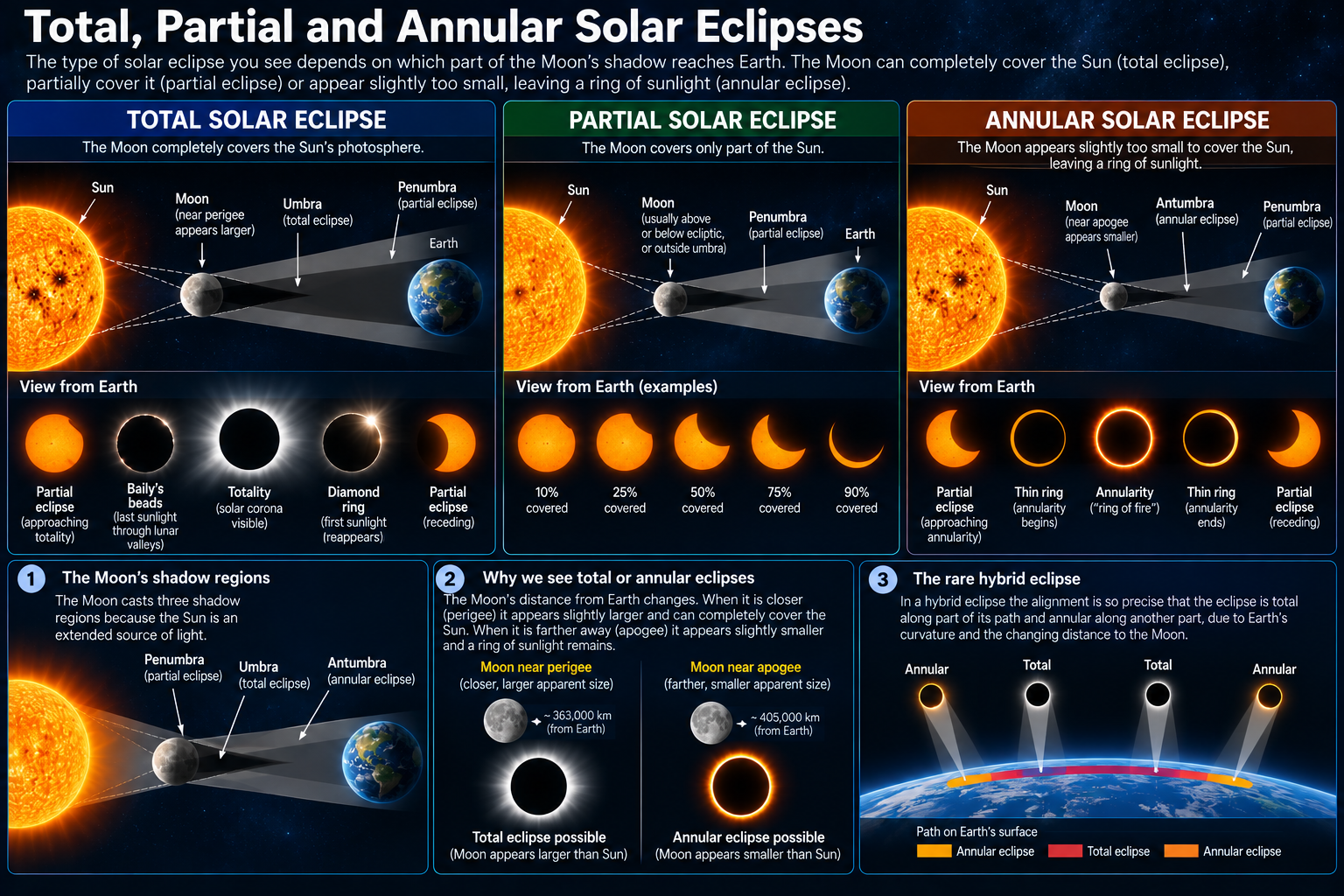
The Moon's shadow has three parts
To understand why there are different kinds of solar eclipse, it helps to picture the Moon's shadow. That shadow is not a single, uniform thing. It has up to three distinct regions, and which region falls on you determines what you see.
- Umbra — the dark central cone of full shadow. From anywhere inside the umbra, the Moon completely blocks the Sun's bright face.
- Penumbra — the lighter outer shadow where the Moon only partly covers the Sun. Observers in the penumbra see a partial eclipse.
- Antumbra — a third zone that appears when the umbra is too short to reach Earth's surface. From inside the antumbra, the Moon appears slightly smaller than the Sun, leaving a bright ring of sunlight around it.
Whether the umbra, the penumbra or the antumbra reaches you is what separates a total eclipse from a partial or an annular one.
Total solar eclipse
A total solar eclipse is the most dramatic of the three. It occurs when the Moon is close enough to Earth and aligned precisely enough that the dark central umbra sweeps across a narrow strip of Earth's surface.
Observers inside this strip, called the path of totality, see the Moon completely cover the Sun's brilliant photosphere. Daylight gives way to an eerie twilight, the temperature drops, and the Sun's faint outer atmosphere — the corona — becomes visible around the black lunar disc.
Totality at any single place lasts only a few minutes at most. The theoretical maximum is a little over:
7½ minutes
In the final moments before totality, the last sunlight pouring through valleys on the Moon's edge breaks into a string of bright beads, known as Baily's beads. As the final bead remains, it briefly forms a dazzling single point of light — the diamond ring — before winking out as totality begins.
During totality, and only during totality, it is safe to view the eclipse with the naked eye. The moment any part of the Sun's bright surface reappears, eye protection becomes essential again.
Partial solar eclipse
A partial solar eclipse is the most common kind, and the one most people have a chance to see. It happens when only the lighter penumbral shadow reaches Earth, or when an observer is outside the narrow path of totality or annularity.
From within the penumbra, the Moon covers just a portion of the Sun. The Sun appears as a crescent or a bitten disc, and the amount covered can range from a tiny nibble at one edge to a deep crescent that leaves only a sliver of the photosphere exposed.
Partial eclipses are far more widely visible than total ones, because the penumbra is much larger than the umbra and covers a far greater area of Earth's surface. But a partial eclipse never reveals the corona, and it is never safe to view without certified eye protection at any stage.
Even when 99% of the Sun is covered, the remaining sliver of the photosphere is still bright enough to injure the eye. The dramatic darkening and the appearance of the corona belong to totality alone.
Annular solar eclipse
An annular solar eclipse occurs when the Moon is near the farther part of its orbit and so appears slightly too small to cover the Sun completely. The umbra falls short of Earth, and the antumbra reaches the surface instead.
Observers inside the antumbra's path see the Moon silhouette the Sun but leave a bright ring of sunlight around the dark lunar disc. This glowing ring is often called the ring of fire, and it is one of the most striking sights in astronomy.
Because the Moon's orbit around Earth is not a perfect circle, its apparent size changes over the course of a month. When a new moon coincides with the Moon being close to Earth, a total eclipse is possible. When it coincides with the Moon being farther away, an annular eclipse is the result instead.
Crucially, the Sun is never fully covered during an annular eclipse. The bright ring of photosphere remains visible throughout, which means an annular eclipse is never safe to view without protection at any stage — not even at the maximum, when the ring is at its thinnest.
Comparing the three kinds
The table below summarises the key differences between total, partial and annular solar eclipses.
| Feature | Total | Partial | Annular |
|---|---|---|---|
| Shadow involved | Umbra | Penumbra | Antumbra |
| Sun covered? | Completely | Partly | Partly (ring remains) |
| Corona visible? | Yes, during totality | No | No |
| Path width | Narrow strip | Wide area | Narrow strip |
| Maximum duration | A few minutes of totality | Several hours overall | A few minutes of ring |
| Safe without protection? | Only during totality | Never | Never |
| Rarity at a given place | Very rare | Relatively common | Rare |
Why the Moon's distance matters
The difference between a total and an annular eclipse comes down to how far the Moon is from Earth. The Moon's orbit is elliptical, not circular, so its distance from us changes over the course of a month by roughly:
about 50,000 kilometres
When the Moon is closer to Earth, it appears larger than the Sun in our sky and can cover it completely — producing a total eclipse. When it is farther away, it appears smaller and cannot cover the Sun entirely — producing an annular eclipse instead.
This is why two eclipses with the same alignment can look completely different. The geometry of the Sun, Moon and Earth may be nearly identical, but the Moon's distance on the day decides whether observers see a black disc with a corona or a bright ring of fire.
The path of totality and annularity
Both total and annular eclipses trace a narrow path across Earth's surface. For a total eclipse, this path is called the path of totality, and it is typically only about:
100 to 200 kilometres wide
Only observers inside this narrow band experience the full drama of totality. Everyone else on the daylit side of Earth, if they see anything at all, sees only a partial eclipse.
The same is true of an annular eclipse, which traces its own central path of annularity. Outside that path, observers within the broader penumbra see a partial eclipse instead of the ring of fire.
Because these central paths are narrow and cover only a small fraction of Earth's surface — much of which is ocean — the most spectacular phases of any single eclipse are visible from only a limited part of the world.
How long each kind lasts
An eclipse is not an instant. The whole event, from the first moment the Moon begins to encroach on the Sun to the last moment it leaves the disc, can last several hours. But the most dramatic central phase is much shorter.
- Total eclipse — totality itself lasts only a few minutes at any one place, with a theoretical maximum of about 7½ minutes.
- Partial eclipse — the partial phases can last two to three hours from first to last contact.
- Annular eclipse — the ring of fire phase lasts a few minutes, though the full event spans several hours including the partial phases on either side.
The exact duration depends on the Moon's distance, Earth's distance from the Sun, the observer's position relative to the centre of the shadow, and the speed of the shadow across Earth's surface.
Safety for every kind of eclipse
A solar eclipse does not make the Sun intrinsically safer to look at. With the single exception of the minutes of totality during a total eclipse, the uncovered portion of the photosphere remains intensely bright throughout every phase of every kind of eclipse.
For partial and annular eclipses, certified eye protection is required at all times. For a total eclipse, protection is required throughout the partial phases and may only be removed during the brief minutes when the photosphere is completely hidden.
Use only solar viewers meeting the ISO 12312-2 standard, or a purpose-designed solar filter fitted to the front of a telescope. Ordinary sunglasses are never sufficient. See our Safe Solar Observing guide for full details.
The contact times of an eclipse
Astronomers describe the progress of a solar eclipse using a series of moments called contacts. These mark the key instants as the Moon's edge meets, covers and leaves the Sun.
- First contact — the instant the Moon first begins to encroach on the Sun's disc. The partial phases begin.
- Second contact — the instant the Moon fully covers the Sun (for a total eclipse) or reaches the inner edge of the ring (for an annular eclipse). Totality or annularity begins.
- Third contact — the instant the Moon first begins to leave the fully covered or ring stage. Totality or annularity ends and the partial phases resume.
- Fourth contact — the instant the Moon last touches the Sun's disc. The eclipse ends.
For a purely partial eclipse, only the first and fourth contacts apply, since the Moon never fully covers the Sun.
These contact times differ from place to place because the Moon's shadow is moving across Earth.
Why totality is so geographically restricted
The Sun is approximately:
1.39 million kilometres in diameter
Earth is about:
12,742 kilometres in diameter
The Moon is only around:
3,475 kilometres in diameter
The Moon therefore casts a relatively small umbral shadow onto the much larger Earth. The path of totality is consequently narrow. By contrast, the penumbral shadow is much broader.
This means that during a typical total eclipse:
- a relatively small number of people may lie inside the path of totality
- while many millions more may be able to see a partial eclipse.
The distinction becomes especially important when planning to observe an eclipse. Being “near” the path isn't the same as being inside it. Our next article, The Path of Totality, explores this in detail.
What would an eclipse look like from space?
Viewed from space, the geometry becomes particularly clear. During a total eclipse, a small dark shadow can be seen moving across Earth's sunlit surface. That is the Moon's umbra. Around it lies a much larger region affected by the penumbra.
An observer standing inside the central dark shadow sees totality. Someone hundreds or thousands of kilometres away but still inside the larger penumbral region sees a partial eclipse.
Seen this way, a total solar eclipse isn't primarily the Sun becoming dark. It is:
the Moon's shadow passing over you
That shadow is moving rapidly across the curved surface of Earth.
How fast does the shadow travel?
There isn't one fixed speed. The velocity of the shadow across Earth's surface depends on the eclipse geometry, the Moon's orbital motion, Earth's rotation and the observer's location.
It commonly travels at speeds of well over:
1,000 km/h
and can be considerably faster in some parts of an eclipse path. This explains why totality is so brief. Even though the entire eclipse may unfold over several hours, the small umbral shadow doesn't remain over one location for long.
Why solar eclipses don't occur every new moon
Whether an eclipse is total, partial or annular is one question. Whether an eclipse occurs at all is another. As explained in What Causes a Solar Eclipse?, the Moon's orbit is tilted by approximately:
5.1°
relative to Earth's orbital plane around the Sun. Most new moons therefore pass slightly above or below the Sun in our sky.
Only when new moon occurs sufficiently close to one of the Moon's orbital nodes can a solar eclipse take place. This creates periodic eclipse seasons, when the geometry becomes favourable. The Moon's changing distance then helps determine whether a central eclipse during that season is total or annular.
Why the Sun and Moon appear almost the same size
The existence of both total and annular eclipses comes from an extraordinary coincidence of scale. The Sun is roughly:
400 times wider than the Moon
But it is also approximately:
400 times farther away
Consequently, the two have very similar apparent diameters in Earth's sky. Their angular sizes aren't identical, however. They vary as the distances change.
- Sometimes: Moon appears slightly larger → total eclipse
- At other times: Moon appears slightly smaller → annular eclipse.
This difference can amount to only a small fraction of a degree in the sky, yet it completely changes what an observer experiences.
Solar eclipse eye safety
The distinction between eclipse types is especially important when it comes to observing safely. The fundamental rule is:
If any part of the Sun's photosphere is directly visible, appropriate solar eye protection is required.
This applies throughout a partial solar eclipse and throughout an annular solar eclipse. It also applies during the partial phases before and after totality in a total solar eclipse.
Ordinary sunglasses aren't adequate, regardless of how dark they appear. For direct naked-eye viewing of partial phases, use suitable eclipse viewers that meet the appropriate ISO 12312-2 standard and follow their instructions.
Totality is the exception
During a total solar eclipse, there is one brief exception. When — and only when — the photosphere is completely covered, the total phase can be viewed directly without eclipse glasses. This allows the faint corona to be seen.
But the moment the bright photosphere begins to reappear, appropriate protection must be used again.
This exception does not apply during annularity. Even at maximum annularity, a bright ring of photosphere remains exposed. An annular eclipse must therefore be viewed through appropriate solar protection throughout.
Telescopes, binoculars and cameras
Optical equipment requires particular care. Never look at the Sun through binoculars, a telescope, camera viewfinder or other magnifying optical device unless an appropriate purpose-designed solar filter is correctly fitted to the front of the instrument.
Eclipse glasses aren't a substitute for a telescope's solar filter. Placing eclipse glasses between your eye and an unfiltered telescope or binoculars is dangerous because the instrument concentrates sunlight before it reaches the glasses. Appropriate solar filtration must prevent the intense sunlight from entering the optical system in the first place.
Our Safe Solar Observing article covers these precautions in more detail.
Which type of eclipse is the most common?
Globally, some kind of solar eclipse occurs at least twice each year and occasionally as many as five can occur in a calendar year. But an individual location sees them much less frequently.
Partial eclipses are visible over much broader areas. Total and annular eclipses require the observer to be within their narrow central paths. A particular location may therefore experience partial eclipses occasionally while waiting many decades — or even centuries — for totality to pass directly over it.
This is why people often travel considerable distances to experience a total solar eclipse. The eclipse isn't especially rare on the scale of the whole Earth. The rarity comes from the chance that the Moon's tiny umbral shadow passes across your particular location.
Will total solar eclipses always occur?
No.
The Moon is gradually moving away from Earth at an average rate of roughly:
3.8 centimetres per year
This is extremely slow on human timescales, but over hundreds of millions of years it becomes significant. As the Moon moves farther away, its apparent size gradually decreases. Eventually, it will no longer appear large enough to completely cover the Sun. Annular eclipses will still be possible, but total solar eclipses as we know them will cease.
We therefore happen to live during a period in Earth's history when the Moon can appear either:
- slightly larger
- or slightly smaller
than the Sun. That is precisely why both total and annular eclipses are possible today.
Three shadows, three experiences
The easiest way to understand the different types of solar eclipse is to stop thinking of them as fundamentally different astronomical events. They all begin with the same arrangement:
Sun → Moon → Earth
What changes is the geometry of the Moon's shadow and the observer's position within it.
- Stand in the penumbra and part of the photosphere remains visible: partial eclipse.
- Stand in the umbra and the Moon completely covers the photosphere: total eclipse.
- Stand in the antumbra and the Moon is centrally aligned but appears slightly too small: annular eclipse.
And in the exceptionally finely balanced geometry of a hybrid eclipse, Earth's curvature can cause the central shadow to change between the umbra and antumbra along its path.
The astronomical differences can be tiny. The experience from the ground can be enormous.
- A shift of perhaps a hundred kilometres can transform a deep partial eclipse into totality.
- A relatively small change in the Moon's distance can transform a total eclipse into an annular one.
- And the disappearance of the final tiny portion of the solar photosphere can transform a strangely dim day into the extraordinary darkness of totality.
That is what makes solar eclipses such a striking demonstration of celestial geometry. The Sun, Moon and Earth may be separated by hundreds of thousands or millions of kilometres, yet their precise alignment determines what an observer standing at one particular point on Earth sees in the sky.
Find out more
Learn how the Moon's shadow traces its narrow route across Earth in The Path of Totality.
More Sun reading
For the underlying geometry of why eclipses happen, see What Causes a Solar Eclipse?, browse other eclipse articles on the Eclipse Articles page, see upcoming eclipses for your location on the Eclipses page, or check today's sun position on the Sun Summary page.