The Path of Totality
Certainly. This should follow very naturally from What Causes a Solar Eclipse? and Total, Partial and Annular Solar Eclipses. Those articles explained how a solar eclipse is the Moon's shadow falling on the Earth, and how the dark central cone of that shadow — the umbra — is what produces totality. This article is about the shape of that shadow on the ground: the narrow strip of Earth's surface inside which the Sun is completely hidden, and the experience of standing within it.
That strip has a name. It is called the path of totality, and understanding it is the key to understanding why a total solar eclipse is at once so rare and so unforgettable.
Warning: Do not look directly at the sun without appropriate eye protection
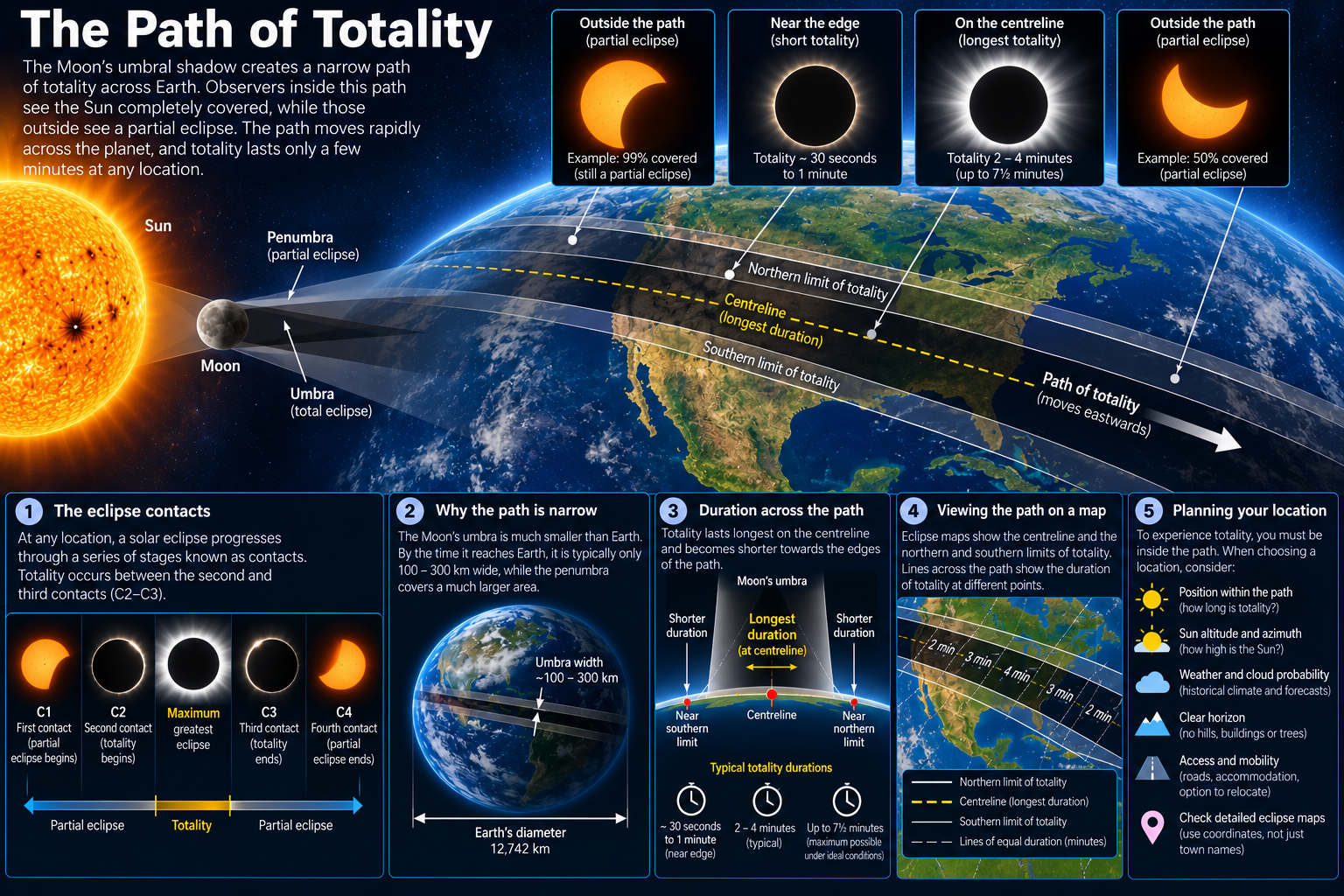
What the path of totality is
During a total solar eclipse, the Moon's umbra — the cone of complete shadow — reaches Earth's surface. But the Moon is comparatively small, and its shadow narrows to a point as it travels the roughly 384,000 kilometres to Earth. By the time it arrives, the umbra touches the ground as only a small dark spot.
As the Moon moves along its orbit and the Earth rotates beneath it, that spot sweeps across the surface. The track it traces is the path of totality. Only an observer standing inside this track at the right moment experiences the Sun being completely covered. Everyone else on the sunlit side of Earth sees, at most, a partial eclipse.
The path of totality is therefore not a time but a place. It is the region of Earth that the umbra passes over, and it is the only place from which the most dramatic features of a total eclipse — the disappearance of the photosphere, the appearance of the corona, and the brief safe window of naked-eye viewing — can be witnessed.
Why the path is so narrow
The Moon is only about 3,475 kilometres across. The Sun is vastly larger — about 1.39 million kilometres in diameter — but also much farther away. Because the two appear almost the same size in our sky, the Moon's umbra comes to a sharp point very close to Earth's surface.
That near-pointed geometry is the whole reason total eclipses are possible at all, but it is also the reason the path of totality is so narrow. The umbra is only just long enough to reach the ground, and where it touches, it covers a relatively small area at any instant. As the shadow moves, it paints a thin ribbon across the globe rather than a broad wash of darkness.
If the Moon were significantly larger, or significantly closer, the umbra would be broader and totality would last longer and cover more ground. If it were smaller or farther away, the umbra would fall short of Earth entirely, and only annular or partial eclipses would occur. The narrowness of the path is a direct consequence of the finely balanced apparent sizes of the Sun and Moon.
How wide the path of totality is
The width of the path of totality varies from one eclipse to another, depending on the Moon's distance from Earth, the geometry of the alignment, and where on Earth the shadow falls. In general, though, it is only about:
100 to 200 kilometres wide
At its very widest, when the Moon is close to Earth and the shadow strikes the surface near the equator at a favourable angle, the path can approach perhaps:
around 270 kilometres
At its narrowest, the path can shrink to only a few tens of kilometres, or even less, particularly when the Moon is near the far part of its orbit and the umbra barely grazes the Earth.
To put that in perspective: the path of totality is typically narrower than many countries, and often narrower than a single large metropolitan area. Most of the populated world lies outside it during any given eclipse.
The central line and the edges
Astronomers draw an imaginary line down the middle of the path of totality, called the central line or centreline. This is the locus of points where the observer is most directly aligned with the axis of the Moon's shadow.
Standing on the central line offers two advantages. First, totality lasts the longest possible time for that eclipse, because the observer is closest to the centre of the umbra, where the shadow is widest and the Sun is most completely hidden. Second, the Sun appears most symmetrically covered, with the corona displayed evenly around the black lunar disc.
Towards the northern and southern edges of the path, the observer is still inside the umbra and still sees totality, but for a shorter time. The Moon is viewed slightly off-centre against the Sun, so the period of complete coverage is briefer and the geometry less symmetric. Right at the very edge, totality may last only a fraction of a second.
This is why eclipse chasers often aim for the centreline: it maximises the duration of totality and gives the most reliable, most symmetrical view.
How fast the shadow travels
The Moon's umbra does not linger. It is swept across Earth by the combined motion of the Moon along its orbit and the rotation of the Earth beneath it. The resulting ground speed is not constant, but it is always high — commonly well over:
1,000 km/h
and often considerably faster. Near the equator, where Earth's rotational speed at the surface is greatest and can move in the same general direction as the shadow, the relative speed of the umbra across the ground is reduced, and totality can last a little longer. Near the ends of the eclipse path, where the shadow strikes the Earth at a shallow, grazing angle, the ground speed can become enormous and totality is correspondingly brief.
This high speed is the fundamental reason totality is so short at any one location. The umbra is small, and it is moving fast. Even though the entire eclipse — from first contact to fourth contact — may unfold over several hours, the minutes of complete coverage at a single point are few.
How long totality lasts
The duration of totality at a given place depends on several factors working together:
- the Moon's distance from Earth (a closer Moon appears larger and produces a wider, longer-lasting umbra)
- Earth's distance from the Sun (a closer Sun appears larger and is harder to cover completely)
- the observer's position within the path (centreline gives the longest duration)
- and the speed of the shadow across the ground at that location
Most total eclipses provide only a few minutes of totality on the centreline. The theoretical maximum, achieved only under the most favourable combination of distances and geometry, is a little over:
7½ minutes
Such long eclipses are rare. Many total eclipses offer totality of only one or two minutes, and some last less than a minute even on the centreline. A few seconds of totality is still totality, but the experience is compressed and intense.
Away from the centreline, towards the edges of the path, the duration falls off steadily. An observer a few kilometres inside the northern or southern boundary may see totality lasting only seconds.
Inside the path versus outside it
The difference between being inside the path of totality and being outside it is not a matter of degree. It is a qualitative, almost categorical difference.
Outside the path, even a few kilometres beyond its edge, the observer is within the Moon's penumbra — the lighter, partial shadow. There the Sun is never completely covered. The observer sees a deep partial eclipse, in which the Moon may hide 99% of the solar disc, but a sliver of the brilliant photosphere always remains visible.
That remaining sliver matters enormously. As explained in What Causes a Solar Eclipse?, the photosphere is so intensely bright that even a small exposed portion dominates the sky. With 1% of the Sun still uncovered, the sky does not darken to twilight, the corona does not appear, and the temperature barely drops. The experience is striking, but it is not totality.
Cross the boundary into the path of totality, and everything changes. In the final seconds before second contact, the light takes on an unnatural, metallic quality. Shadows sharpen. The temperature falls noticeably. Birds may fall silent or go to roost. Then the last bead of sunlight collapses into the diamond ring, and the Sun vanishes — replaced by a black disc ringed by the pearly glow of the corona.
This transition — from a deep partial eclipse to true totality — happens over a distance of only a few kilometres. It is one of the sharpest natural boundaries anywhere on Earth.
The edge of the path
The boundary of the path of totality is not a line you can feel. There is no fence, no signpost. It is defined entirely by geometry: the set of points on Earth's surface where the Moon's umbra just reaches, and beyond which it falls short.
Near this edge, the duration of totality drops rapidly. An observer a kilometre inside the boundary might see totality lasting only a second or two; an observer a kilometre outside sees none at all, only a 99.9% partial eclipse. This is why precise maps of the path are so important to eclipse planners: a small error in position can mean the difference between witnessing totality and missing it entirely.
At the very edge, unusual effects can sometimes be seen. Because the Moon's edge and the Sun's edge are so closely matched in apparent size, the geometry is exquisitely sensitive to the irregular lunar profile — its mountains and valleys. Observers near the path boundary may see extended displays of Baily's beads, as sunlight streams through individual valleys on the Moon's limb for longer than it would near the centreline.
Why being near the path is not enough
One of the most common and costly mistakes in eclipse viewing is to assume that being close to the path of totality is almost as good as being inside it. It is not.
A location 50 kilometres outside the path may experience a 99% partial eclipse. The Sun will be reduced to a thin crescent, the daylight will dim somewhat, and the event will be well worth watching. But the corona will not appear, the sky will not darken to twilight, and the temperature will not plunge. The defining features of a total eclipse belong to the umbra alone.
The difference between a 99% partial eclipse and a 100% total eclipse is, as the earlier articles stressed, far greater than the numbers suggest. The transition is not gradual. It is a threshold, and the path of totality is where that threshold is crossed.
For this reason, anyone serious about seeing a total solar eclipse should make the effort to position themselves comfortably inside the path — ideally on or near the central line, with some margin to spare in case of uncertainty in the path's exact edges.
Where paths of totality fall
Paths of totality do not favour any particular part of the world. Because they are determined by the geometry of the Sun, Moon and Earth — not by human geography — they fall wherever that geometry happens to place them.
This means a great many paths cross the oceans, which cover most of Earth's surface. Others traverse remote deserts, polar regions, or sparsely populated land. Only occasionally does a path of totality pass over major population centres, and such events are rightly regarded as special.
The orientation and length of a path also vary. Some paths sweep roughly west-to-east across a continent; others curve from polar regions towards the equator or vice versa. The path may be only a few thousand kilometres long, or it may stretch for many thousands of kilometres across the globe.
Because the paths are narrow and their placement essentially random with respect to where people live, a total solar eclipse passes directly over any single fixed location only roughly once every few centuries on average. This is the practical source of the rarity of totality: not that total eclipses are uncommon on Earth, but that the tiny umbra so seldom finds you.
The shape of the shadow on the ground
Viewed from space, the Moon's umbra reaches Earth as a small, dark, roughly circular spot. As the Moon moves and the Earth turns, that spot traces the path of totality across the surface.
The spot is not always perfectly round, and its size changes along the path. Near the beginning and end of an eclipse, where the shadow strikes the Earth at a shallow angle, the umbra meets the surface obliquely and the path is narrow and elongated. Near the middle of the path, where the shadow falls more directly, the spot is rounder and the path is at its widest.
This is why the width of the path of totality is not constant along its length. A single eclipse may have a path only a few tens of kilometres wide at its extremes and well over a hundred kilometres wide near its middle.
Planning to see totality
Because the path of totality is narrow and totality is brief, seeing a total solar eclipse usually requires planning. The essential steps are straightforward.
- Find a reliable map of the path of totality for the eclipse in question, showing the northern and southern limits and the central line.
- Choose a viewing location comfortably inside the path, ideally near the central line, to maximise the duration of totality and provide margin against any uncertainty in the path edges.
- Have a contingency plan for cloud cover, including alternative sites along the path reachable by road on the day.
- Arrive early, since roads into the path often become congested as the eclipse approaches.
- Obtain certified solar viewing equipment meeting the ISO 12312-2 standard for the partial phases before and after totality.
The reward for this preparation is the few minutes — or in some cases only seconds — during which the Sun is completely hidden and the corona stands revealed in a sky turned to twilight.
Safety inside and outside the path
The rules of solar safety apply with full force to the path of totality. Outside the path, during a partial eclipse, certified eye protection is required at all times. There is no safe moment to view the Sun directly, no matter how thin the remaining crescent appears.
Inside the path, the same rule holds throughout the partial phases before and after totality. From first contact until second contact, and again from third contact until fourth contact, the uncovered photosphere remains intensely bright and dangerous to the unaided eye.
The single exception is the brief period of totality itself. Only while the photosphere is completely covered — between second and third contact — may the eclipse be viewed directly without a solar filter, and only then to see the corona. The instant any part of the bright solar surface reappears, protection must be used again immediately.
This exception applies only to observers genuinely within the path of totality. It does not apply during a partial eclipse, and it does not apply during an annular eclipse, when a ring of photosphere always remains visible. If you are uncertain whether totality has begun or ended, keep your solar protection in place. See our Safe Solar Observing guide for full details.
What totality feels like
Standing inside the path of totality as the umbra arrives is an experience unlike any other in nature. The light does not simply dim; it changes character. Colours flatten and shift. Shadows take on an odd, crisp quality, and the tiny gaps between leaves can project thousands of crescent images of the Sun onto the ground.
As totality begins, the sky darkens with startling speed — far faster than any sunset. The brightest planets and stars appear. The air grows noticeably cooler. And then, where the Sun stood, there is a black disc surrounded by the pale, streamered glow of the corona, visible only because the blinding photosphere has been hidden.
For a few minutes, day becomes a strange and beautiful twilight. Then the diamond ring reappears as the first sliver of photosphere emerges, totality ends, and the partial phases resume in reverse until the Moon finally leaves the Sun's disc altogether.
None of this is visible outside the path of totality. It is the umbra, and the umbra alone, that produces it.
A moving shadow, a moving experience
It is worth pausing to appreciate what the path of totality really represents. The umbra is the Moon's shadow — a cone of darkness cast by a body a quarter the diameter of the Earth, falling across a world tens of thousands of times larger than the shadow itself.
That shadow races across the surface at the speed of a fast aircraft or faster. It touches down, sweeps over a narrow ribbon of land and sea, and lifts off again, all within a few hours. The people it passes over are, for a few minutes, inside the Moon's shadow in the most literal sense: the direct light of the Sun is blocked from reaching them by the body of the Moon itself.
This is why eclipse chasers travel such distances, and why they speak of totality with such reverence. They are not merely watching the Sun disappear. They are placing themselves inside a shadow cast across hundreds of thousands of kilometres of empty space by another world, and standing in the one narrow place where that shadow touches theirs.
You aren't merely looking at an event occurring in the sky. You are surrounded by the geometry of the Moon's shadow.
The shape of the Moon's shadow
Diagrams often depict the umbra as a simple cone. That is a useful approximation, but the actual geometry projected onto Earth's surface is more complicated. Earth's curvature, the angle of the shadow and local topography all influence where the shadow boundary falls.
The Moon's own edge isn't perfectly smooth either. Mountains and valleys along the lunar limb affect the precise instant at which sunlight disappears or reappears. Modern eclipse predictions can incorporate detailed models of the lunar surface to calculate these effects with remarkable precision.
Why mountains on the Moon matter
The Moon's apparent edge is known as its limb. During an eclipse, sunlight shines through lunar valleys while mountains block neighbouring parts of the solar surface. This produces Baily's beads.
It also means the boundary of totality isn't, at the finest scale, a perfectly simple geometric line. Detailed lunar topography can shift the precise local timing of the beginning or end of totality by small amounts.
For ordinary eclipse viewing this is rarely important if you are comfortably inside the path. Near the extreme edge, however, lunar topography becomes much more significant.
Weather versus geometry
Astronomers can predict the Moon's shadow extremely accurately. They cannot predict the weather months or years ahead with comparable precision. This creates one of the great frustrations of eclipse observing.
A location may have excellent eclipse duration, a position directly on the centreline, and a beautifully high Sun — but none of those advantages matter if the sky is completely overcast.
When choosing between possible observing locations, eclipse travellers therefore often study historical climate patterns. They may consider:
- average cloud cover
- seasonal rainfall
- local terrain
- coastal effects
- and the ability to move on the day
As the eclipse approaches, ordinary weather forecasts become increasingly important.
Mobility can be valuable
For a travelling observer, flexibility can sometimes be more useful than selecting one supposedly perfect location months in advance. If several observing sites are accessible within the path, changing location in response to cloud forecasts may greatly improve the chances of seeing the eclipse.
But there is a complication. Total eclipses can attract very large numbers of visitors. Roads inside the path may become heavily congested. An apparently simple relocation on a map can therefore become difficult on eclipse day.
Good planning balances:
- astronomical geometry
- weather
- access
- and traffic
How high will the Sun be?
The Sun's altitude during totality matters. A high Sun is generally easier to observe from an open location. A low Sun can produce spectacular scenery but requires a clear horizon. Buildings, hills, mountains and trees can obstruct the view.
Near the beginning or end of a global eclipse path, totality may occur with the Sun very low in the sky. An observer there needs to pay particular attention to horizon visibility.
The Sun's altitude and azimuth at the time of totality are therefore useful planning information. This connects directly with the principles explained in our Understanding Solar Altitude and Azimuth guide.
A path across oceans and continents
Most of Earth's surface is ocean. It follows that much of the path of many total solar eclipses also crosses ocean. An eclipse may make landfall only briefly, perhaps crossing a few islands or a narrow part of a continent before returning to sea.
Other eclipses have long overland paths crossing several countries. This has a major effect on how accessible a particular eclipse is. Two eclipses may be astronomically similar but offer very different opportunities for observation from land.
Totality from an aircraft or ship
Observers aren't restricted entirely to fixed locations on land. Some eclipses are observed from ships or aircraft.
A ship can reach parts of an eclipse path that cross the ocean. Aircraft offer an even more unusual possibility. By flying in the same general direction as the Moon's shadow, an aircraft can sometimes increase the duration of totality experienced by its occupants. This requires extremely careful planning of altitude, route and timing.
For most observers, however, a fixed land-based site remains the simplest and most accessible way to experience totality.
Why the path is different for every eclipse
A total solar eclipse requires very precise alignment, but the details are never exactly the same.
- The Moon's distance changes.
- Earth's distance from the Sun changes.
- The Moon crosses the ecliptic at different locations.
- Earth has moved to a different point in its orbit.
- The orientation of Earth relative to the shadow changes.
As a result, every total eclipse traces its own path across the planet. One may cross the Arctic. Another may pass through tropical regions. Another may cross a major city. Another may spend almost its entire journey over an ocean.
This geographical variety is one reason eclipse maps are such an important part of eclipse prediction.
The Saros and changing eclipse paths
Eclipses do repeat in related families. After approximately:
18 years, 11 days and 8 hours
the orbital geometry of the Sun, Earth and Moon becomes sufficiently similar for another related eclipse to occur. This is the Saros cycle.
But the additional eight hours are important. During those eight hours, Earth rotates by roughly one-third of a turn. The next eclipse in the same Saros series therefore occurs about:
120° of longitude farther west
Its path isn't simply repeated over the same locations. Across many repetitions, the paths belonging to a Saros series gradually shift across Earth.
Why totality is rare at one location
Total solar eclipses occur somewhere on Earth reasonably regularly. But the path of totality covers only a tiny fraction of Earth's surface during each event. A particular town or city therefore has a relatively small chance of lying inside any one eclipse path.
It can take many decades or even several centuries for totality to return to the same location.
This explains an apparent contradiction. Total solar eclipses aren't extraordinarily rare as global astronomical events. But experiencing one without travelling can be exceptionally rare.
The path makes totality a geographical event
Many astronomical events can be seen simultaneously across huge areas. A bright planet may be visible to almost everyone across a hemisphere. A meteor shower can be observed from many countries. A lunar eclipse can be seen across much of Earth's night side.
A total solar eclipse is different. It is intensely local. The experience depends on precisely where you stand. A line drawn across a map can separate totality from partial eclipse. This makes geography an essential part of the astronomy.
Planning to observe from within the path
If you intend to travel to see a total solar eclipse, several pieces of information are particularly useful:
- Confirm that your location is comfortably inside the predicted path of totality, and check the local C1, C2, maximum, C3 and C4 times.
- Check the duration of totality, the Sun's altitude and azimuth, historical weather patterns, horizon obstructions and alternative observing sites.
- As the date approaches, use current weather forecasts and retain some mobility if practical, while allowing for potentially severe eclipse-day traffic.
- Arrive early, have appropriate solar-viewing equipment ready, and make sure everyone in your group understands when eye protection is required.
The astronomical calculations may be precise, but a successful observation still depends on practical preparation.
Eye safety within the path
Being inside the path of totality does not mean eclipse glasses can be removed throughout the eclipse. During the long partial phase before totality, appropriate solar protection is required. Only when the Sun's bright photosphere is completely covered may the total phase be viewed directly without a solar filter.
As soon as the photosphere begins to reappear, appropriate protection must be used again. If you are outside the path of totality, there is no total phase and therefore no period during which the partially eclipsed Sun can safely be viewed directly without suitable protection.
An annular eclipse similarly has no unfiltered viewing phase because a ring of photosphere remains visible throughout annularity. See our Safe Solar Observing guide for detailed precautions.
Imagine the shadow approaching
Consider standing on a hillside near the centre of the path. For more than an hour, the Moon has been slowly covering the Sun. The solar crescent has become extremely thin. The daylight now looks distinctly unusual. The temperature has fallen.
Far towards the horizon, the sky begins to darken. The Moon's umbra is approaching. It is moving across the landscape at enormous speed. Baily's beads appear. The final brilliant region of photosphere produces the diamond-ring effect. Then it disappears.
You are inside the Moon's shadow. The corona surrounds the black lunar disc. Planets and bright stars become visible. The horizon glows with twilight colours in every direction. For perhaps two, three or four minutes, your location lies within a moving patch of darkness only a few hundred kilometres across.
Then the opposite edge of the umbra arrives. A brilliant point of sunlight appears. Totality ends. The shadow races away across the landscape. Within minutes, ordinary daylight begins returning.
The astronomical event hasn't ended — the partial eclipse may continue for more than another hour. But the umbra has moved on. Someone hundreds of kilometres farther along the path is now experiencing the same transformation.
Standing in the shadow of another world
The path of totality is more than a line on an eclipse map. It is the track of the Moon's shadow across Earth. Every point along that path represents a location where, for a brief period, the Sun, Moon and observer become aligned closely enough for the solar photosphere to disappear completely.
Outside the path, some sunlight remains. Inside it, the Moon temporarily blocks the surface of a star. This is why choosing a location matters so much. A difference of a few kilometres near the boundary can determine whether totality lasts seconds or doesn't occur at all. A journey towards the centre can increase its duration. Cloud can make a theoretically perfect location useless. And Earth's curvature, rotation and geography determine how the shadow moves from one observer to the next.
From the ground, a total solar eclipse appears to be an extraordinary transformation of the Sun. From space, the explanation is beautifully simple: a small shadow is racing across a planet.
For the people fortunate enough to be standing inside that shadow, however, those few minutes produce one of the most remarkable sights available in observational astronomy.
The path of totality is the narrow corridor where the shadow of the Moon touches Earth — and where day briefly becomes night.
Find out more
Learn how the Earth's orbit, axial tilt and rotation determine where the Sun appears in the sky in The Position of the Sun.
More Sun reading
For the underlying geometry of why eclipses happen, see What Causes a Solar Eclipse?. For the different kinds of solar eclipse and the structure of the Moon's shadow, see Total, Partial and Annular Solar Eclipses. Browse other eclipse articles on the Eclipse Articles page, see upcoming eclipses for your location on the Eclipses page, or check today's sun position on the Sun Summary page.