Understanding Solar Altitude and Azimuth
Where exactly is the Sun in the sky? We instinctively describe its position using expressions such as “low in the east”, “high in the south” or “setting in the west”. Astronomers can describe exactly the same thing more precisely using two measurements: altitude and azimuth.
Together, these answer two very straightforward questions: which direction is the Sun, and how high is it above the horizon? Sun Summary uses altitude and azimuth to describe the Sun's position from your location at a particular time. Understanding these two values makes it much easier to relate the information shown on the site to the Sun's actual path across your sky.
Warning: Do not look directly at the sun without appropriate eye protection
What is solar altitude?
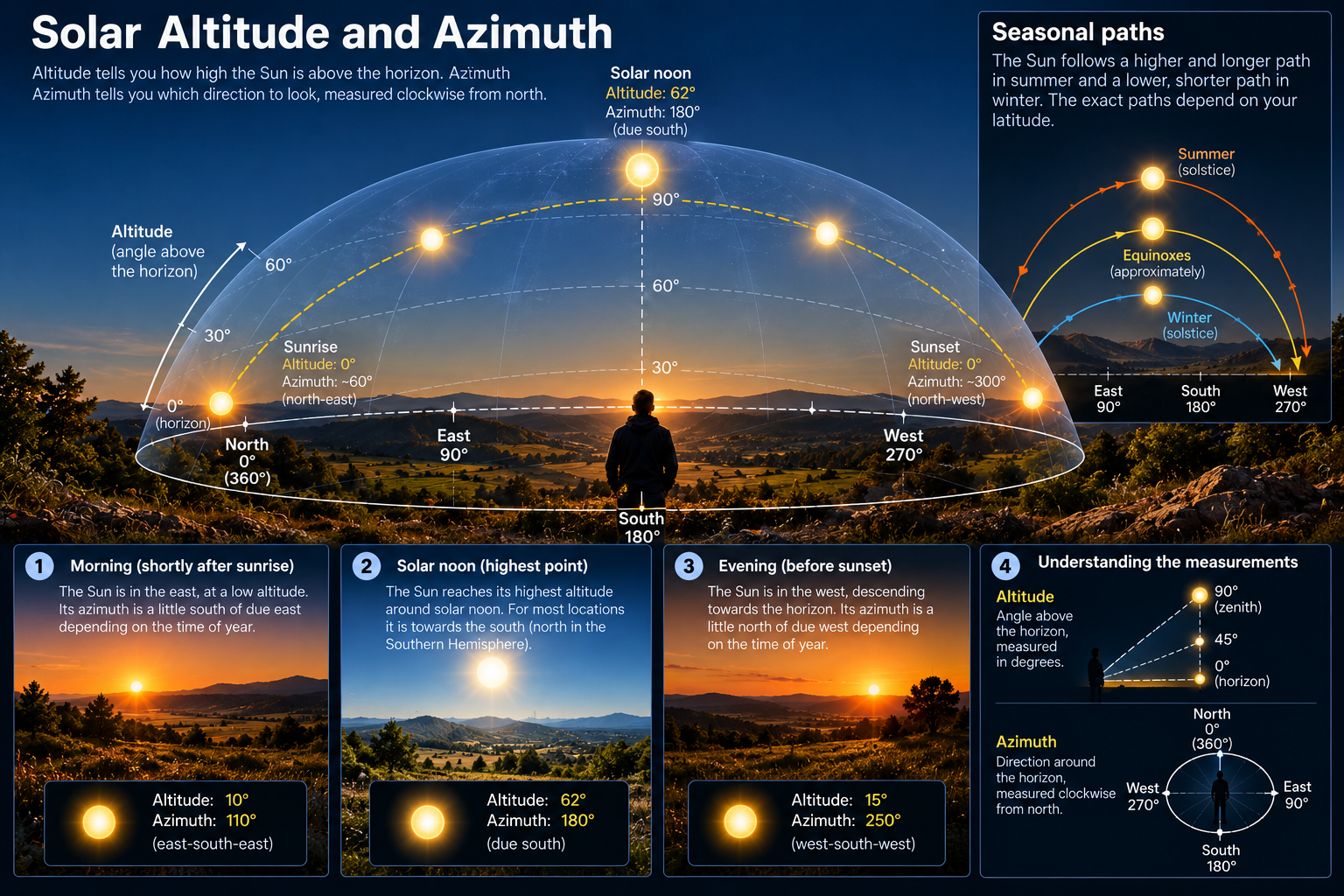
Solar altitude is the angle of the Sun above or below the horizon. It is measured in degrees. When the centre of the Sun is on the astronomical horizon, its altitude is approximately:
0°
Halfway between the horizon and the point directly overhead is:
45°
The point directly overhead is:
90°
That overhead point is known as the zenith. So if Sun Summary shows Solar altitude: 30°, the centre of the Sun is approximately 30 degrees above your astronomical horizon. The greater the altitude, the higher the Sun appears in the sky.
What does a negative solar altitude mean?
Solar altitude can also be negative. For example, Solar altitude: −10° means that the centre of the Sun is 10 degrees below the horizon. Although you cannot see the Sun directly, its position below the horizon remains important because sunlight can still illuminate the atmosphere and produce twilight.
After sunset, the Sun moves progressively farther below the horizon. Astronomers divide twilight into three commonly used stages:
- Civil twilight: Sun between 0° and −6°
- Nautical twilight: Sun between −6° and −12°
- Astronomical twilight: Sun between −12° and −18°
Once the Sun is more than about 18° below the horizon, the sky is generally considered astronomically dark, although artificial light, moonlight and atmospheric conditions can still affect the darkness you actually experience. The same process occurs in reverse before sunrise. Solar altitude therefore remains useful even when the Sun itself is below the horizon.
What is solar azimuth?
Altitude tells you how high the Sun is, but not which direction to look. For that we use azimuth. Azimuth describes a direction around the horizon and is normally measured clockwise from true north. The principal directions are:
- North — 0°
- East — 90°
- South — 180°
- West — 270°
Returning to north completes the circle at 360°, which is equivalent to 0°. So if Sun Summary displays Solar azimuth: 135°, the Sun is towards the south-east. An azimuth of 225° places it towards the south-west. Combine azimuth with altitude and you have a practical description of the Sun's position.
Using altitude and azimuth together
Suppose Sun Summary reports Altitude: 25° and Azimuth: 120°. An azimuth of 120° places the Sun in the south-eastern part of the sky. An altitude of 25° tells you it is moderately low above the horizon.
A few hours later you might see Altitude: 48° and Azimuth: 180°. The Sun is now due south and considerably higher. Later still, Altitude: 18° and Azimuth: 245°: the Sun has moved into the south-western sky and is descending towards the horizon. Together, these changing values describe the apparent path of the Sun across your sky.
Why do altitude and azimuth change throughout the day?
The principal cause is Earth's rotation. Earth rotates from west to east approximately once every 24 hours. Because we are standing on the rotating Earth, the Sun appears to travel across the sky in the opposite direction. For many observers the familiar pattern is:
Sunrise → Sun climbs higher → maximum altitude → Sun descends → Sunset
The Sun isn't travelling around Earth each day. Your position on Earth's rotating surface is continually changing its orientation towards the Sun. Altitude and azimuth provide a numerical description of that changing viewpoint.
Does the Sun always rise exactly in the east?
No. The familiar statement that the Sun “rises in the east and sets in the west” is a useful approximation, but it isn't generally exact. The Sun rises due east and sets due west only around the equinoxes. At other times of year, its rising and setting positions move north or south along the horizon.
For an observer in the Northern Hemisphere, the Sun generally rises and sets farther north during the summer and farther south during the winter. In the Southern Hemisphere, the seasonal pattern is reversed. This movement occurs because Earth's rotational axis is tilted relative to its orbit around the Sun. You can see the effect directly in the Sun's changing azimuth at sunrise and sunset throughout the year.
The Sun follows a different path in summer and winter
The Sun's daily path doesn't remain fixed throughout the year. For observers at mid-northern latitudes, the summer Sun follows a longer and generally higher arc across the sky. It rises farther towards the north-east, climbs relatively high, remains above the horizon for longer and sets farther towards the north-west.
During winter its path is shorter and lower. It rises farther towards the south-east, remains comparatively low in the sky and sets towards the south-west. This changing path explains two familiar seasonal effects: summer days are longer, and the midday Sun is higher in summer than in winter. Both can be understood directly from solar altitude and azimuth.
Why does Earth's tilt matter?
Earth's rotational axis is tilted by about 23.4° relative to the plane of its orbit around the Sun. As Earth travels around the Sun during the year, this tilt changes the way each hemisphere is oriented towards the Sun.
During Northern Hemisphere summer, the north is tilted towards the Sun. The Sun follows a higher and longer apparent path through the sky. During Northern Hemisphere winter, it is tilted away. The Sun follows a lower and shorter path. Six months later the situation is reversed for the Southern Hemisphere.
This is the underlying reason for the changing seasons and for the annual changes in solar altitude, sunrise and sunset direction, and day length.
What happens at solar noon?
During the course of a day, the Sun eventually crosses your local meridian. This is known as solar noon. For most locations, this is when the Sun reaches its greatest altitude of the day.
Solar noon does not necessarily occur at 12:00 on your clock. Civil time is determined by time zones and can also be affected by daylight-saving time, while solar noon depends on your longitude and the apparent position of the Sun. There is also a smaller variation caused by Earth's elliptical orbit and axial tilt, described by the equation of time.
Is the Sun always due south at solar noon?
This depends upon where you are on Earth. For observers at typical mid-northern latitudes, the Sun crosses the meridian towards the south at solar noon. For observers at typical mid-southern latitudes, it crosses towards the north.
Within the tropics, however, the situation becomes more interesting. Because the Sun's apparent position north or south of the celestial equator changes throughout the year, observers between the Tropic of Cancer and Tropic of Capricorn can experience days when the Sun passes directly overhead. At that moment its altitude reaches approximately:
90°
and vertical objects cast extremely short shadows. Depending on the observer's latitude and time of year, the midday Sun within the tropics can pass either north or south of the zenith.
Why doesn't the Sun reach the same maximum altitude every day?
The maximum solar altitude changes gradually throughout the year because the Sun's apparent north-south position changes as Earth travels around its orbit. Astronomers describe this position using solar declination.
- Around the June solstice, the Sun reaches a declination of approximately +23.4°.
- Around the December solstice, it reaches approximately −23.4°.
- At the equinoxes, solar declination is close to 0°.
The maximum altitude the Sun can reach on a particular day therefore depends on both your latitude and the Sun's declination. This is why the midday Sun may be high in your summer sky but remain much lower during winter.
Latitude makes a major difference
The path of the Sun can look very different depending on where you are on Earth. Near the equator, the Sun can climb extremely high and day length remains relatively close to 12 hours throughout the year. At mid-latitudes, the seasonal difference becomes much more obvious. At high latitudes, the effect becomes extreme.
Within the Arctic and Antarctic Circles there are periods when the Sun doesn't set at all, producing the midnight Sun. At the opposite part of the year there are periods when the Sun doesn't rise, producing polar night. The same system of altitude and azimuth still describes the Sun's position in all of these situations.
A simple way to estimate altitude
You can estimate angular altitude surprisingly well using your hand. Hold your arm straight out in front of you. For many people, a closed fist spans approximately:
10°
from top to bottom. A little finger held at arm's length is roughly:
1°
and the span from an extended thumb to little finger is approximately:
20–25°
These are only rough estimates because everyone's hands and proportions differ. Suppose Sun Summary gives a solar altitude of 30°. Starting at the horizon, approximately three fist widths upwards gives you a rough idea of that height in the sky.
An important safety point
Although this technique is useful for understanding angles, do not stare directly at the Sun while trying to measure its position. Looking directly at the Sun can damage your eyesight. Never look at the Sun through binoculars, a telescope, camera viewfinder or other magnifying optical equipment unless it has an appropriate, purpose-designed solar filter correctly fitted to the front of the instrument.
For observing rather than simply understanding its position, see our Safe Solar Observing guide.
Shadows provide another way to see solar altitude
You don't actually need to look at the Sun to observe the effect of changing solar altitude. Watch a shadow. When the Sun is low in the sky, objects cast long shadows. As solar altitude increases, those shadows become shorter. Around solar noon, when the Sun generally reaches its maximum altitude, shadows are usually at their shortest for that day. Later, as the Sun descends, the shadows lengthen again.
This also produces an obvious seasonal effect. Because the Sun reaches a lower maximum altitude in winter at mid-latitudes, winter shadows at midday are longer than summer shadows from the same object.
A fixed post in a garden can therefore become a simple astronomical instrument. Mark the end of its shadow at the same clock time — or, better, around solar noon — on different dates throughout the year and you can observe the changing seasonal position of the Sun without looking at it directly.
Solar altitude and the strength of sunlight
The Sun's altitude also affects how its energy reaches Earth's surface. When the Sun is high, its rays strike the ground more directly and the same amount of incoming solar energy is concentrated over a smaller area. When the Sun is low, the incoming energy is spread over a larger area. Sunlight from a low Sun must also travel through more of Earth's atmosphere before reaching the surface.
These effects help explain why a high summer Sun generally provides more intense heating than a low winter Sun. However, solar altitude isn't the only influence on temperature. Cloud, atmospheric conditions, land and sea temperatures, wind and the thermal response of the surface all play important roles. This is why the warmest part of a day usually occurs after solar noon rather than precisely when the Sun is highest.
Why does the Sun look different near the horizon?
When the Sun is close to the horizon, its light travels through much more of Earth's atmosphere than when it is high overhead. This can make the Sun appear more orange or red because shorter wavelengths of visible light are scattered more strongly from the direct beam.
Atmospheric refraction also affects the Sun's apparent position. Near sunrise and sunset, Earth's atmosphere bends sunlight sufficiently that we can see the Sun when its geometric position would otherwise place it slightly below the horizon. Refraction can also make the Sun appear flattened when it is very close to the horizon because light from the lower and upper parts of the solar disc is refracted by slightly different amounts.
This means that the relationship between a calculated geometric solar position and the Sun's apparent position can become more complicated very close to the horizon.
Azimuth can reveal the changing seasons
One particularly interesting observing project requires no telescope and no direct observation of the Sun. Choose a location where you have a good view of the horizon. Notice where the Sun sets relative to distant landmarks — a building, hill, tree or other fixed feature. Repeat the observation every few weeks.
You will see the sunset position gradually move along the horizon. Around one solstice it reaches its most northerly extreme. It then reverses direction and moves back. Around the opposite solstice it reaches its most southerly extreme before reversing again. At the equinoxes it sets approximately due west.
You are effectively observing the annual change in sunset azimuth. Ancient cultures noticed these patterns thousands of years ago, long before modern astronomical instruments existed.
Altitude and azimuth depend on both place and time
Solar altitude and azimuth aren't universal values. At exactly the same moment, the Sun may be high in the sky for one observer, close to the horizon for another and below the horizon for someone elsewhere on Earth. The values depend upon your latitude, your longitude, the date and the time.
This is why Sun Summary uses your location when calculating the Sun's position. Location allows an astronomical position to be translated into something directly useful: where the Sun is in your sky.
A practical example
Imagine Sun Summary displays Solar altitude: 18° and Solar azimuth: 110°. The azimuth places the Sun a little south of east. The altitude tells you it is still fairly low above the horizon.
Later you check again: Solar altitude: 52° and Solar azimuth: 175°. The Sun has climbed substantially higher and is now almost due south. Later in the afternoon: Solar altitude: 24° and Solar azimuth: 240°. The Sun is now descending through the south-western sky.
Eventually its altitude approaches zero and sunset occurs. After sunset the altitude becomes negative while the Sun continues moving farther below the horizon. One pair of changing numbers has described the Sun's entire daily journey across your sky.
From numbers to the real sky
At first, values such as Altitude: 36.4° and Azimuth: 147.8° can look like little more than calculated data. But they describe something very tangible. The azimuth tells you which way the Sun lies around your horizon. The altitude tells you how high it is.
Watch those values during a single day and you are seeing the effect of Earth's rotation. Compare them at the same time over several months and you begin to see the effects of Earth's axial tilt and its journey around the Sun. Compare them from different locations and you see how our view of the Sun depends upon our position on a spherical Earth.
That is one of the aims of Sun Summary: not simply to tell you where the Sun is, but to help connect the numbers with the astronomical movements that produce them.
The Sun's apparent journey across the sky is something we experience every day. Altitude and azimuth give us a simple language for describing that journey — and a way to see the motion of our own planet reflected in the sky above us.
Find out more
Explore the Sun's daily journey across the sky in Understanding sunrise and sunset times.
More Sun reading
Read the full chain of reasoning behind every sunrise, sunset and maximum-angle figure on this site in The position of the Sun, browse other reading on the Articles page, or check today's sun position on the Sun Summary page.