Understanding Sunrise and Sunset Times
Sunrise and sunset are among the most familiar astronomical events. We experience them every day, and their changing times provide one of the clearest signs of the progression of the seasons.
At first glance, the terms seem straightforward. Sunrise is when the Sun rises above the horizon. Sunset is when the Sun disappears below it. Astronomically, however, there is a little more to both events than this simple description suggests.
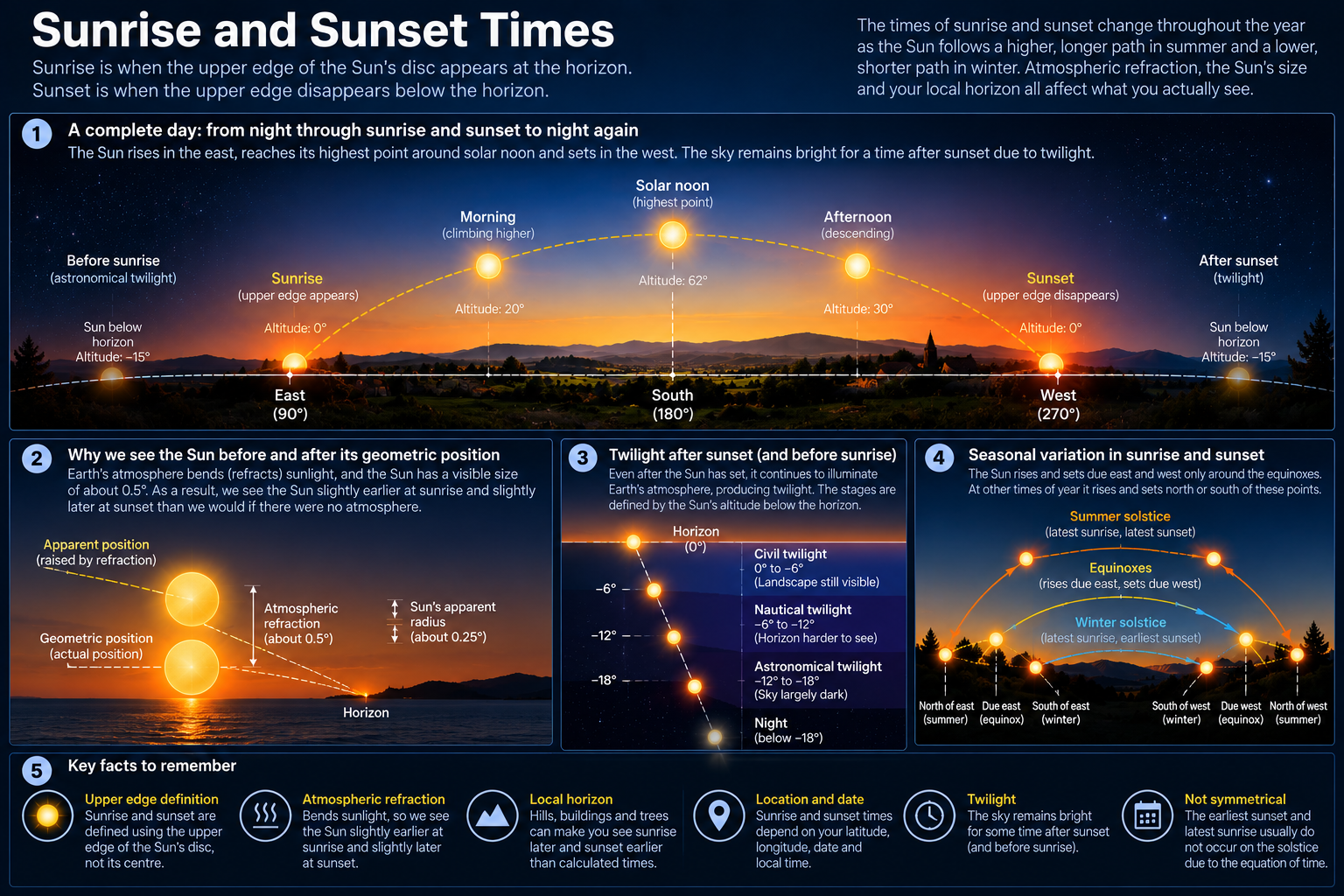
The Sun is not a point of light. It has a visible disc about half a degree across. Earth's atmosphere bends sunlight near the horizon, allowing us to see the Sun when it is geometrically slightly below the horizon. Your location, elevation and local landscape can also affect when you actually see it appear or disappear.
Understanding these effects helps explain what the sunrise and sunset times shown by Sun Summary really represent.
Warning: Do not look directly at the sun without appropriate eye protection
What is sunrise?
In everyday terms, sunrise is the moment the Sun first appears above the eastern horizon.
Astronomical sunrise is normally defined as the moment when the upper edge of the Sun's disc appears at the horizon in the morning, with standard atmospheric refraction taken into account.
This is an important detail. If sunrise were calculated using the centre of the Sun, the time would be slightly different. And if Earth's atmosphere didn't bend sunlight, it would be different again.
The sunrise time shown for a location is therefore based on an astronomical definition intended to correspond reasonably closely with what an observer would experience at an ideal horizon. Your actual sunrise may differ because the real horizon is rarely ideal.
What is sunset?
Sunset is essentially the reverse. It is normally defined as the moment when the upper edge of the Sun's disc disappears below the western horizon, again allowing for standard atmospheric refraction.
Notice that it is the upper edge that matters. When you watch a clear sunset, the lower edge of the Sun reaches the horizon first. The solar disc then gradually sinks until only a small segment remains. Astronomical sunset occurs when that final upper edge disappears.
After sunset, however, the sky doesn't immediately become dark. The Sun remains close enough below the horizon to illuminate Earth's atmosphere, producing twilight.
Why isn't sunrise calculated when the Sun's centre reaches 0° altitude?
There are two principal reasons.
The first is the apparent size of the Sun. The Sun appears as a disc roughly half a degree in diameter, so its edge is approximately a quarter of a degree from its centre. When the upper edge first becomes visible, the centre is therefore still geometrically below the horizon.
The second reason is atmospheric refraction. Earth's atmosphere bends sunlight as it passes through layers of air with differing densities. The effect is particularly strong near the horizon. This makes the Sun appear slightly higher in the sky than its purely geometric position.
Combined, these effects mean that the centre of the Sun is normally geometrically somewhat below the horizon at the calculated time of sunrise or sunset.
The atmosphere allows us to see the Sun early
Atmospheric refraction produces a fascinating consequence. When you see the Sun apparently sitting on the horizon, the Sun's geometric position is actually a little lower. The atmosphere has bent its light around the curvature of Earth sufficiently for that light to reach you.
In the morning, this means you see the Sun before you would if Earth had no atmosphere. In the evening, you continue seeing it after it would otherwise have disappeared. The atmosphere therefore slightly lengthens the apparent day.
The precise amount of refraction isn't perfectly constant. It depends on atmospheric temperature, pressure and the structure of the air near the horizon. Calculated sunrise and sunset times consequently use a standard model of atmospheric refraction rather than attempting to predict the exact state of the atmosphere above your particular horizon.
Why might the Sun rise later than Sun Summary says?
Imagine Sun Summary predicts sunrise at 06:30. At 06:30 you look east and see no Sun. There may be nothing wrong with the calculation.
Astronomical sunrise normally assumes an ideal horizon. Your actual eastern horizon might contain a hill, trees, buildings or other obstructions. The Sun must climb high enough to clear them before you can see it. If a hill raises your effective horizon by several degrees, the difference can be significant.
The same applies to sunset. A distant ridge or nearby building can cause the Sun to disappear from view before the calculated astronomical sunset.
The times shown by Sun Summary should therefore be understood as times relative to an astronomical horizon, rather than a prediction of the exact moment sunlight will appear or disappear behind your particular surroundings.
Your location determines sunrise and sunset
Sunrise and sunset times depend upon where you are on Earth. Longitude affects when your location rotates into and out of sunlight relative to your local clock. Latitude has a major influence on the path the Sun takes across the sky and consequently on day length.
The date matters as well because Earth's axial tilt changes the apparent path of the Sun throughout the year.
This means sunrise and sunset are determined by a combination of:
- your latitude
- your longitude
- the date
- and the relationship between your local civil time and solar time.
This is why Sun Summary uses your location to calculate times relevant to the sky you actually experience.
Why doesn't the Sun always rise in the east?
We often say: The Sun rises in the east and sets in the west. This is broadly true, but the precise directions change throughout the year.
Around the equinoxes, the Sun rises approximately due east and sets approximately due west. For an observer at mid-northern latitudes, during the months around summer the Sun rises north of east and sets north of west. During the months around winter, it rises south of east and sets south of west. The pattern is reversed seasonally in the Southern Hemisphere.
You can observe this yourself by noting where the Sun appears relative to distant landmarks at different times of year. Its changing sunrise and sunset azimuth provides a direct visual demonstration of Earth's axial tilt.
Why do sunrise and sunset times change throughout the year?
Earth's rotational axis is tilted by approximately 23.4° relative to its orbit around the Sun. This tilt is responsible for the seasons.
As Earth travels around the Sun, each hemisphere alternately tilts more towards or away from the Sun. When your hemisphere is tilted towards the Sun, the Sun follows a longer path above your horizon. It generally rises earlier, travels higher across the sky and sets later.
When your hemisphere is tilted away, the Sun follows a shorter and lower path. It generally rises later and sets earlier.
The difference between sunrise and sunset gives us the length of the daylight period. Our Why Day Length Changes Throughout the Year guide explores this relationship in more detail.
Why does latitude matter so much?
The seasonal variation in sunrise and sunset becomes increasingly dramatic as you travel away from the equator.
Near the equator, sunrise and sunset remain relatively consistent throughout the year and daylight stays close to 12 hours. At mid-latitudes, the difference between summer and winter becomes much more noticeable. Travel towards the poles and the variation becomes extreme.
Inside the Arctic and Antarctic Circles there are periods when the Sun doesn't set at all. This produces the midnight Sun. During the opposite part of the year there are periods when the Sun doesn't rise, producing polar night.
The same basic geometry is responsible for all of these situations. Only the observer's latitude has changed.
What happens after sunset?
Sunset doesn't mark the immediate beginning of night. Even after the Sun has disappeared below the horizon, it continues illuminating the upper atmosphere. This produces twilight.
Astronomers commonly divide twilight into three stages according to how far the centre of the Sun is below the horizon.
Civil twilight
Civil twilight occurs while the Sun is between approximately:
0° and 6° below the horizon
The landscape remains relatively well illuminated and many outdoor activities can still be performed without artificial lighting. Bright planets and the brightest stars may begin to appear.
Nautical twilight
Nautical twilight occurs when the Sun is approximately:
6° to 12° below the horizon
The sky becomes substantially darker and more stars become visible. Historically, the term relates to navigation because the horizon could remain visible while sufficiently bright stars were available for celestial observations.
Astronomical twilight
Astronomical twilight occurs while the Sun is approximately:
12° to 18° below the horizon
Beyond approximately 18°, the Sun's contribution to natural sky brightness becomes very small under favourable conditions, and astronomical night is considered to have begun.
Before sunrise, these stages occur in reverse.
Why can twilight last much longer in summer?
Twilight duration depends strongly on latitude and season.
Near the equator, the Sun tends to cross the horizon at a relatively steep angle. It therefore moves through the twilight altitude ranges fairly quickly.
At higher latitudes the Sun can cross the horizon at a much shallower angle. Instead of descending rapidly beneath it, the Sun effectively travels sideways beneath the horizon. Twilight consequently lasts longer.
During summer at sufficiently high latitudes, the Sun may never reach 18° below the horizon at all. Astronomical twilight then continues throughout the night, meaning there is no true astronomical darkness even though the Sun has set. Travel farther towards the pole and eventually the Sun doesn't set at all.
Why doesn't the earliest sunset occur on the winter solstice?
This is one of the more surprising features of sunrise and sunset times. You might reasonably expect the shortest day of the year to have both the latest sunrise and the earliest sunset. Usually it doesn't.
At mid-northern latitudes, the earliest sunset generally occurs before the December solstice, while the latest sunrise occurs after it. Similarly, around the June solstice, the earliest sunrise and latest sunset don't necessarily fall on the solstice itself.
The reason is that two different effects are involved. The length of daylight is changing because of Earth's axial tilt, but the time of solar noon relative to our clocks is also shifting. That shift results principally from the combination of Earth's axial tilt and the slightly elliptical shape of its orbit.
The resulting difference between apparent solar time and a uniform clock is described by the equation of time.
Solar noon connects sunrise and sunset
Solar noon is the moment when the Sun crosses your local meridian and normally reaches its greatest altitude for that day.
You might imagine that this should always occur at exactly 12:00. It doesn't. Our clocks are organised into standard time zones, while the Sun responds to your precise longitude. Daylight-saving time can introduce another hour of difference.
On top of this, the equation of time causes apparent solar time to move ahead of or behind uniform mean solar time during the year. Consequently, the midpoint between sunrise and sunset will often not occur at 12:00 on your clock.
Our What Is Solar Noon? guide explains this effect in detail.
Sunrise changes from one day to the next
Check the sunrise time on Sun Summary every morning and the change from one day to the next may be quite small. But those small changes accumulate.
During part of the year, sunrise gradually becomes earlier. Eventually that trend slows, reaches an extreme and reverses. Sunrise then begins becoming later. Sunset follows its own corresponding pattern.
Watching these times over several weeks provides a simple way of seeing the seasonal cycle unfold numerically. You can then step outside and observe the physical result: the Sun rising and setting at different places along the horizon and following a changing arc across the sky.
Why do the times sometimes appear to change suddenly?
The Sun's astronomical movement is smooth. Our clocks aren't always.
When a region changes between standard time and daylight-saving or summer time, sunrise and sunset may suddenly appear to shift by an hour from one day to the next. The Sun hasn't suddenly changed its behaviour. We have changed the clocks.
This distinction is useful when looking at long-term sunrise and sunset information. Civil time is a human convention applied on top of astronomical events. Changes to time zones and daylight-saving rules can therefore alter the clock time assigned to sunrise without altering the underlying position of the Sun.
What about elevation?
Elevation can also affect the horizon you can see. An observer standing at sea level sees a different horizon from someone standing on a mountain.
From a sufficiently elevated location, the geometric horizon lies slightly below the horizontal plane through the observer. This allows an elevated observer to see the Sun a little earlier at sunrise and a little later at sunset than someone lower down, assuming an unobstructed view.
In everyday circumstances this effect may be small compared with local buildings, trees and terrain. From a mountain or aircraft, however, it becomes much more noticeable. This is another reason why a calculated sunrise or sunset time should not be treated as a guarantee of the exact second at which you personally will see the Sun.
Why does the Sun sometimes appear flattened at sunset?
Watch a sunset over a very clear, distant horizon and you may notice that the Sun doesn't always look perfectly circular. It can appear compressed or flattened vertically.
This is another consequence of atmospheric refraction. When the Sun is near the horizon, light from its lower edge travels through slightly different layers of atmosphere from light arriving from its upper edge. The lower edge is generally refracted more strongly. The result can be an apparently flattened solar disc.
The effect is atmospheric—the Sun itself has not changed shape.
Why are sunsets red?
Sunlight contains the range of visible wavelengths that we perceive as different colours. When the Sun is high in the sky, its light follows a relatively short route through the atmosphere.
Near sunrise and sunset, sunlight travels through a much longer atmospheric path. Shorter wavelengths, particularly blue light, are scattered more strongly out of the direct beam. The light reaching you directly from the low Sun therefore tends to contain a greater proportion of longer red and orange wavelengths.
Dust, aerosols, cloud and other atmospheric conditions can dramatically affect the colours of an individual sunrise or sunset. This is why no two sunsets look exactly alike even though the underlying astronomical event is the same.
Can sunrise and sunset be predicted exactly?
Their astronomical times can be calculated very accurately, but what you personally observe has additional uncertainty.
The calculated value depends upon a defined model of the horizon and atmosphere. The actual event you see depends on:
- your precise position;
- your elevation;
- local terrain;
- buildings and vegetation;
- atmospheric pressure and temperature;
- atmospheric refraction;
- and weather conditions.
A clear sea horizon may correspond closely to the calculated time. A valley surrounded by hills may not.
For this reason, Sun Summary's times are best thought of as precise astronomical calculations applied to an idealised observing situation rather than a promise of the exact instant the Sun will become visible from a particular window or garden.
A practical example
Imagine Sun Summary displays:
Sunrise: 06:42 — Sunset: 19:28
This gives a daylight period of approximately:
12 hours 46 minutes
Shortly before 06:42, the Sun is below the eastern horizon and the sky may already be bright with morning twilight. Around the calculated sunrise, the upper edge of the Sun reaches the apparent astronomical horizon.
During the morning, its altitude increases as Earth rotates. Around solar noon it reaches its greatest altitude of the day. During the afternoon its altitude decreases as it moves towards the western horizon. At approximately 19:28, the upper edge disappears below the apparent horizon.
But daylight doesn't instantly become darkness. Civil twilight follows, then nautical twilight and finally astronomical twilight as the Sun moves progressively farther below the horizon. The following day, the entire sequence repeats—but the times and the Sun's path will have changed slightly.
Watching sunrise and sunset through the year
One of the simplest astronomical projects requires no telescope, binoculars or specialist equipment.
Choose somewhere with a reasonably clear view of the eastern or western horizon and identify a fixed landmark. Every few weeks, note where the Sun rises or sets relative to it. You will see the position gradually move along the horizon.
At the same time, use Sun Summary to follow the changing sunrise or sunset time and azimuth. Around the equinoxes, the Sun will rise approximately east and set approximately west. As the months progress, the positions move north or south before eventually reaching their extremes around the solstices. Then the direction reverses.
You are observing the consequences of Earth's axial tilt directly.
Observe safely
There is no need to stare directly at the Sun to follow its movement. Direct observation of the Sun can damage your eyesight, and the Sun must never be viewed through binoculars, a telescope or other magnifying optical equipment without appropriate purpose-designed solar filtration fitted correctly to the front of the instrument.
For information on observing the Sun, see our Safe Solar Observing guide.
Sunrise and sunset are more than times on a clock
It is easy to think of sunrise and sunset as two entries in a daily timetable. They are much more than that.
Their changing times reveal Earth's journey around the Sun. Their changing positions along the horizon reveal the tilt of Earth's axis. The duration between them gives us the changing length of the day. Twilight reveals what happens as sunlight continues to illuminate the atmosphere after the Sun has moved below our horizon. Even the small difference between the Sun's geometric and apparent positions reveals the effect of Earth's atmosphere on the light reaching us.
Sun Summary brings these pieces of information together for your location. By following them from one day to the next—and occasionally stepping outside to compare the calculations with the real sky—you can watch the seasons develop and see the movements of Earth expressed in something as familiar as the rising and setting Sun.
Find out more
Find out why the Sun appears to move across the sky in Why the Sun Appears to Move Across the Sky.
More Sun reading
Read more about the two angles that describe the Sun's position in the sky in Understanding Solar Altitude and Azimuth, the full chain of reasoning behind every sunrise and sunset figure in The position of the Sun, or check today's times on the Sun Summary page.