Why the Sun Appears to Move Across the Sky
Every clear day, the Sun appears to perform the same familiar journey. It emerges near the eastern horizon, climbs higher during the morning, reaches its greatest altitude around the middle of the day, and then descends towards the western horizon before disappearing at sunset.
From our viewpoint on Earth's surface, it looks as though the Sun is travelling around us. For thousands of years, this apparent motion provided humanity with one of its most important ways of measuring time. The movement of shadows marked the passing hours, while changes in the Sun's path helped mark the progression of the seasons.
But the Sun's daily journey is largely an illusion produced by our own movement. The Sun appears to move across the sky because Earth is rotating beneath it. At the same time, Earth is also travelling around the Sun. This second movement causes the Sun's apparent position amongst the stars to change gradually throughout the year. Together, Earth's rotation and orbit create the solar movements we observe from day to day and season to season.
Warning: Do not look directly at the sun without appropriate eye protection
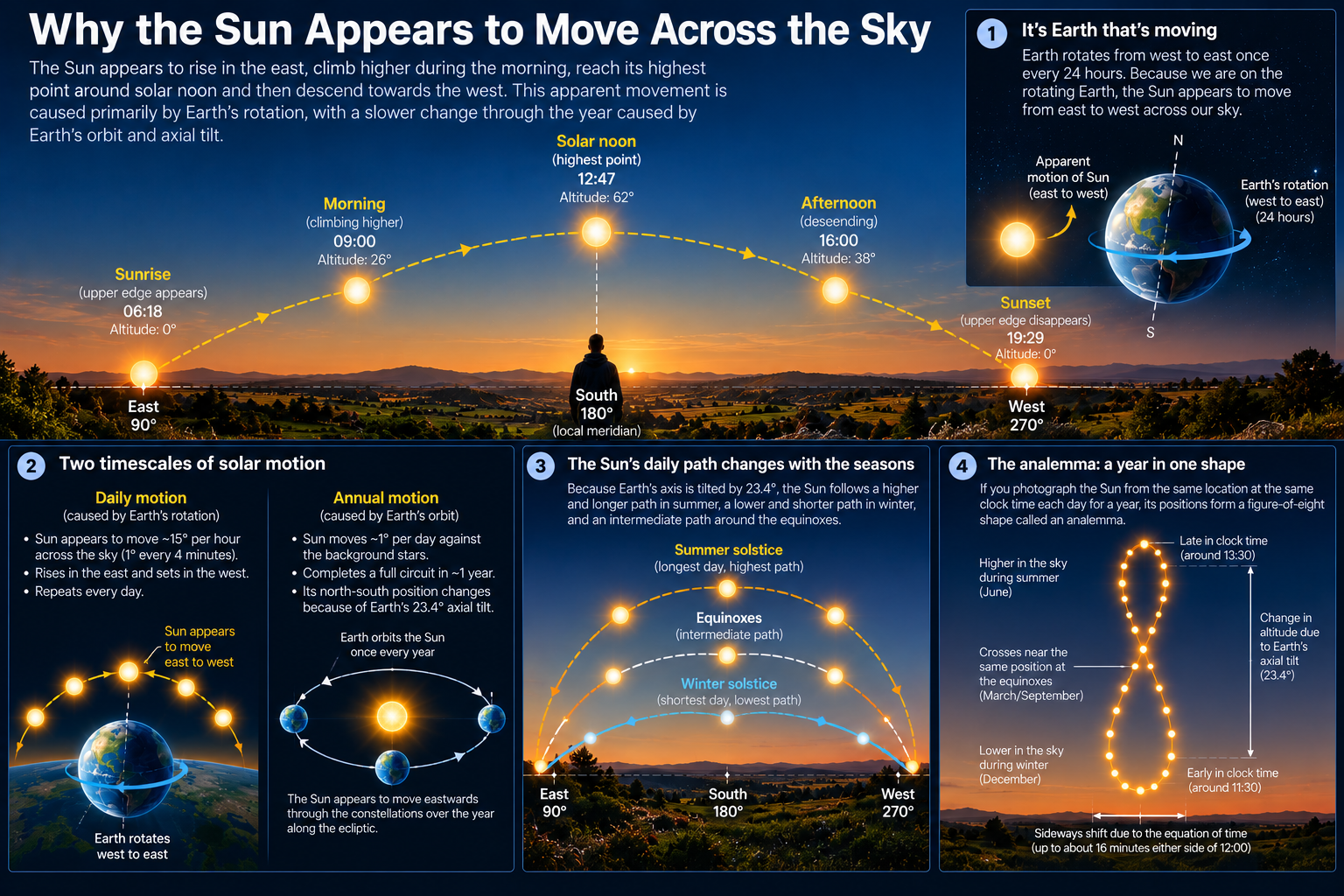
The Sun appears to move, but Earth is turning
Earth rotates around an imaginary line running between the North and South Poles. This line is Earth's rotational axis. One rotation relative to the Sun takes approximately 24 hours and produces the familiar cycle of:
day → night → day
Earth rotates from west to east. Because we are standing on the rotating Earth, objects in the sky appear to move in the opposite direction. The Sun therefore appears to travel broadly:
east → west
across our sky. The same effect applies to the Moon, planets and stars. Their daily movement across the sky is largely a reflection of Earth's rotation rather than all those objects physically travelling around Earth once every day.
Why does the Sun rise in the east?
Imagine looking down on Earth from above the North Pole. Earth rotates counter-clockwise, towards the east. As your location rotates from Earth's night side towards the illuminated side, the Sun gradually comes into view above your eastern horizon. This is sunrise.
During the following hours, Earth's continued rotation changes the direction from which you see the Sun. It appears to climb higher and travel across the sky. Eventually your location rotates away from the Sun again. The Sun approaches your western horizon and disappears below it. This is sunset.
Earth continues rotating through the night until your location once again approaches the sunlit side and the cycle repeats.
Is the Sun actually stationary?
Not completely. The explanation that “Earth rotates while the Sun stays still” is useful for understanding the Sun's daily apparent motion, but the real Solar System is more complicated.
- Earth orbits the Sun.
- The Sun itself rotates.
- The Sun also travels through the Milky Way along with the rest of the Solar System.
- And the Milky Way itself is moving.
There is therefore no simple sense in which the Sun is absolutely stationary. For understanding the Sun's movement across our sky during a single day, however, Earth's rotation is overwhelmingly the important motion.
How fast is Earth rotating?
Earth completes one rotation relative to the Sun in approximately:
24 hours
A complete circle contains:
360°
Dividing this by 24 hours gives an average apparent movement of roughly:
15° per hour
across the celestial sphere. That is approximately:
1° every four minutes
The Sun itself appears about half a degree across, so its apparent motion is equivalent to roughly its own diameter every two minutes. This movement is usually too gradual to notice if you simply stare at the sky for a short period. But use a fixed reference — such as a building, tree or shadow — and the change soon becomes obvious.
Why does the Sun climb higher during the morning?
At sunrise, the Sun is close to the horizon. As Earth continues rotating, your local horizon changes orientation relative to the Sun. The Sun's altitude increases. Eventually it reaches its greatest altitude for that particular day when it crosses your local meridian. This event is known as solar noon.
After solar noon, Earth's rotation carries your location onwards. The Sun's altitude decreases until it reaches the western horizon and sets. The familiar daily sequence is therefore:
sunrise → increasing altitude → solar noon → decreasing altitude → sunset
Sun Summary's altitude and azimuth values provide a numerical description of this apparent journey.
Altitude and azimuth describe the movement
Two measurements are particularly useful for following the Sun across the sky.Altitude tells you how high the Sun is above or below the horizon. Azimuth tells you its direction around the horizon.
Suppose Sun Summary shows:
08:00 — Altitude 14°, Azimuth 105°
Later:
12:00 — Altitude 42°, Azimuth 165°
And later still:
16:00 — Altitude 24°, Azimuth 235°
The changing altitude shows the Sun climbing and then descending. The changing azimuth shows it progressing around the sky from east towards west. Our Understanding Solar Altitude and Azimuth guide explains how these coordinates work in more detail.
The Sun doesn't follow the same path every day
Although the Sun always displays a daily east-to-west motion, its exact path through the sky changes throughout the year. For an observer at a typical mid-northern latitude, the summer Sun follows a higher and longer arc. It rises towards the north-east, climbs relatively high and sets towards the north-west.
During winter, it follows a lower and shorter arc. It rises towards the south-east, remains much lower and sets towards the south-west. Around the equinoxes, its path lies between these two extremes, with sunrise approximately due east and sunset approximately due west.
So there are really two changes taking place simultaneously:
- a rapid daily apparent movement caused by Earth's rotation, and
- a much slower seasonal change caused by Earth's orbit and axial tilt.
Why does the Sun's path change through the year?
Earth's rotational axis is tilted by approximately:
23.4°
relative to the plane of its orbit around the Sun. As Earth travels around the Sun, this tilt causes the Sun's apparent position north or south of Earth's celestial equator to change. Astronomers describe this using solar declination.
Around the June solstice, the Sun reaches approximately:
+23.4° declination
Around the December solstice, it reaches approximately:
−23.4° declination
At the March and September equinoxes, its declination is approximately:
0°
This changing declination alters the Sun's daily path through your local sky.
Earth's rotation and orbit do different things
It is useful to distinguish these two movements clearly.
Earth's rotation
Earth's rotation causes the Sun's apparent movement during a single day. It produces:
- sunrise;
- the Sun climbing during the morning;
- solar noon;
- the afternoon descent;
- sunset;
- and the cycle of day and night.
Earth's orbit around the Sun
Earth's orbit, combined with its axial tilt, causes the Sun's position to change gradually over days, weeks and months. It produces changes in:
- sunrise and sunset direction;
- maximum solar altitude;
- day length;
- solar declination;
- and the seasonal path of the Sun.
Both motions happen continuously at the same time.
The Sun also moves against the background stars
The stars are normally invisible during the day because scattered sunlight makes the sky much brighter than they are. But imagine that we could somehow see them. If we recorded the Sun's position against the stars at the same time every day, we would find that it doesn't remain in the same place. Instead, it gradually moves eastwards through the constellations.
Over the course of a year, the Sun completes an apparent circuit of the celestial sphere. The path it follows is known as the ecliptic.
What is the ecliptic?
The ecliptic is the apparent annual path of the Sun against the background stars. It exists because Earth is orbiting the Sun.
Imagine looking at a distant tree while walking around a nearby object. The nearby object appears to move relative to the distant background because your viewpoint is changing. Something similar happens as Earth travels around the Sun. From one side of Earth's orbit, we see the Sun against one region of the distant star background. Several months later, from another part of the orbit, we see it against a different region.
The Sun therefore appears to move through the celestial sphere even though this annual apparent movement is primarily a consequence of Earth changing position.
How quickly does the Sun move against the stars?
Earth completes an orbit of the Sun in approximately:
365.24 days
The Sun consequently appears to complete approximately 360° around the celestial sphere during that period. On average, that corresponds to roughly:
1° per day
This is much slower than the apparent daily movement caused by Earth's rotation. It gives us two useful scales of solar motion:
- about 15° per hour due to Earth's daily rotation; and
- about 1° per day against the background stars due to Earth's annual orbit.
The first carries the Sun across your sky each day. The second gradually changes which stars lie behind the Sun throughout the year.
Why can't we normally see the Sun moving through the constellations?
The constellations surrounding the Sun are present during the daytime. We simply can't normally see them because Earth's atmosphere scatters sunlight and produces the bright daytime sky.
Six months later, Earth has moved to the opposite side of its orbit. The region of sky that was previously behind the Sun is then visible at night. This is why different constellations dominate the night sky during different seasons. The stars haven't suddenly appeared or disappeared. Our viewing direction relative to the Sun has changed.
Shadows make the Sun's movement easy to see
You don't need to look directly at the Sun to observe its apparent motion. A shadow provides a much safer and more obvious demonstration.
Place a vertical stick in a sunny location. During the morning, its shadow will be relatively long. As the Sun climbs higher, the shadow becomes shorter. Around solar noon, when the Sun reaches its greatest altitude, the shadow generally reaches its shortest length for the day. During the afternoon it grows longer again.
The direction of the shadow also changes continuously. A stationary stick can therefore reveal the apparent movement of the Sun without you ever looking directly at it.
Sundials use this movement to tell time
This predictable movement of shadows has been used for thousands of years to measure time. A sundial uses the changing position of the Sun to cast a shadow onto a calibrated surface. As Earth rotates, the shadow moves.
The instrument is therefore not really measuring the Sun travelling around Earth. It is using the apparent movement produced by Earth's own rotation as a clock.
There is a subtle complication: apparent solar time doesn't remain perfectly synchronised with our modern clocks throughout the year. The difference is described by the equation of time, which we discuss in What Is Solar Noon?
Why does the Sun appear to move at different angles?
The Sun doesn't always rise vertically from the horizon. The angle at which its path meets the horizon depends strongly on your latitude and the time of year.
Near the equator, the Sun generally crosses the horizon at a relatively steep angle. At higher latitudes, its path can become much shallower. This affects how quickly the Sun gains altitude after sunrise and how long twilight lasts after sunset.
At very high latitudes, the Sun can travel almost parallel to the horizon. Around the polar circles in summer it may remain above the horizon throughout the entire 24-hour rotation. Instead of rising and setting, it appears to circle around the observer.
What happens during the midnight Sun?
The midnight Sun provides an especially striking demonstration that sunrise and sunset aren't fundamental features of Earth's rotation everywhere.
Within the Arctic or Antarctic Circles during local summer, Earth's axial tilt can keep a location facing sufficiently towards the Sun throughout an entire rotation. The Sun still appears to move across the sky because Earth is still rotating. But instead of descending below the horizon, it reaches a low point and then begins climbing again. An observer can therefore watch the Sun travel around the sky without setting.
Six months later, during polar winter, the opposite can occur: the Sun remains below the horizon throughout the entire day.
What would the Sun do at the North Pole?
At the geographic North Pole, the Sun's movement is very different from the familiar rising-and-setting arc seen at mid-latitudes. Around the March equinox, the Sun appears near the horizon. Over the following months it gradually spirals higher while circling around the observer once each day.
Around the June solstice it reaches its maximum altitude of approximately:
23.4°
It then gradually spirals lower again. Around the September equinox it disappears below the horizon and remains there through the polar winter.
The daily east-to-west motion hasn't vanished. It has become a nearly horizontal circuit around the observer because of the unusual geometry at the pole.
What happens at the equator?
At the equator the Sun behaves very differently. Around the equinoxes it can pass almost directly overhead. Its daily path rises steeply from the eastern horizon, crosses high through the sky and descends steeply towards the west.
Sunrise and sunset occur relatively quickly because the Sun crosses the horizon at a steep angle. Day length also remains close to 12 hours throughout the year.
The contrast between the equator and the poles demonstrates that the Sun's apparent path depends not only on Earth's rotation but also on where the observer is standing on the rotating Earth.
The Sun can pass directly overhead — but not everywhere
The point directly overhead is called the zenith, with an altitude of:
90°
The Sun can reach the zenith only for observers within the tropics — the region between approximately 23.4° north and 23.4° south latitude. Outside the tropics, the Sun never passes directly overhead.
For example, from the United Kingdom the Sun always remains in the southern part of the sky during its normal daytime meridian transit. Even at midsummer, it cannot reach the zenith. Again, this is a consequence of the relationship between your latitude and the maximum ±23.4° range of solar declination.
Why do sunrise and sunset positions move along the horizon?
If you observe sunset from the same location over several months, you will notice something interesting. The Sun doesn't set at the same point every evening.
Around an equinox it sets approximately due west. As the season progresses, its setting position gradually moves along the horizon. It eventually reaches an extreme around a solstice, slows, reverses direction and begins moving back. The sunrise position behaves similarly on the eastern horizon.
This is the slow annual movement caused by Earth's orbit and axial tilt superimposed on the rapid daily motion caused by Earth's rotation. Following these changing positions is one of the simplest ways to observe the geometry of Earth's orbit for yourself.
The solstices are turning points
The word solstice is derived from Latin words associated with the idea of the Sun “standing still”. The Sun doesn't actually stop moving. Instead, its gradual north-south movement reaches an extreme.
Around the June solstice, the Sun reaches its most northerly declination. Around the December solstice, it reaches its most southerly declination. For several days around these turning points, the change in sunrise and sunset position can be relatively small. The Sun appears to pause before reversing its seasonal direction.
Our Why Day Length Changes Throughout the Year article explores these turning points in more detail.
The Sun's movement isn't perfectly uniform
The Sun's apparent annual motion doesn't proceed at exactly the same rate throughout the year. Earth's orbit is slightly elliptical rather than perfectly circular. Earth therefore moves faster along its orbit when it is closer to the Sun and more slowly when farther away.
Earth's axial tilt also affects how the Sun's apparent movement projects onto the celestial coordinate system used to measure solar time. Together these effects contribute to the equation of time. This is why a sundial and a perfectly uniform clock can differ by several minutes depending on the date.
The analemma: a year of solar motion in one shape
There is a particularly striking way to visualise the Sun's changing position throughout the year. Imagine photographing the Sun from exactly the same location at exactly the same clock time every few days for an entire year and combining the images.
The Sun wouldn't form a single point. Instead, its positions would trace a shape resembling a distorted figure of eight. This shape is called an analemma.
Its vertical dimension primarily reflects the Sun's changing declination caused by Earth's axial tilt. Its sideways displacement reflects the changing relationship between apparent solar time and mean clock time — the equation of time. The analemma therefore captures two important consequences of Earth's orbit in a single image.
A daily movement and an annual movement
It is useful to imagine the Sun as having two apparent movements superimposed upon one another.
The first is fast: east to west across the sky every day. This is principally caused by Earth's rotation.
The second is slow: approximately eastwards against the background stars over the course of a year. This is principally caused by Earth's orbit around the Sun. Earth's axial tilt changes the north-south component of that annual position and produces the seasonal changes in the Sun's daily path.
The sky we see is the result of all these motions happening simultaneously.
An important safety point
You never need to look directly at the Sun to observe its apparent movement. Shadows and the changing positions of sunrise and sunset against landmarks reveal everything described on this page. Never stare directly at the Sun, and never view it through binoculars, a telescope, camera optics or other magnifying equipment unless appropriate purpose-designed solar filtration is correctly fitted to the front of the instrument.
For more information, see our Safe Solar Observing guide.
Find out more
Discover why daylight hours change through the year in Why Day Length Changes Throughout the Year.
More Sun reading
Read more about the two angles that describe the Sun's position in Understanding Solar Altitude and Azimuth, about the moment the Sun is highest in What Is Solar Noon?, or browse other reading on the Articles page.