What Is Solar Noon?
We commonly think of noon as 12:00 in the middle of the day. Astronomically, however, noon has a rather different meaning.
Solar noon is the moment when the Sun crosses your local meridian and, for the usual daily passage, reaches its highest altitude in the sky.
It divides the Sun's apparent daily journey into two parts. Before solar noon, the Sun is generally climbing higher. After solar noon, it is generally descending towards the horizon.
But solar noon doesn't necessarily occur at 12:00 on your clock.
Depending on where you live, the date, your position within your time zone and whether daylight-saving time is being used, solar noon can occur noticeably earlier or later.
Understanding why reveals an interesting difference between the time measured by our clocks and the time indicated by the Sun.
Warning: Do not look directly at the sun without appropriate eye protection
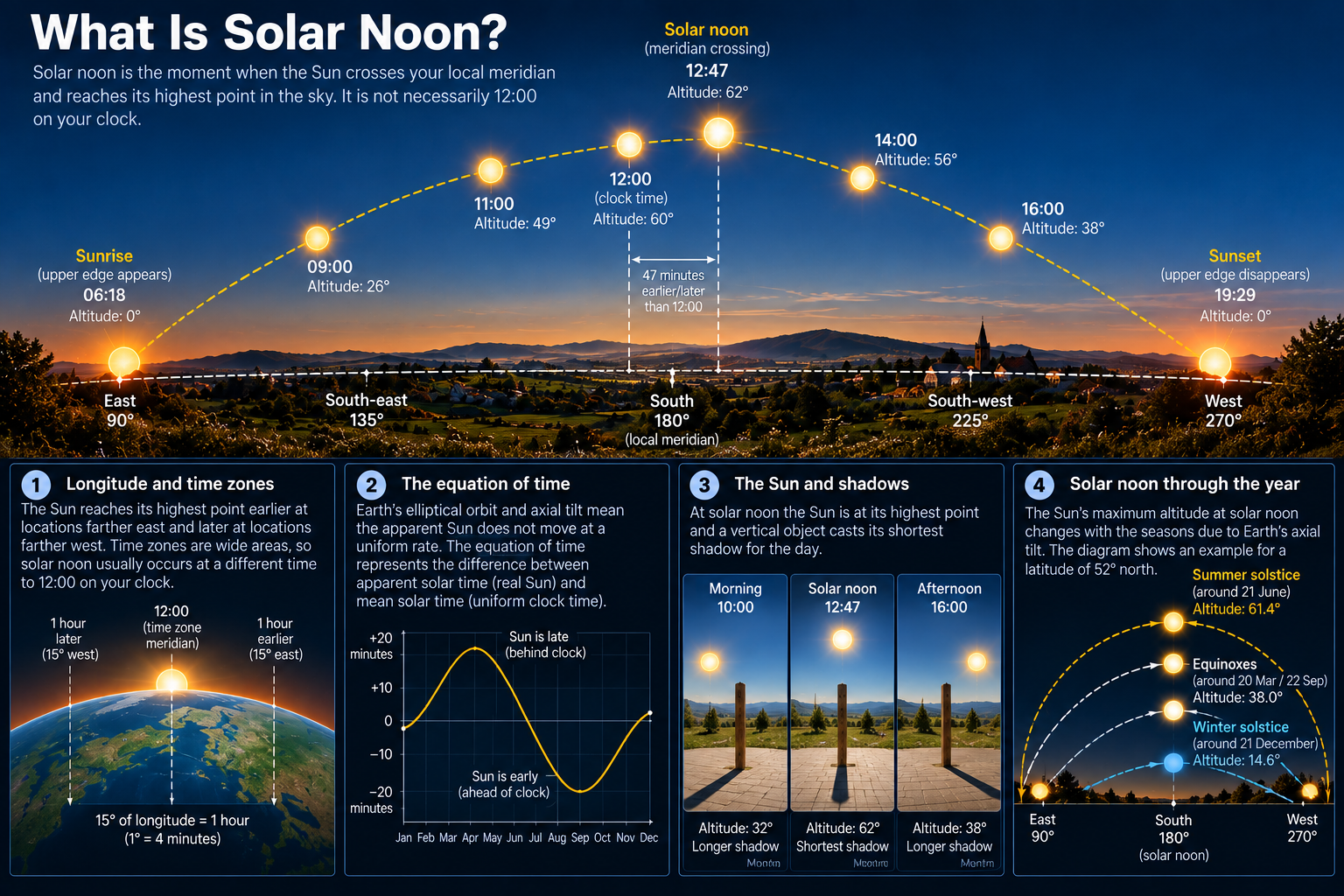
What happens at solar noon?
As Earth rotates, the Sun appears to travel across our sky.
It rises, climbs progressively higher, crosses the local meridian and then begins descending towards sunset.
The moment when the Sun crosses that meridian during its upper daily transit is solar noon.
At this time the Sun generally reaches its maximum altitude for the day.
If Sun Summary shows:
Solar noon: 12:58
that means the Sun reaches the local meridian at approximately 12:58 according to your civil clock.
It doesn't mean that sunrise and sunset must be equally spaced around 12:00.
The astronomical middle of the solar day is centred on solar noon, not necessarily clock noon.
What is the local meridian?
Imagine a great circle passing through:
due north → the point directly overhead → due south
and continuing around the other side of the celestial sphere.
This is your local meridian.
Its position depends on your location.
As Earth rotates, the Sun appears to move from one side of this meridian to the other.
When the Sun crosses it during its upper daily transit, solar noon occurs.
For an observer at typical mid-northern latitudes, the Sun is towards the south at this time.
For an observer at typical mid-southern latitudes, it is towards the north.
In the tropics the situation can be different because the Sun can pass north or south of the zenith at different times of year.
Is solar noon when the Sun is highest?
For the ordinary daytime passage, yes: solar noon corresponds to the Sun crossing the local meridian and reaching its greatest altitude for that daily transit.
Suppose the Sun has:
- Altitude: 35° at 10:30
- Altitude: 48° at 12:00
- Altitude: 52° at 12:47
- Altitude: 49° at 13:30
Solar noon is around 12:47, when the Sun reaches the meridian and its altitude peaks.
Afterwards its altitude begins decreasing.
This makes solar noon particularly useful when interpreting the solar altitude information shown by Sun Summary.
Why isn't solar noon always at 12:00?
There are several reasons.
The most important are:
- your longitude within your time zone;
- the way civil time zones are defined;
- daylight-saving or summer time;
- and the equation of time.
Our clocks are designed to provide a convenient standardised time for large geographical areas.
The Sun isn't interested in those conventions.
Solar noon is determined by astronomical geometry and your actual position on Earth.
Longitude and solar noon
Earth rotates through approximately 360 degrees in 24 hours.
That corresponds to roughly:
15° of longitude per hour
or:
1° every four minutes
Locations at different longitudes therefore experience solar noon at different moments.
Imagine two towns at the same latitude but separated east to west.
The eastern town rotates through the Sun's meridian first.
It therefore experiences solar noon before the western town.
If the towns use the same civil time zone, their clocks may show different times when solar noon occurs.
This is one of the principal reasons solar noon varies geographically.
Why do we have time zones?
If every location set its clocks according to the local Sun, towns only a modest distance apart would use slightly different times.
Historically, local mean solar time was indeed common.
That became increasingly inconvenient as transport and communication improved.
Modern societies therefore use time zones, allowing large geographical regions to share the same standard time.
A nominal time-zone meridian represents that standard, but most people don't live exactly on it.
If you are east or west of the reference meridian, your local solar noon will consequently tend to occur earlier or later than 12:00 standard time even before other effects are considered.
Daylight-saving time moves solar noon on the clock
Daylight-saving or summer time provides an especially obvious example of the difference between astronomical and civil time.
When clocks are moved forward by one hour, the Sun doesn't change its position.
We simply assign a different clock reading to the same astronomical event.
If solar noon occurred at approximately:
12:10 standard time
then, ignoring the small day-to-day astronomical change, it would occur at approximately:
13:10 daylight-saving time
Nothing has happened to Earth's rotation or the Sun.
Only the clock has changed.
This is why solar noon can occur well after 13:00 in some places during summer.
But longitude and time zones aren't the whole story
Even if you lived exactly on your time zone's reference meridian and never changed your clocks, solar noon still wouldn't occur at exactly 12:00 every day of the year.
It would gradually move a little earlier and later.
The reason is that the apparent Sun doesn't move across our sky at a perfectly uniform rate when measured against a perfectly uniform clock.
This variation is described by the equation of time.
What is the equation of time?
The equation of time describes the difference between apparent solar time, indicated by the real Sun, and mean solar time, based on an imaginary Sun moving uniformly throughout the year.
The difference varies through the year, reaching a little over a quarter of an hour in either direction at its largest.
Two characteristics of Earth's orbit create this effect:
Earth's orbit is elliptical rather than perfectly circular.
and
Earth's rotational axis is tilted relative to the plane of its orbit.
Together, these mean that the apparent Sun sometimes runs ahead of mean solar time and sometimes behind it.
The equation of time is therefore another reason the Sun may cross your meridian before or after 12:00 mean solar time.
Why does Earth's elliptical orbit matter?
Earth doesn't travel around the Sun at exactly the same speed throughout its orbit.
Its orbit is slightly elliptical.
According to Kepler's laws of planetary motion, Earth travels faster when it is nearer the Sun and more slowly when it is farther away.
If Earth's orbit were perfectly circular and its axis weren't tilted, the apparent movement of the Sun relative to a uniform clock would be much simpler.
But Earth's varying orbital speed causes part of the difference between apparent solar time and mean solar time.
Why does Earth's axial tilt matter?
Earth's rotational axis is tilted by approximately 23.4° relative to the plane of its orbit.
This tilt is responsible for the seasons, but it also contributes to the equation of time.
The Sun's apparent annual movement takes place along the ecliptic, while our measurement of solar time is related to its movement relative to the celestial equator.
Because these two circles are inclined to one another, equal movement along the ecliptic doesn't translate into perfectly uniform east-west movement around the celestial equator.
This creates another variation in apparent solar time.
Combined with Earth's elliptical orbit, it produces the equation-of-time pattern seen throughout the year.
What is mean solar time?
Imagine a fictional Sun that travels across the celestial sky at a perfectly uniform rate throughout the year.
This imaginary object is known as the mean Sun.
Mean solar time is based upon this uniform motion.
The real Sun—the apparent Sun—sometimes runs ahead of it and sometimes behind.
Our civil timekeeping is based ultimately on uniform time rather than following every small variation in the real Sun's apparent motion.
That is why a sundial and a clock don't necessarily agree.
Can a sundial show solar noon?
Yes.
A correctly constructed sundial is fundamentally an instrument for showing apparent solar time.
At local apparent solar noon, the Sun crosses the local meridian.
For a simple vertical object on level ground, the shadow is normally at its shortest length for that day around this time, although the direction and interpretation depend on the observer's location and the type of sundial.
A sundial doesn't automatically show the same time as your watch.
To compare the two properly you may need to account for:
- longitude within the time zone;
- the equation of time;
- and daylight-saving time.
This is why a sundial can appear to be several minutes—or even considerably more—different from a civil clock while functioning correctly.
What happens to shadows at solar noon?
Solar noon provides an easy astronomical observation that doesn't require looking at the Sun.
Place a vertical pole or stick on level ground and watch its shadow during the day.
During the morning, the shadow becomes progressively shorter as the Sun climbs higher.
Around solar noon it reaches its minimum daily length.
During the afternoon it begins growing longer again.
At mid-northern latitudes the solar-noon shadow generally points approximately north because the Sun is towards the south.
At mid-southern latitudes the reverse normally applies.
This simple experiment provides a direct way of finding the approximate time of local solar noon.
It also allows you to follow the changing maximum altitude of the Sun through the seasons.
Does the Sun always appear due south at solar noon in the Northern Hemisphere?
Not everywhere.
For much of the Northern Hemisphere outside the tropics, the Sun is indeed due south at upper transit.
Similarly, for much of the Southern Hemisphere outside the tropics, it is due north.
But observers within the tropics can experience the Sun passing directly overhead or even crossing the meridian on different sides of the zenith at different times of year.
The tropics extend between approximately:
23.4° north — Tropic of Cancer
and
23.4° south — Tropic of Capricorn
Within this region, the Sun can reach the zenith on particular dates.
At the zenith its altitude is:
90°
and a perfectly vertical object can cast an extremely short shadow.
How high will the Sun be at solar noon?
The Sun's maximum altitude depends primarily on:
- your latitude
- and the Sun's declination.
A useful relationship for the ordinary upper transit is:
Maximum solar altitude ≈ 90° − |latitude − solar declination|
Suppose an observer is at latitude:
52° north
and the Sun's declination is:
0°
as occurs approximately around an equinox.
The solar-noon altitude is roughly:
90° − 52° = 38°
Now suppose the Sun's declination is approximately +23.4° near the June solstice:
90° − |52° − 23.4°| ≈ 61.4°
Near the December solstice, with declination approximately −23.4°:
90° − |52° − (−23.4°)| ≈ 14.6°
The difference is dramatic.
At the same location, the solar-noon Sun can be more than four times higher above the horizon in angular terms during summer than during winter.
Solar noon changes through the seasons
Although solar noon always represents the Sun's meridian crossing, its altitude changes considerably throughout the year.
Around the summer solstice for a mid-latitude observer, the Sun follows its highest daily path.
Solar-noon altitude reaches its seasonal maximum.
Around the winter solstice, the daily path is much lower and solar-noon altitude reaches its minimum.
Around the equinoxes, the Sun follows an intermediate path.
This changing maximum altitude is one of the most direct ways to observe the seasonal effect of Earth's axial tilt.
Solar noon and day length are related—but different
Solar noon is connected to sunrise and sunset, but it shouldn't be confused with day length.
Solar noon describes a particular moment: the Sun's local meridian crossing.
Day length describes the interval between sunrise and sunset.
As the seasons change, sunrise and sunset move relative to solar noon, changing the length of daylight.
During summer the interval between them becomes longer at mid and high latitudes.
During winter it becomes shorter.
The time of solar noon itself also shifts relative to our clocks, principally because of longitude, civil time conventions and the equation of time.
This combination explains some apparently surprising behaviour in sunrise and sunset times.
Why isn't the earliest sunset on the winter solstice?
If solar noon always occurred at exactly the same clock time, the relationship between the shortest day and sunrise and sunset would be more symmetrical.
But solar noon moves relative to clock time during the year because of the equation of time.
At the same time, the length of daylight is changing because of Earth's axial tilt.
The combination means that at many mid-latitude locations in the Northern Hemisphere:
the earliest sunset occurs before the December solstice
while:
the latest sunrise occurs after it.
The shortest day still occurs around the solstice, but sunrise and sunset aren't moving symmetrically around a fixed clock noon.
This is one of the most visible consequences of the distinction between solar and civil time.
Is solar noon halfway between sunrise and sunset?
In the idealised astronomical sense, the meridian transit lies very close to the midpoint between the corresponding sunrise and sunset events for a normal day.
For practical observation, however, local terrain and atmospheric conditions can make your visible sunrise and sunset asymmetric.
A mountain to the east could delay your first sight of the Sun, for example, while a flat western horizon allows you to see it until astronomical sunset.
So the midpoint between the moments when you personally see sunrise and sunset need not correspond exactly with calculated solar noon.
Sun Summary uses astronomical calculations rather than the shape of your individual local horizon.
Does solar noon mean the hottest part of the day?
No.
This is another common misconception.
Solar noon is approximately when the Sun is highest and incoming solar energy is most directly presented to the surface.
But Earth's surface and atmosphere take time to warm.
For a period after solar noon, incoming solar energy can still exceed the rate at which the surface is losing energy.
Temperatures therefore often continue rising into the afternoon.
This delay is sometimes called thermal lag.
The precise timing of the day's maximum temperature depends on weather, cloud, wind, humidity, surface type and many other factors.
Solar noon tells us about the Sun's position—not directly about the time of maximum temperature.
Solar noon is different at different locations
Two locations can use exactly the same clock time and still experience solar noon at different times.
Suppose one town lies considerably east of another but both are in the same time zone.
As Earth rotates, the eastern town reaches the Sun's meridian first.
Its solar noon occurs earlier by the clock.
The western town reaches the same stage later.
This is why a single civil time zone cannot make 12:00 coincide with solar noon everywhere within it.
The wider the geographical extent of the time zone, the greater these differences can become.
A practical example
Imagine Sun Summary shows:
- Sunrise: 06:18
- Solar noon: 12:54
- Sunset: 19:29
During the morning the Sun rises in altitude as it moves towards the local meridian.
At 12:00 the clock says noon, but the Sun hasn't yet reached its highest point.
At approximately 12:54, it crosses the local meridian and reaches its maximum altitude for the day.
Afterwards, the altitude begins decreasing.
Eventually the Sun reaches the western horizon and sets at approximately 19:29.
Now imagine daylight-saving time begins.
The astronomical events haven't suddenly shifted by an hour relative to Earth's rotation.
But the clocks have.
Solar noon may now appear on your clock at something closer to:
13:54
This provides a particularly clear demonstration that clock noon and solar noon are different concepts.
Finding solar noon yourself
You can perform a simple experiment.
Choose a sunny day and place a straight vertical object on a reasonably level surface.
Without looking directly at the Sun, mark the end of its shadow periodically around the middle of the day.
You should see the shadow become progressively shorter.
Eventually it reaches a minimum length.
Afterwards it begins lengthening again.
The shortest-shadow period gives you a practical indication of local solar noon.
Repeat the experiment several weeks later.
You may notice two things.
The time of the shortest shadow may have shifted slightly relative to your clock.
And the length of that shortest shadow will probably have changed because the Sun's maximum altitude has changed.
Continue throughout the year and you can observe both the equation-of-time effect and the seasonal change in solar declination using little more than a stick and a clock.
An important safety point
The shadow experiments described on this page never require looking at the Sun directly. Never stare at the Sun, and never look at it through binoculars, a telescope, a camera viewfinder or other magnifying optical equipment unless it has an appropriate, purpose-designed solar filter correctly fitted to the front of the instrument.
For observing rather than simply understanding its position, see our Safe Solar Observing guide.
The Sun and the clock tell different stories
Modern clocks are extraordinarily precise.
But they are designed to divide time uniformly and conveniently.
The apparent Sun doesn't behave quite that way.
Earth's elliptical orbit, axial tilt and our system of geographical time zones mean that the real Sun crosses your meridian at a clock time that changes according to both your location and the date.
That doesn't make either system wrong.
They answer different questions.
Civil time asks: what time have we collectively agreed it is?
Solar time asks: where is the Sun in its daily journey across my sky?
Solar noon is where those two systems meet.
Sun Summary calculates that moment for your location, allowing a value on a clock to be connected with something happening in the real sky: the moment when Earth's rotation carries you through the Sun's local meridian and the Sun reaches the highest point of its daily path.
Once you understand that, solar noon stops being simply another time displayed on a page.
It becomes a daily reminder that the clock on the wall is a human convention, while the original clock is still moving across the sky.
Find out more
Explore how the year’s turning points shape the Sun’s path in Understanding the Solstices and Equinoxes.
More Sun reading
Read more about the two angles that describe the Sun's position in Understanding Solar Altitude and Azimuth, the full chain of reasoning behind every sunrise, sunset and maximum-angle figure on this site in The position of the Sun, browse other reading on the Articles page, or check today's sun position on the Sun Summary page.