Understanding the Solstices and Equinoxes
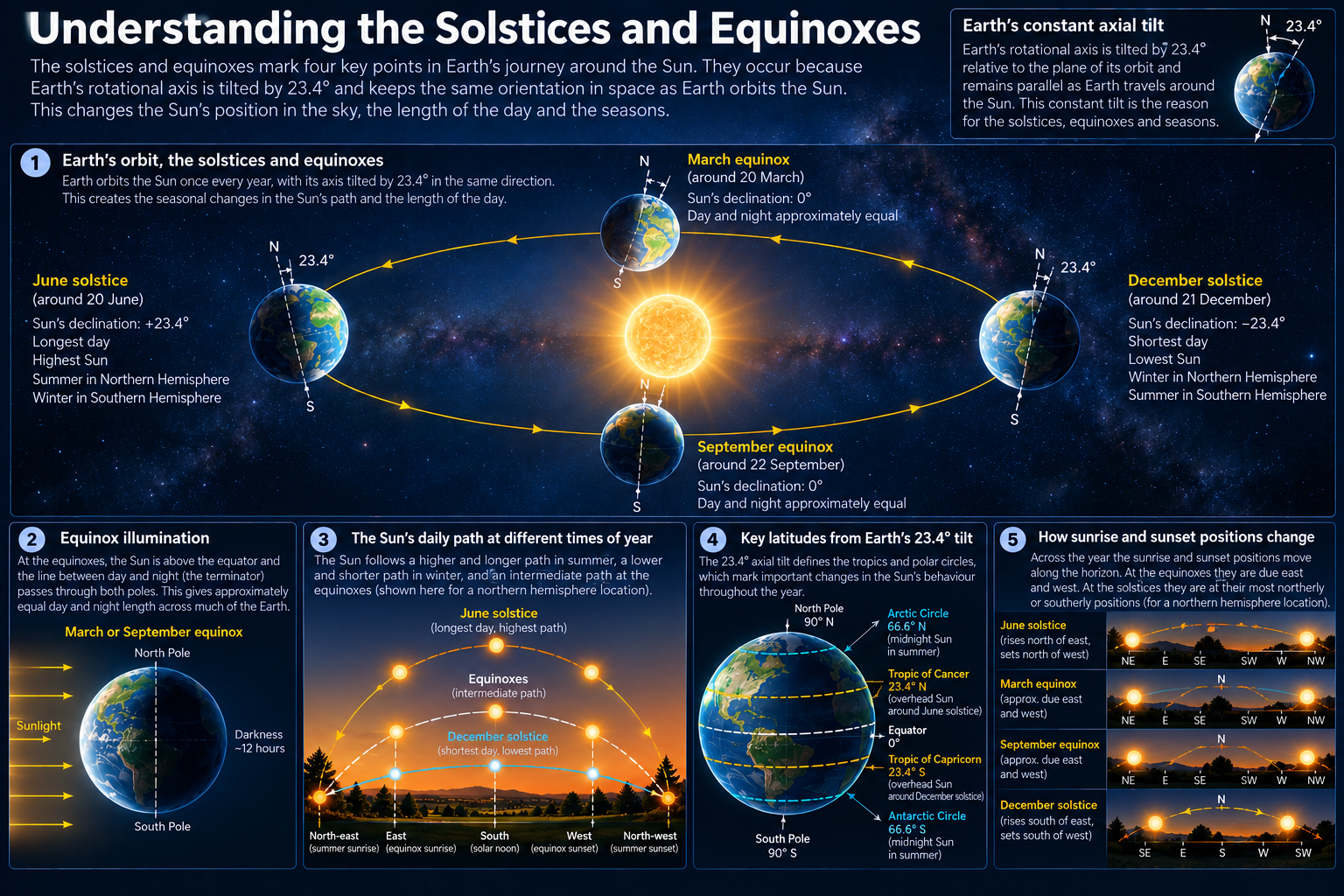
As Earth travels around the Sun each year, the length of the day changes, the Sun rises and sets at different points along the horizon, and its daily path becomes alternately higher and lower in the sky.
Four astronomical events mark important points in this annual cycle:
- the March equinox
- the June solstice
- the September equinox
- the December solstice
Together, the solstices and equinoxes divide Earth's orbit into four astronomical seasons.
The equinoxes occur when the Sun crosses the celestial equator, producing approximately equal periods of day and night across much of the world. The solstices occur when the Sun reaches its greatest apparent distance north or south of the celestial equator. They correspond to the longest and shortest daylight periods of the year outside the tropics.
But these events are about much more than dates on a calendar. They are direct consequences of one of Earth's most important characteristics: our planet rotates on a tilted axis. Understanding that tilt explains why the seasons occur, why the Sun follows different paths through the sky throughout the year, and why the effects of the solstices and equinoxes vary so dramatically depending on where you live.
Warning: Do not look directly at the sun without appropriate eye protection
What is an equinox?
An equinox is the moment when the Sun crosses the celestial equator — the imaginary projection of Earth's equator onto the sky. Because the Sun's position relative to the celestial equator is continually changing throughout the year, this crossing happens twice: once moving northwards and once moving southwards.
The March equinox occurs around 20 March each year, when the Sun crosses the celestial equator moving northwards. The September equinox occurs around 22 or 23 September, when the Sun crosses the celestial equator moving southwards. On the exact dates, the moments can fall on either side of these dates depending on your time zone and the year.
At an equinox, the Earth's axis is tilted neither towards nor away from the Sun. Neither hemisphere is favoured. Everywhere on Earth outside the polar regions, the Sun rises approximately due east and sets approximately due west, and day and night are approximately equal in length.
What is a solstice?
A solstice is the moment when the Sun reaches its greatest apparent distance north or south of the celestial equator. Astronomers describe the Sun's north-south position using solar declination. At the solstices, that declination reaches its extreme values:
+23.4°
at the June solstice, which occurs around 21 June, and:
−23.4°
at the December solstice, which occurs around 21 or 22 December. The word solstice comes from the Latin for “Sun stands still”, because for a few days around each solstice the Sun's declination changes very slowly. The sunrise and sunset points along the horizon also barely move, before reversing direction.
At the June solstice, the Northern Hemisphere is tilted maximally towards the Sun. It experiences its longest daylight period of the year, while the Southern Hemisphere experiences its shortest. At the December solstice, the situation is exactly reversed.
Why does Earth's axial tilt cause the seasons?
Earth's rotational axis is tilted by approximately:
23.4°
relative to the plane of its orbit around the Sun. Crucially, the axis always points in the same direction in space as Earth travels around its orbit. As a result, each hemisphere is tilted towards the Sun for part of the year and away from it for the other part.
When your hemisphere is tilted towards the Sun, the Sun follows a longer and higher path across your sky. It remains above the horizon for longer, and its rays strike the ground more directly, concentrating the incoming energy over a smaller area. When your hemisphere is tilted away, the Sun follows a shorter and lower path, the daylight period shrinks, and the Sun's energy is spread more thinly across the surface.
This is why the solstices and equinoxes are so much more than calendar markers. They are the four turning points of that geometry. The equinoxes mark the moments of transition between the two solstice extremes, and together the four events divide Earth's orbit into the astronomical seasons of spring, summer, autumn and winter.
Is it really the tilt, not the distance from the Sun?
A common misconception is that summer happens when Earth is closer to the Sun and winter when it is farther away. This cannot be the explanation, because the seasons are opposite in the two hemispheres. When it is summer in the north, it is winter in the south — on the same Earth, at the same distance from the Sun.
In fact, Earth is closest to the Sun — at perihelion — in early January, during the Northern Hemisphere winter, and farthest — at aphelion — in early July. The change in distance is small enough that its effect on seasonal temperature is minor compared with the effect of axial tilt. The tilt changes the Sun's altitude and the length of the daylight period, and those are what drive the seasons.
Why are day and night not exactly 12 hours at the equinox?
The word equinox suggests equal day and night, and the equinoxes do produce approximately equal periods of daylight and darkness. But the day containing the equinox is usually slightly longer than 12 hours of daylight. Two effects are responsible.
First, sunrise and sunset are defined using the upper edge of the Sun's disc rather than its centre. The Sun's disc spans about half a degree, so the upper edge becomes visible while the centre is still below the horizon. Second, Earth's atmosphere refracts sunlight, bending it around the curve of the planet so that we see the Sun slightly before it has geometrically risen and slightly after it has geometrically set.
Together, these effects add several minutes of daylight to the equinox day. The date on which day and night are truly equal — sometimes called the equilux — falls a few days before the March equinox and a few days after the September equinox for observers at mid-latitudes in the Northern Hemisphere.
What happens at the equator and in the tropics?
At the equator, day length changes remarkably little through the year. The Sun is always above the horizon for roughly 12 hours, and the solstices pass with little change in the length of the day. What changes instead is the direction of the Sun's midday path. Twice a year, around the equinoxes, the Sun passes almost directly overhead, reaching an altitude close to:
90°
Between the Tropic of Cancer and the Tropic of Capricorn — the band of latitudes within about 23.4° of the equator — the Sun passes directly overhead on two dates each year. These overhead Sun dates, rather than the solstices, are what define the tropical seasons in many cultures. Away from the equator within the tropics, one of the two overhead dates falls close to the local summer solstice.
What happens at the polar circles?
At high latitudes, the solstices become extreme. North of the Arctic Circle — latitude approximately 66.6° north — the Sun remains above the horizon for a full 24 hours or more around the June solstice, producing the midnight Sun. Around the December solstice, the Sun does not rise at at all, producing the polar night. South of the Antarctic Circle, the same phenomena occur with the solstices reversed.
The length of these periods grows with latitude. At the polar circles themselves, the midnight Sun and polar night last only about a day. Near the poles, the Sun can remain above or below the horizon for months. The equinoxes mark the moments when the day-night terminator sweeps across these regions and the long polar day gives way to the long polar night, or vice versa.
Why the warmest and coldest weather lags the solstices
Although the June solstice is the longest day of the year in the Northern Hemisphere, it is usually not the warmest. Similarly, the coldest weather in the Northern Hemisphere typically arrives weeks after the December solstice, despite the days already lengthening.
The reason is that land and oceans store heat. Temperatures depend not only on the rate at which energy arrives from the Sun but on the balance between incoming and outgoing energy over the preceding weeks. Around the solstice, incoming energy is still greater than the energy the surface is losing, so temperatures continue to rise for a while. This seasonal lag is why the warmest days of summer typically fall in July or August in the Northern Hemisphere, and the coldest days of winter in January or February.
How the solstices and equinoxes appear in your sky
You can see the effect of these four events without any instrument at all. Around the equinoxes, the Sun rises approximately due east and sets approximately due west, everywhere on Earth. Between the March equinox and the June solstice, the sunrise and sunset points march steadily northwards along the horizon for observers in the Northern Hemisphere, the Sun climbs higher each day at solar noon, and the daylight period grows.
Around the June solstice, that movement slows, stops and reverses. The sunrise and sunset points then retreat southwards until the December solstice, where the movement again slows, stops and reverses. In the Southern Hemisphere, the same horizon movement happens in the opposite direction, and the longest day accompanies the December solstice.
Sun Summary shows this changing geometry as numbers: the Sun's altitude and azimuth at any time, the day length, and the sunrise and sunset times for your location. Follow those values across a solstice or an equinox and you are watching Earth's tilted orbit made visible.
Observing the solstices and equinoxes yourself
The solstices and equinoxes are among the easiest astronomical events to follow, and none of the methods requires looking directly at the Sun.
- Track the sunset point. From a fixed observing spot, notice where the Sun sets relative to distant landmarks. Repeat every week or two and watch the point move along the horizon.
- Follow a shadow. A fixed post in a garden becomes a simple solar instrument. Mark the end of its shadow at the same clock time on different dates and watch the marks shift and lengthen or shorten with the seasons.
- Compare day length. Note the sunrise and sunset times, or the day length shown by Sun Summary, at intervals through the year. The changes are fastest around the equinoxes and slowest around the solstices.
Over a full year, these simple observations reveal the entire annual cycle: the horizon points reaching their extremes at the solstices, sweeping past due east and due west at the equinoxes, and the Sun's midday altitude rising and falling between its summer maximum and winter minimum.
An important safety point
None of the observations described above require looking directly at the Sun, and that is deliberate. Never stare directly at the Sun, and never view it through binoculars, a telescope, a camera viewfinder or other magnifying optical equipment unless an appropriate, purpose-designed solar filter is correctly fitted to the front of the instrument. Shadows and horizon landmarks reveal everything you need to follow the solstices and equinoxes safely.
See our Safe Solar Observing guide for more information.
Four events, one tilted planet
The solstices and equinoxes are often presented as four dates to remember. It is more useful to think of them as four moments in a continuous process. Earth's axis points steadily in one direction in space while the planet travels around the Sun. The Sun's declination therefore swings between +23.4° and −23.4° once each year, and every consequence follows from that swing: the changing day length, the moving sunrise and sunset points, the changing midday altitude, the seasons, the midnight Sun and the polar night.
The equinoxes are the moments of balance, when neither hemisphere is favoured and the Sun stands above the equator. The solstices are the moments of extremes, when the tilt favours one hemisphere as strongly as it ever can. Between them, the whole year unfolds.
That is one of the aims of Sun Summary: to connect familiar annual events — the longest evening of summer, the short afternoon of winter, the equal days of the equinoxes — with the tilted, orbiting planet that produces them.
A year of the Sun
Imagine beginning at the March equinox in the Northern Hemisphere. The Sun rises approximately due east and sets approximately due west. Day and night are close to equal.
Over the following weeks, sunrise and sunset move northwards along the horizon. The Sun climbs higher at solar noon and the days become longer.
At the June solstice, this progression reaches its northern extreme. The Sun follows its highest and longest daily path.
Then the process reverses. The Sun's path gradually becomes lower and shorter until the September equinox, when it once again rises approximately east and sets approximately west.
Afterwards, sunrise and sunset continue moving southwards. The Sun's maximum altitude falls and daylight becomes shorter.
At the December solstice the Sun reaches its lowest and shortest path.
Then the direction reverses once more. Day by day the Sun climbs higher, the daylight period lengthens and the sunrise and sunset positions move back towards their equinox locations.
Eventually Earth returns to the March equinox and the cycle begins again.
Four moments that describe an entire year
The solstices and equinoxes are sometimes treated simply as dates marking the beginnings of seasons. Astronomically, they tell a much richer story.
The equinoxes mark the moments when the Sun crosses Earth's celestial equator. The solstices mark the extremes of its apparent north-south movement.
Together they reveal:
- Earth's 23.4° axial tilt
- our planet's orbit around the Sun
- the changing altitude of the Sun
- the changing length of daylight
- the movement of sunrise and sunset along the horizon
- the annual cycle of the seasons.
They also demonstrate how dramatically the same astronomical geometry can appear from different parts of Earth.
Near the equator, day length changes relatively little. At mid-latitudes, summer and winter produce clearly different solar paths. Inside the polar circles, the same effect becomes powerful enough to produce continuous daylight and continuous darkness.
All of these phenomena originate from the same tilted Earth travelling around the same Sun. That is why the solstices and equinoxes are so useful for understanding our place in the Solar System.
They transform everyday changes—the lengthening evening, the low winter Sun, a sunset gradually moving along the horizon—into visible evidence of the orientation and movement of our planet.
And once you know what to look for, you don't need a telescope to observe any of it. The changing seasons themselves become an astronomical observation.
Find out more
Explore another aspect of the Sun in What Are Sunspots?.
More Sun reading
Read about why day length changes through the seasons in Why Day Length Changes Throughout the Year, the full chain of reasoning behind every sunrise and sunset figure in The Position of the Sun, or browse other reading on the Articles page.