What Are Sunspots?
Look at the Sun through properly filtered solar-observing equipment and you may sometimes see small dark markings scattered across its bright surface.
These are sunspots.
Some appear as tiny isolated dots. Others develop into complex groups containing numerous dark patches and can persist for days or even weeks as the Sun rotates.
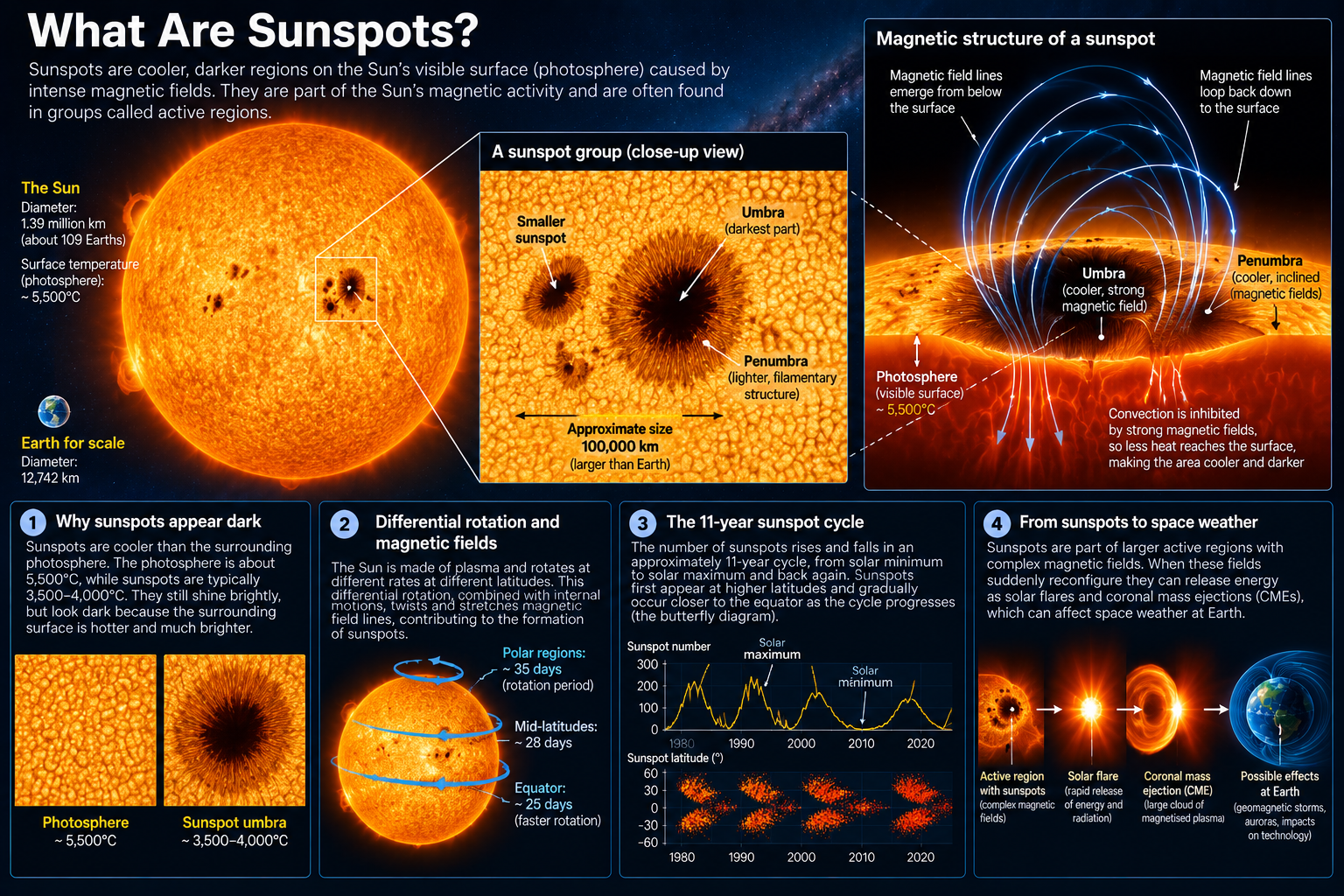
Despite their dark appearance, sunspots are not holes in the Sun, nor are they cold areas. They are regions where extremely strong magnetic fields alter the way energy is transported through the Sun's outer layers, causing the visible surface to become cooler than its surroundings.
And “cooler” is very much a relative term.
A sunspot is still thousands of degrees hot and would shine brilliantly if it could somehow be viewed by itself against the darkness of space. It looks dark only because the surrounding surface of the Sun is considerably hotter and brighter.
Sunspots are among the most visible signs that the Sun is not a quiet, unchanging ball of light.
It is a dynamic and magnetically active star.
Warning: Do not look directly at the sun without appropriate eye protection
Where sunspots appear
Sunspots appear on the Sun's visible surface, the layer astronomers call the photosphere. This is the bright “surface” we see with our eyes (through appropriate filters) and the layer from which most of the Sun's visible light escapes into space.
They do not appear randomly anywhere on the disc. Sunspots almost always form within two bands of latitude, one north and one south of the Sun's equator. Early in the solar cycle those bands sit close to the equator; as the cycle progresses, new spots tend to appear at progressively lower latitudes, drifting towards the equator as the cycle unfolds.
The umbra and the penumbra
A well-developed sunspot is not simply a uniform dark blob. Look closely and it has structure. The darkest central region is called the umbra. Surrounding the umbra is a lighter, filamentary fringe called the penumbra, which resembles radial strands spreading outwards from the dark core.
The umbra is the coolest and darkest part of the spot, where the magnetic field is strongest and most nearly vertical. In the penumbra the field is more inclined, the suppression of energy transport is weaker, and the surface is not quite so dark. Small, young spots may show only an umbra with little or no penumbra; large, mature spots display both clearly.
How hot is a sunspot?
The normal photosphere has a temperature of roughly:
5,500 °C
A typical sunspot umbra is cooler, at around:
3,500–4,500 °C
That difference of a couple of thousand degrees is enough to make a spot look dramatically dark against its brilliant surroundings, because the brightness of a hot surface falls off steeply with temperature. Yet the umbra alone would still glow brighter than an electric arc lamp. Darkness, for a sunspot, is entirely a matter of contrast.
What the magnetic field does
The Sun is a giant ball of hot, electrically conducting plasma, and it behaves like a huge, complicated magnet. Its magnetic field is generated deep inside by the combination of the Sun's rotation and the churning motion of its outer layers.
In places, loops of magnetic field push up through the photosphere. Where the field is strong, it resists the upward flow of hot, rising plasma that normally carries energy to the surface. With that energy transport suppressed, the surface region inside the magnetic loop cools slightly relative to its surroundings and darkens — a sunspot is born.
Sunspots therefore mark places where the Sun's internal magnetism has broken through to the surface. They usually appear in pairs of opposite magnetic polarity, like the two ends of a horseshoe magnet poking through the photosphere, with the magnetic loop arching between them.
Sunspots are temporary
A sunspot is a temporary feature. Small spots may last only a few hours or days. Large groups can survive for weeks, sometimes for more than a solar rotation, changing shape, growing and decaying as their magnetic fields evolve.
Complex groups — which astronomers call active regions — can contain dozens of spots of both polarities tangled together. These complicated magnetic tangles are where the most dramatic solar activity, including flares, tends to occur.
The Sun rotates, and sunspots move with it
Watch a sunspot group from one day to the next and you will notice it drifts steadily across the Sun's disc. It is not migrating over the surface so much as being carried around by the Sun's rotation, just as a passenger is carried by a rotating carousel.
The Sun rotates once every:
about 25–35 days
depending on latitude, because the Sun is not a solid body and rotates faster at its equator than near its poles. This differential rotation is one of the key ingredients that winds up and amplifies the solar magnetic field in the first place.
A spot that appears on the Sun's eastern edge will journey across the disc over roughly two weeks and disappear around the western edge. If it survives, the same spot can reappear about two weeks later on the eastern limb once more. Observers in Galileo's time used exactly this motion to show that the Sun rotates.
The solar cycle
The number of sunspots visible on the Sun is not constant. It rises and falls in a rhythmic pattern known as the solar cycle, sometimes called the sunspot cycle. From one minimum to the next, the cycle lasts on average:
about 11 years
At solar minimum, the Sun may show no spots at all for days or weeks at a time. At solar maximum, the disc can be dotted with spots and active regions, and solar activity of all kinds — flares, eruptions and auroras on Earth — becomes much more frequent.
The cycle is magnetic in origin. Over about 11 years the Sun's large-scale magnetic field becomes progressively twisted and tangled by differential rotation and convection, until it essentially reorganises itself and flips: the Sun's magnetic north and south poles swap places. Taking the full magnetic flip into account, the complete magnetic cycle is closer to 22 years.
A short history of watching sunspots
Sunspots have been observed with the naked eye since antiquity — Chinese and Korean astronomers recorded dark marks on the Sun more than two thousand years ago. Modern telescopic study began around 1610–1613, when Galileo Galilei, Thomas Harriot and Christoph Scheiner independently turned the new telescope on the Sun and tracked the spots drifting across its face.
In the 1840s, the German amateur astronomer Heinrich Schwabe, patiently counting spots every clear day for decades, discovered that sunspot numbers rise and fall in a cycle of about ten or eleven years. Later in the nineteenth century, Richard Carrington used sunspot motions to establish how the Sun rotates, and Rudolf Wolf of Zurich established a standard way of counting spots that is still used today.
In 1891, Edward Maunder and others noticed something remarkable in the historical records: between roughly 1645 and 1715, sunspots were extraordinarily rare. This long quiet interval is now called the Maunder Minimum, and it coincided suspiciously with a chilly period in parts of Europe sometimes called the Little Ice Age — a hint, still studied today, that solar activity can influence Earth's climate in subtle ways.
How sunspots are counted
Astronomers do not simply count spots. The standard measure combines the number of individual spots with the number of groups into which they fall, producing a figure called the sunspot number. Ten isolated spots and one group of ten spots do not score the same, because grouped activity is taken to represent a more significant magnetic event.
Sunspot numbers have been recorded in a fairly consistent way since the middle of the nineteenth century, and reconstructed with care back to the telescopic era. This long, continuous record makes the sunspot cycle one of the best-documented natural cycles in all of science.
Sunspots and the Sun's brightness
Because sunspots are cooler, you might expect the Sun to shine less brightly when its face is covered with them — and it does, very slightly. Space-based instruments measuring the Sun's total energy output have shown that the brightening caused by other magnetic activity almost compensates for the dark spots, so the Sun is actually, on average, very slightly brighter at solar maximum than at minimum.
The variation is small — a fraction of one percent — far too small to see with the naked eye, but large enough for sensitive instruments to measure precisely, and large enough for scientists to study carefully when considering the Sun's role in Earth's climate.
Sunspots, flares and space weather
Sunspots matter far beyond the Sun's appearance. The complex magnetic fields in and around large sunspot groups store enormous amounts of energy. When those fields reorganise themselves, that energy can be released suddenly.
A sudden, intense burst of radiation from an active region is called a solar flare. A larger-scale eruption that flings billions of tonnes of magnetised plasma into space is a coronal mass ejection. Both are far more likely when large, complicated sunspot groups are present — which is why forecasters who track space weather watch sunspot regions so closely.
When an eruption is directed towards Earth, the arriving particles and fields can disturb the magnetosphere, spark beautiful auroras far from the poles, and in strong events interfere with satellites, radio communication, navigation systems and power grids. Sunspots are the visible signposts of the magnetic machinery that drives all of this.
An important safety point
Sunspots must never be observed with the unprotected eye or with ordinary sunglasses, smoked glass, exposed film or any other improvised filter. Looking directly at the Sun without purpose-designed, certified solar filters can cause permanent eye damage, including blindness — often without any pain, because the retina has no pain receptors.
Safe alternatives exist. A pinhole projector lets you see sunspots as small dark marks on a projected image of the Sun without ever looking at the Sun itself. For direct viewing, use only certified solar viewing glasses (compliant with the ISO 12312-2 standard) or a purpose-designed solar filter fitted to the front of a telescope. See our Safe Solar Observing guide for full details.
Sunspots as a window into the Sun
For centuries, sunspots were the only visible sign that the Sun changes at all. Today we understand them as the surface expression of a deep magnetic engine: markers of field lines that have broken through the photosphere, sites where energy is stored and released, and a natural clock whose roughly 11-year tick has been kept, in one way or another, for hundreds of years.
A single glance at a sunspot group tells an astronomer a great deal: the strength and complexity of the local magnetic field, the likelihood of flares in the days ahead, the phase of the solar cycle, and even which magnetic polarity dominates that hemisphere of the Sun during that cycle.
Sunspots grow and decay over days and weeks. They are carried around the Sun by its rotation, which takes weeks. They appear and vanish in numbers that rise and fall over the 11-year solar cycle, and the Sun's magnetic field itself flips and rebuilds over about 22 years.
The Sun changes on several timescales at once.
A practical example
Imagine observing the Sun safely through suitable filtered equipment and finding a large group of sunspots towards the eastern side of the solar disc.
Two days later, the group appears farther towards the centre.
Several days after that, it lies west of centre.
Eventually it approaches the western limb and rotates out of view.
During the same period, the group itself may change.
Small spots may appear.
Others may disappear.
The penumbra surrounding a large spot may develop or fragment.
You are watching two processes simultaneously:
the Sun rotating
and
an active magnetic region evolving.
A few weeks later, another collection of sunspots may appear at a different location.
Over years, the overall frequency and latitude of these regions changes as the Sun progresses through its activity cycle.
What initially looked like a few dark marks therefore reveals several fundamental properties of the Sun.
More than dark spots
Sunspots are among the simplest solar features to recognise, but they provide a window into some of the most complex processes occurring within our star.
They reveal that the Sun rotates.
Their movement helps demonstrate that different solar latitudes rotate at different rates.
Their magnetic fields show that the Sun is governed by powerful electromagnetic processes.
Their changing numbers reveal the approximately 11-year solar cycle.
And the active regions associated with them can sometimes produce eruptions powerful enough to affect the space environment around Earth.
Perhaps most importantly, sunspots challenge the everyday impression of the Sun as an unchanging disc.
From Earth, the Sun can appear almost perfectly constant.
In reality, it is an enormous sphere of moving plasma containing magnetic fields that continually twist, reorganise and occasionally release extraordinary amounts of energy.
Sunspots are one of the most visible signs of that activity.
A dark mark on the solar surface can be larger than Earth, contain magnetic fields thousands of times stronger than Earth's surface field, evolve over a period of days, and form part of a magnetic cycle lasting decades.
By following sunspots, we aren't simply looking at blemishes on the Sun.
We are seeing the magnetism of a star made visible.
Find out more
Explore how sunspot activity fits into the Sun’s longer rhythm in Understanding the Solar Cycle.
More Sun reading
Browse more articles about the science of the Sun on the Solar Science Articles page, other articles about the Sun and solar astronomy on the Articles page, or check today's sun position on the Sun Summary page.