Understanding the Solar Cycle
The Sun can appear remarkably constant.
Day after day it rises as the same brilliant disc, providing the light and heat that sustain life on Earth. But beneath that familiar appearance, the Sun is continually changing.
Its magnetic field evolves. Sunspots appear and disappear. Solar flares erupt. Enormous clouds of magnetised plasma can be thrown into space. At other times, the Sun becomes comparatively quiet and its visible surface may remain almost free of sunspots.
These changes aren't completely random.
Solar activity rises and falls in a repeating pattern known as the solar cycle.
The most familiar solar cycle lasts approximately:
11 years
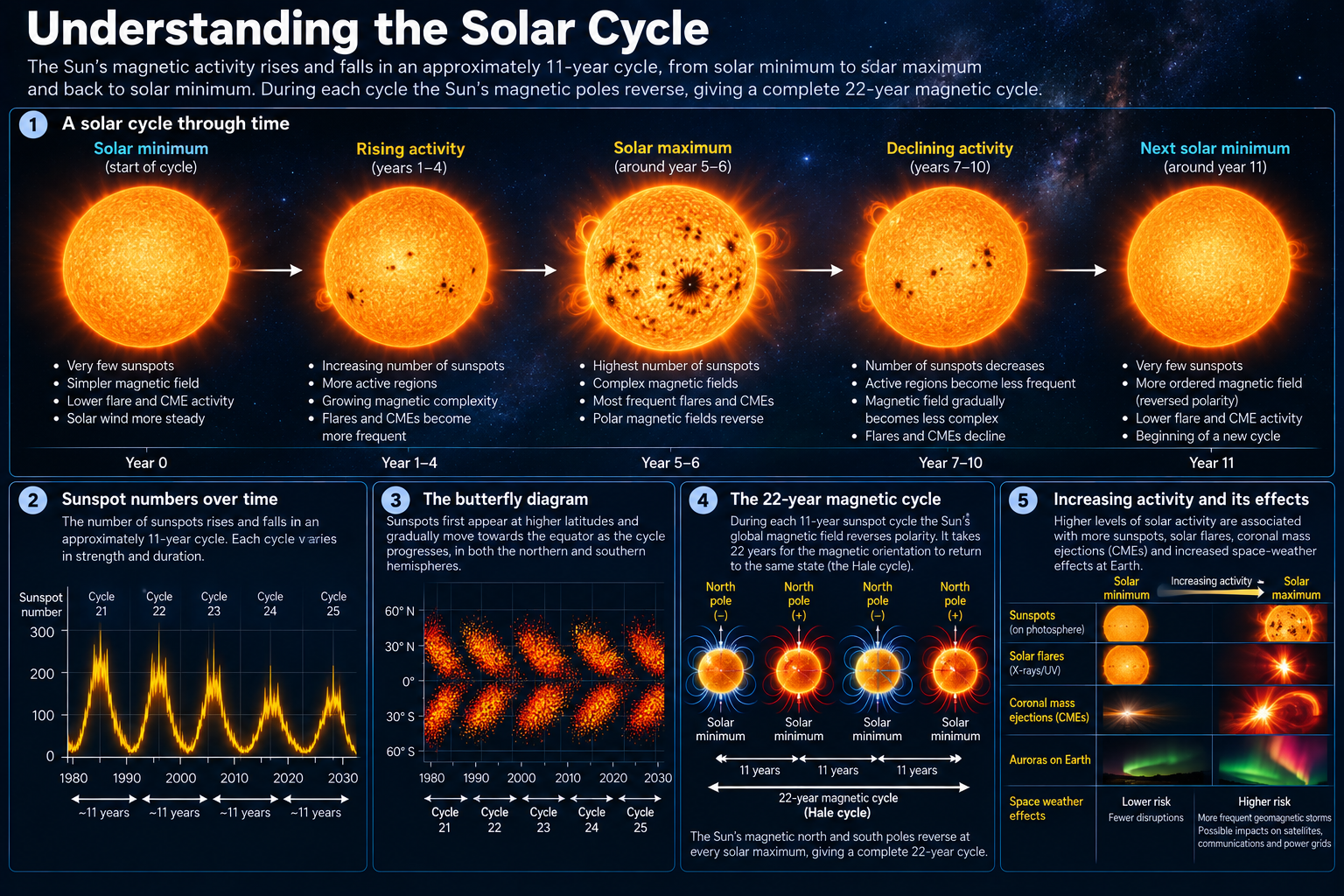
During that time the Sun progresses from a relatively quiet state known as solar minimum, through a period of increasing activity to solar maximum, and eventually back towards another minimum.
But there is another remarkable part of the story.
During each 11-year cycle, the Sun's global magnetic field reverses polarity. Its magnetic north and south poles effectively exchange places.
It takes another cycle for them to reverse again.
The complete magnetic cycle therefore lasts approximately:
22 years
Understanding this cycle helps explain sunspots, solar flares, coronal mass ejections, auroras and many of the changing conditions collectively known as space weather.
Warning: Do not look directly at the sun without appropriate eye protection
What solar minimum and solar maximum look like
At solar minimum, the Sun is at its quietest. Sunspots are scarce or entirely absent for days or weeks at a time, large flare-producing active regions are rare, and geomagnetic storms and low-latitude auroras are uncommon. The Sun's large-scale magnetic field is at its simplest and most orderly, closer to a smooth dipole, like the field of a giant bar magnet.
As the cycle climbs towards solar maximum, sunspots become numerous and appear in increasingly complicated groups. Flares and coronal mass ejections become more frequent and more powerful, and when those eruptions reach Earth they can drive auroras, disturb satellites, degrade radio communication and, in extreme events, stress power grids.
The transition is not sudden or perfectly smooth. Activity rises and falls in bursts, with quiet spells even near maximum and active spells even near minimum. But the underlying trend — a slow build over five or six years and a slower decline — repeats with striking regularity, cycle after cycle.
How the cycle is measured
The classic yardstick of the solar cycle is the sunspot number, which combines the count of individual spots with the count of the groups they form. Plotted month by month and year by year, the sunspot number traces the familiar rise-and-fall wave through more than two dozen cycles since reliable telescopic records began in the mid-eighteenth century.
Modern instruments add many more measures: the Sun's total energy output, the strength of its magnetic field across the whole disc, the intensity of ultraviolet and X-ray radiation, the number of flares of each class, and the rate of coronal mass ejections. Nearly all of these rise and fall together with the sunspot number, because all of them are driven by the same underlying magnetic engine.
Cycles are numbered sequentially from the cycle that began in 1755. The cycle underway today is Solar Cycle 25, which began in December 2019 and is expected to reach its maximum in the mid-2020s.
The butterfly diagram
One of the most beautiful records in all of astronomy emerges when sunspots are plotted by latitude against time. Early in each cycle, new spots appear at relatively high latitudes, roughly 25 to 35 degrees north and south of the equator. As the cycle progresses, later spots appear at progressively lower latitudes, until the final spots of the cycle emerge close to the equator just as the first spots of the next cycle appear at high latitudes again.
Drawn out over many cycles, the spots trace a repeating pair of wing-like bands drifting towards the equator — a pattern known as the butterfly diagram, first assembled by Walter and Annie Maunder in the early twentieth century.
The drifting bands are a direct clue to what the cycle actually is: not a weather pattern on the Sun's surface, but the slow winding, transport and cancellation of magnetic flux inside a rotating, churning star.
Why the cycle happens
The engine of the solar cycle lies in two facts about the Sun. First, it is not a solid body: it rotates faster at its equator than near its poles. Second, it is made of plasma — electrically charged, electrically conducting gas in which magnetic fields are frozen into the flow and carried along with it.
Because of this differential rotation, an initially simple north-south magnetic field is gradually stretched and wound around the Sun in the east-west direction, like a rubber band twisted tighter and tighter. Meanwhile, the churning convection beneath the surface tangles the wound-up field into concentrated ropes, some of which become buoyant and bob up through the surface, emerging as sunspot pairs of opposite polarity.
As the cycle advances, the sunspot-pair belts drift towards the equator, where opposite-polarity flux from the two hemispheres meets and cancels. What remains is a leftover field of the reversed orientation, which migrates towards the poles and gradually rebuilds the Sun's global dipole — with north and south exchanged. The stage is then set for the next 11-year cycle, running with the opposite overall polarity.
This is why the full magnetic pattern — sometimes called the Hale cycle, after George Ellery Hale, who discovered sunspot polarity in the early twentieth century — takes two sunspot cycles, about 22 years, to complete.
The cycle in space weather
Near solar maximum, the complex magnetic fields of large active regions store enormous energy, and they release it more often — as solar flares, sudden bursts of radiation across the spectrum, and as coronal mass ejections, vast clouds of magnetised plasma flung into interplanetary space.
When those eruptions and their associated streams of fast solar wind arrive at Earth, they rattle the magnetosphere. The result is more frequent and more intense auroras, visible from lower latitudes than usual during strong storms, alongside the practical hazards that space-weather forecasters track: radiation exposure for astronauts and high-altitude flyers, drag and damage to satellites, fading and scintillation of high-frequency radio communication, errors in satellite navigation, and induced currents that can trouble long power lines and transformers.
Even the upper atmosphere itself follows the cycle. The Sun's ultraviolet and X-ray output — which varies far more than its visible light — heats and thickens the outer atmosphere at solar maximum, increasing the drag on low-orbiting satellites and changing the altitude at which they fly.
When the cycle falters
The cycle is regular, but not metronomic. Cycles have ranged from about nine to about fourteen years, and their peaks have varied greatly in height. The strongest cycle on record peaked in the late 1950s; the weakest of the modern era, Solar Cycle 24, peaked in 2014 at less than half that level.
Occasionally the cycle has faltered almost completely. Between roughly 1645 and 1715, sunspots were extraordinarily rare — the Maunder Minimum, which coincided with a notably cold period in parts of Europe. A weaker dip in the early nineteenth century is known as the Dalton Minimum. And the deep minimum of 2008–2009, with its long stretch of a blank Sun, took many forecasters by surprise.
These episodes are a reminder that the solar cycle is a dynamic, self-organising process rather than a fixed clock — and that predicting the size and timing of the next maximum remains one of the genuinely difficult problems in solar physics.
The solar cycle and Earth's climate
Because the Sun drives Earth's climate, it is natural to ask how much the solar cycle contributes to climate change. The measured answer is: only a little.
The Sun's total energy output varies by only about:
0.1%
between solar minimum and solar maximum — a difference far too small to account for the sustained warming observed over the past century. The Maunder Minimum's overlap with Europe's Little Ice Age is suggestive, but regional climate varied for many reasons, and the quiet Sun was at most a contributing factor among several.
Where the cycle's influence is clearer is in the atmosphere's upper reaches. The varying ultraviolet and particle input measurably changes temperatures, winds and chemistry in the stratosphere and above, and it modulates the formation of auroras and the behaviour of the ionosphere on which radio communication depends.
The solar cycle remains important for understanding natural variability and the upper atmosphere, but it shouldn't be treated as a simple explanation for changes in Earth's climate.
An important safety point
Sunspots and other signs of the solar cycle must never be observed with the unprotected eye or with improvised filters. Looking directly at the Sun without purpose-designed, certified solar filters can cause permanent eye damage, including blindness — often without any pain, because the retina has no pain receptors.
Safe alternatives exist. A pinhole projector shows sunspots as dark marks on a projected image of the Sun without ever looking at the Sun itself. For direct viewing, use only certified solar viewing glasses (compliant with the ISO 12312-2 standard) or a purpose-designed solar filter fitted to the front of a telescope. See our Safe Solar Observing guide for full details.
A clock made of magnetism
The solar cycle gives the Sun a rhythm. It organises the appearance of sunspots, the frequency of flares and eruptions, the frequency of auroras, the state of the upper atmosphere, and the working environment of every satellite in orbit around Earth.
It is a rhythm we can now watch from many vantage points at once: telescopes on the ground counting spots, spacecraft monitoring the Sun's face and magnetic field around the clock, and sensors on Earth and in orbit recording what each cycle sends our way.
And it connects timescales. Sunspots form and decay over days and weeks. Active regions come and go over months. The sunspot cycle turns over about 11 years, and the Sun's global magnetism completes its full reversal and return in about 22.
The steady disc that rises each morning is, on closer inspection, a star with a slow magnetic heartbeat — one that has been counted, cycle by cycle, for nearly three centuries, and that we are still learning to predict today.
Solar maximum and solar flares
Solar flares are intense releases of electromagnetic energy from magnetically active regions. Because active regions are more common around solar maximum, flares generally occur more frequently during the active part of the cycle.
However, the relationship isn't absolute. A powerful flare can occur outside the precise maximum period, and an active Sun doesn't mean a major flare will occur on any particular day.
The solar cycle changes the overall likelihood and frequency of energetic activity. It doesn't provide a timetable for individual events.
Solar maximum and coronal mass ejections
The same general principle applies to coronal mass ejections, or CMEs. A CME is an enormous eruption of magnetised plasma from the Sun's corona.
CMEs occur more frequently when the Sun is active. But most aren't directed towards Earth. Even an Earth-directed CME doesn't automatically produce a severe geomagnetic storm. Its effect depends on factors including its speed and, importantly, the orientation of the magnetic field carried with it when it reaches Earth.
Our next article, Solar Flares and Coronal Mass Ejections, will examine the differences between these events and why some have much greater effects on Earth than others.
The solar cycle and auroras
The solar cycle can also influence how often strong auroras are seen. When disturbances from the Sun interact with Earth's magnetosphere, charged particles can be directed into the upper atmosphere. Collisions with atmospheric atoms and molecules produce the light of the aurora.
During periods of elevated solar activity, significant geomagnetic disturbances tend to occur more frequently. This can increase opportunities for bright auroras to be visible at lower latitudes than usual.
But the relationship isn't as simple as:
solar maximum = aurora
Auroral activity depends on conditions in the solar wind and Earth's magnetosphere at a particular time. Some significant geomagnetic activity can also occur during the declining phase of a solar cycle, including disturbances associated with high-speed solar-wind streams.
The cycle changes the solar wind too
The Sun continually releases charged particles into space. This flow is called the solar wind. It doesn't switch on at solar maximum and off at solar minimum. It is always present.
But the structure of the Sun's corona and magnetic field changes during the solar cycle, altering conditions in the solar wind. Around solar minimum, the Sun's large-scale magnetic structure tends to be simpler. Around maximum, it becomes considerably more complicated.
These changes affect the environment throughout the heliosphere — the enormous region of space dominated by the Sun and its solar wind.
Our later article The Solar Wind will explore this continuous connection between the Sun and the rest of the Solar System.
The solar cycle reaches far beyond the Sun
The effects of changing solar activity aren't confined to the solar surface. The Sun's magnetic influence and solar wind extend far beyond the planets. Together they create the heliosphere, an enormous bubble-like region surrounding the Solar System. As solar activity changes, conditions throughout this environment change too.
The solar cycle can influence:
- Earth's magnetosphere;
- the frequency of geomagnetic storms;
- auroral activity;
- Earth's upper atmosphere;
- satellite operations;
- radio propagation;
- navigation systems;
- radiation conditions experienced by spacecraft and astronauts;
- and the number of galactic cosmic rays reaching the inner Solar System.
The cycle of sunspots visible from Earth is therefore the surface expression of a phenomenon extending across billions of kilometres of space.
Cosmic rays and the solar cycle
One particularly interesting relationship involves galactic cosmic rays. These are extremely energetic particles arriving in the Solar System from beyond it. The Sun's magnetic field and solar wind help modulate how easily these particles reach the inner Solar System.
Around solar maximum, the Sun's magnetic environment is generally more disturbed and provides greater modulation of galactic cosmic rays. Measurements near Earth therefore tend to show fewer galactic cosmic rays. Around solar minimum, more can reach the inner Solar System.
This means that cosmic-ray intensity near Earth tends to vary broadly opposite to solar activity. It is another example of the solar cycle affecting an environment far beyond the visible surface of the Sun.
Can we predict the solar cycle?
Scientists can make forecasts of how a solar cycle is likely to develop. They use information such as sunspot observations, polar magnetic-field strength, previous cycle behaviour, and sophisticated models of the Sun's magnetic activity.
These predictions can estimate the likely timing and strength of an upcoming maximum. But the Sun remains difficult to predict precisely. Forecasting the broad behaviour of an 11-year cycle is very different from predicting exactly when a particular active region will produce a major solar flare or CME.
Solar forecasting therefore operates on several timescales, from years-long cycle predictions to short-term space-weather forecasts.
Why is predicting solar activity important?
Modern civilisation depends heavily on technologies that operate in or communicate through environments affected by solar activity.
Strong space-weather events can influence satellites and spacecraft. Changes in Earth's upper atmosphere can affect satellite drag. Radio communications can be disrupted. Navigation signals can become less reliable. Large geomagnetic storms can induce electrical currents in long conductors and power networks. Astronauts outside the protection of Earth's lower atmosphere and magnetic environment can face increased radiation exposure during energetic solar events.
Understanding where the Sun is within its activity cycle helps scientists place short-term space-weather events into a broader context.
Observing the solar cycle yourself
The solar cycle unfolds slowly enough that it can't be appreciated in a single observing session. But that makes it an excellent long-term observing project.
Using appropriate solar-observing equipment, you can record the Sun at regular intervals and note the number of sunspot groups, their size and complexity, their positions on the solar disc, and the number of spotless observing days.
Over weeks you can see individual active regions evolve. Over months you can see the overall activity level change. Over several years you can watch a substantial portion of the solar cycle unfold.
Public solar images from professional observatories can also make it possible to follow the cycle even when weather prevents direct observation.
Observe safely
Solar observation requires appropriate safety precautions. Never look directly at the Sun without suitable protection. Never look through binoculars, telescopes, camera optics or other magnifying equipment unless an appropriate purpose-designed solar filter is securely and correctly fitted to the front of the instrument.
Ordinary sunglasses don't provide adequate protection. Improvised filters should not be used. For suitable methods and further guidance, see our Safe Solar Observing article.
A solar cycle in miniature
Imagine beginning near solar minimum. The Sun may frequently appear almost spotless. Eventually, new sunspot groups begin appearing at higher latitudes.
Over the following years they become more numerous. Active regions grow more common and magnetic activity increases. Solar flares and CMEs occur more frequently. The Sun approaches solar maximum. Its magnetic field becomes highly complicated and its polar magnetic fields reverse.
After maximum, the overall activity begins declining. New sunspots appear progressively closer to the equator. Several years later the Sun again approaches minimum.
But something fundamental has changed. Its global magnetic polarity is now the reverse of what it was at the previous minimum.
A new 11-year cycle begins. Activity rises and falls again. The magnetic poles reverse once more. Only after this second cycle has the Sun completed its full approximately 22-year magnetic cycle.
The changing heartbeat of our star
The solar cycle shows us that the Sun is neither static nor perfectly repetitive. Its activity has rhythm, but not the precision of a clock. Cycles differ in length and strength. Individual active regions develop unpredictably. Powerful eruptions can occur amid broader patterns that unfold over years.
Yet beneath that complexity is a remarkable degree of organisation. Sunspots appear at characteristic latitudes and migrate towards the equator. Their magnetic polarities follow patterns. Activity rises towards maximum and falls towards minimum. The Sun's global magnetic poles reverse. And after approximately 22 years, the broad magnetic orientation returns to where it began.
A graph of sunspot numbers may initially look like little more than a sequence of peaks and troughs. But those peaks represent a vast magnetic process operating inside an object almost 1.4 million kilometres across. That process can produce dark regions larger than Earth, eruptions visible across the Solar System and disturbances capable of interacting with our own planet's magnetic field.
The solar cycle therefore connects phenomena occurring deep within the Sun with events we can observe from Earth. It explains why the appearance of the Sun changes over years. It helps us understand why some periods are more magnetically active than others. And it provides one of the clearest reminders that the star at the centre of our Solar System is not an unchanging source of light.
The Sun is a dynamic magnetic star — and the solar cycle is the rhythm of that changing activity.
Other major events
The Carrington Event isn't the only significant geomagnetic disturbance on record.
In March 1989, a major geomagnetic storm contributed to the collapse of the Hydro-Québec electricity grid in Canada, leaving millions of people without power for several hours.
More recently, strong solar activity has demonstrated the continuing relevance of space weather to satellites, communications and power systems.
Modern monitoring means that we can now observe eruptions on the Sun, track disturbances through interplanetary space and issue warnings before some effects reach Earth.
That capability didn't exist for earlier generations.
How do we monitor solar eruptions?
Modern solar observation uses a combination of spacecraft and ground-based instruments.
- Telescopes observing the Sun in visible, ultraviolet and extreme-ultraviolet wavelengths can monitor active regions and flares.
- X-ray detectors measure the radiation used to classify solar flares.
- Coronagraphs observe CMEs expanding through the corona.
- Other spacecraft monitor the solar wind between the Sun and Earth.
Particularly valuable are spacecraft positioned near the Sun–Earth L1 point, roughly 1.5 million kilometres sunward of Earth. From there, instruments can directly measure an approaching solar-wind disturbance before it reaches Earth's magnetosphere.
Depending on the speed of the solar wind, these measurements can provide roughly tens of minutes of additional warning about the magnetic conditions that are about to arrive.
Why can't we predict CMEs perfectly?
We can observe a CME leaving the Sun and estimate its direction and speed. But several uncertainties remain.
- A CME is an enormous three-dimensional magnetic structure moving through a variable solar wind.
- It can accelerate or decelerate.
- It can interact with other solar-wind structures or previous CMEs.
- Its direction can evolve.
- And one of the most important factors — its magnetic orientation at Earth — can be difficult to determine accurately far in advance.
Forecasting therefore improves as the disturbance approaches. The broad question:
“Is this CME likely to reach Earth?”
may be answerable relatively early. The more difficult question:
“Exactly how strong will the resulting geomagnetic storm be?”
may remain uncertain until the CME is much closer.
Are flares and CMEs more common at solar maximum?
Generally, yes.
During solar maximum, the Sun contains more active regions and its magnetic field is more complicated. Solar flares and CMEs therefore tend to occur more frequently.
Around solar minimum, major eruptions are less common. But they don't stop completely. Powerful events can occur outside the precise period of maximum activity.
The approximately 11-year solar cycle therefore changes the overall frequency of solar eruptions, but it doesn't provide a simple schedule for individual events. Our Understanding the Solar Cycle article explains this broader pattern.
Can we see solar flares from Earth?
Some exceptionally energetic flares can produce effects observable in visible light, but ordinary visual solar observing isn't an appropriate way to look for them.
Professional and advanced amateur solar observations often use specialised wavelengths and purpose-designed equipment. Images taken in extreme ultraviolet or X-rays can make flares appear spectacularly bright. Other specialised solar telescopes reveal structures in the chromosphere and prominences above the solar limb.
These views show that the Sun's atmosphere is vastly more dynamic than its relatively calm white-light appearance suggests.
Can we see a CME directly?
Not with ordinary naked-eye observation. CMEs are best observed using specialised instruments, particularly coronagraphs and space-based solar observatories.
Their plasma is extremely tenuous compared with the bright photosphere. Blocking the solar disc allows the much fainter surrounding corona and an expanding CME to become visible.
Images from solar-monitoring spacecraft therefore provide one of the best ways for the public to follow an eruption as it leaves the Sun.
A solar eruption from Sun to Earth
Imagine a magnetically complex active region facing Earth. Its magnetic field has been evolving for several days. Suddenly, magnetic reconnection releases a large amount of stored energy. A brilliant solar flare develops.
About eight minutes later
The flare's X-rays and ultraviolet radiation reach Earth. The increased radiation changes ionisation in the upper atmosphere. Radio communication on Earth's sunlit side may be affected.
Tens of minutes to hours later
If the eruption accelerated high-energy particles towards Earth, solar energetic particles may begin arriving. These are particularly important for spacecraft, satellites and human spaceflight.
A day or two later
Suppose the eruption also launched a fast Earth-directed CME. The expanding cloud of plasma and magnetic field now reaches Earth's vicinity. Its arrival compresses the magnetosphere. If its magnetic field interacts strongly with Earth's field, a geomagnetic storm develops.
During the geomagnetic storm
Auroras intensify and may expand towards lower latitudes. Satellite operations may be affected. Navigation and radio systems may experience disturbances. Electrical network operators may monitor geomagnetically induced currents.
One eruption on the Sun has therefore produced several different effects separated by very different travel times. This is why distinguishing flares, energetic particles and CMEs is so useful.
A useful way to remember the difference
The terminology can initially be confusing, so a simple comparison helps.
| Solar flare | Coronal mass ejection | |
|---|---|---|
| What is it? | Rapid release of electromagnetic radiation | Eruption of plasma and magnetic field |
| Origin | Magnetically active solar region | Solar corona/magnetic eruption |
| Travels at | Speed of light for its radiation | Hundreds to thousands of km/s |
| Typical arrival at Earth | About 8 min 20 sec | Many hours to several days |
| Major Earth effect | Ionospheric disturbances and radio blackouts | Geomagnetic storms and enhanced auroras |
| Always occur together? | No | No |
| More common near solar maximum? | Yes | Yes |
The simplest distinction remains:
A flare is something we receive primarily as radiation.
A CME is material and magnetic field travelling through space.
They can be parts of the same solar eruption, but they aren't interchangeable terms.
The Sun and Earth are connected
The distance between the Sun and Earth is approximately:
150 million kilometres
That distance can make the Sun seem remote from events on our planet. Solar flares and coronal mass ejections show that it isn't.
Radiation from an eruption can cross that distance in just over eight minutes. Energetic particles can follow. A huge magnetic cloud can cross interplanetary space and eventually collide with Earth's magnetic environment.
When that happens, energy originating in magnetic structures on the Sun can ultimately illuminate our atmosphere as an aurora. At the same time, sufficiently strong events can disturb radio communications, satellites, navigation and electrical infrastructure.
The chain of events might begin with a magnetic field twisting around a group of sunspots. But its effects can extend across the Solar System.
That connection is one of the central ideas of solar science.
The Sun isn't simply an object that provides Earth with steady light and heat. It continually interacts with the space surrounding it.
Solar flares demonstrate the enormous amounts of energy stored in its magnetic fields. Coronal mass ejections show that the Sun can physically throw vast quantities of magnetised plasma into space.
And when some of those disturbances encounter Earth, they remind us that our planet exists inside the atmosphere and magnetic influence of an active star.
Space weather begins at the Sun — but sometimes its consequences reach all the way to Earth.
Find out more
Explore how solar activity produces powerful eruptions in Solar Flares and Coronal Mass Ejections.
More Sun reading
Read about the dark markings that track the solar cycle in What Are Sunspots?, browse more articles about the science of the Sun on the Solar Science Articles page, or check today's sun position on the Sun Summary page.