Solar Flares and Coronal Mass Ejections
The Sun may look calm from Earth, but its atmosphere can produce some of the most energetic events in the Solar System.
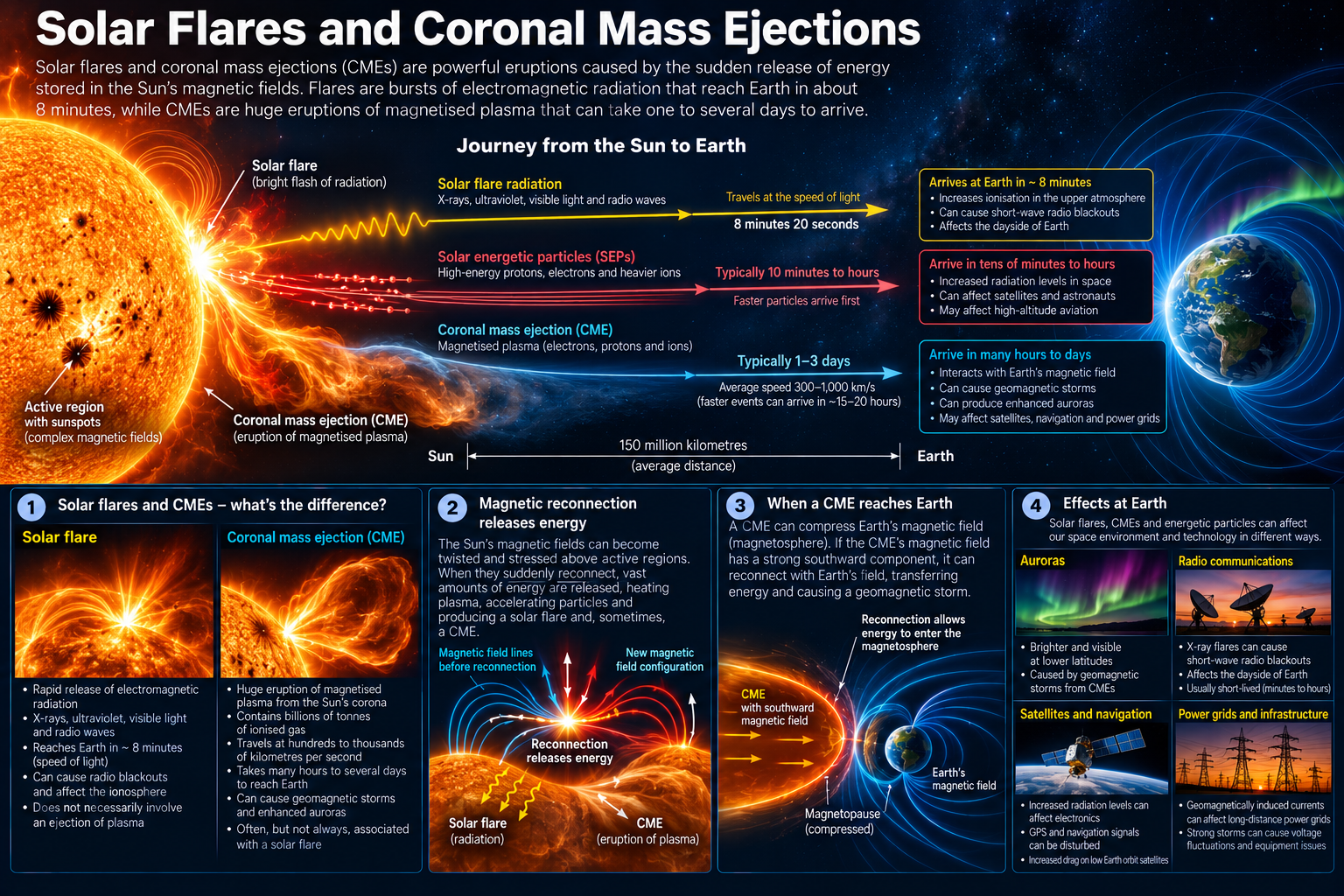
Magnetic fields above the solar surface can become twisted and stressed. Sometimes those fields suddenly reorganise, releasing enormous amounts of stored magnetic energy.
The result can include a brilliant burst of radiation known as a solar flare.
At other times, huge quantities of plasma and magnetic field are expelled from the Sun into space in a coronal mass ejection, usually shortened to CME.
Solar flares and CMEs are closely associated with the Sun's magnetic activity and sometimes occur together. But they are fundamentally different phenomena.
A useful distinction is:
Solar flare → a rapid burst of electromagnetic radiation
Coronal mass ejection → a huge eruption of magnetised solar plasma into space
That difference is important because the two events travel from the Sun to Earth in very different ways and can have very different effects.
Together, they form an important part of space weather—the changing conditions produced by the Sun that can affect Earth's space environment and, during sufficiently powerful events, some technologies on and around our planet.
Warning: Do not look directly at the sun without appropriate eye protection
Where the energy comes from
The Sun's visible surface churns constantly, and beneath it hot plasma circulates in great convective cells. Because plasma is electrically conducting, all of this motion drags and distorts the Sun's magnetic field, winding it into loops that arch high above the surface.
In active regions — the complicated magnetic areas associated with large sunspot groups — neighbouring loops can become tangled together, twisted and stressed like rubber bands wound far past their comfortable limit. The field stores enormous energy in that stressed configuration.
Magnetic fields, however, cannot remain in an unstable state indefinitely. When the stress exceeds what the configuration can sustain, the field suddenly reorganises into a simpler, lower-energy arrangement — a process physicists call magnetic reconnection. The stored energy is released in a flash, and it is this sudden release that powers both solar flares and coronal mass ejections.
What a solar flare is
A solar flare is a sudden, intense burst of electromagnetic radiation from a compact region of the solar atmosphere. In minutes, the site of the eruption can brighten dramatically, emitting radiation across the whole spectrum — from radio waves through visible light to ultraviolet, X-rays and even gamma rays in the most powerful events.
A large flare can release as much energy as billions of hydrogen bombs, yet it does so without flinging significant material into space. A flare is, in essence, light: an outpouring of pure electromagnetic radiation.
Because radiation travels at the speed of light, a flare's effects on Earth begin almost immediately. X-rays and ultraviolet light from a strong flare reach our planet in about:
8 minutes
Those photons can ionise the upper atmosphere on the sunlit side of Earth, causing sudden radio blackouts on high-frequency communication channels used by aviation, shipping and emergency services, and slightly increasing the radiation dose for people on high-altitude polar flights.
How solar flares are classified
Flares are ranked by the peak intensity of their soft X-ray emission, measured by monitoring spacecraft. The scale is logarithmic — each class is ten times stronger than the one before it:
A → B → C → M → X
A- and B-class flares are so weak they are essentially background activity. C-class flares are minor. M-class flares are moderate and can cause noticeable radio effects at Earth. X-class flares are the most powerful, and each class is further subdivided by number — an X3 flare is three times stronger than an X1.
Flares of every size occur far more often near solar maximum, when complicated active regions are abundant, and the rare X-class events cluster around the peak years of the solar cycle.
What a coronal mass ejection is
A coronal mass ejection is a different kind of event altogether. Instead of releasing its energy primarily as radiation, a CME launches a vast bubble of magnetised plasma — billions of tonnes of electrically charged gas, threaded through with magnetic field lines — out from the Sun's outer atmosphere, the corona, into interplanetary space.
A CME is a physical eruption: material genuinely leaves the Sun. A large CME can carry a mass comparable to a mountain range, expanding as it travels until it dwarfs the Sun itself, and it can reach speeds from a few hundred to more than 2,000 kilometres per second.
Many CMEs erupt in directions that miss Earth entirely. But when one happens to be aimed our way, it sweeps outward along the Sun's spiral magnetic field lines and typically arrives at our planet after roughly:
1 to 3 days
How the two events differ at Earth
The contrast between a flare and a CME becomes clearest when comparing how each one reaches us and what each one can do.
A flare's radiation arrives at the speed of light, within minutes, and its direct effects are immediate but relatively brief: ionospheric disturbance, radio fading and scintillation on the daylit side of Earth, and enhanced radiation levels in the upper atmosphere and near-Earth space.
A CME's material arrives days later, but it carries with it a magnetic field of its own. When that field meets Earth's magnetosphere, what matters most is its orientation. If the CME's field points southward relative to Earth's, it can connect with our planet's field and pour energy into it, triggering a geomagnetic storm.
This is why a fast, massive, Earth-directed CME with a southward field is the classic recipe for the most severe space-weather disturbances — and why a large flare without a CME, or a CME whose field points the wrong way, may pass with little more than a beautiful show.
When flares and CMEs occur together
Flares and CMEs are closely related because both are driven by the same underlying process: the sudden reorganisation of a stressed magnetic field. It is therefore common for a large flare and a CME to erupt from the same active region within minutes of each other.
But the pairing is not absolute. Some flares occur with no detectable CME at all, and some CMEs — especially the large, gradual ones that balloon away from the Sun without a dramatic flash — occur without any significant flare. The two phenomena overlap without being inseparable.
For space-weather forecasters, this means watching for both signatures independently: X-ray monitors that reveal flares the moment they begin, and coronagraph telescopes that image CMEs as they expand away from the Sun.
The effects on Earth
When flares and CMEs disturb Earth's space environment, the consequences reach a remarkable range of technologies and natural phenomena.
- Auroras — energetic particles guided into the upper atmosphere produce shimmering displays, which during strong storms can be seen at latitudes far from the poles;
- Radio communication — flare-induced ionospheric changes can black out high-frequency channels for minutes to hours;
- Satellites — increased radiation and atmospheric drag can upset electronics, degrade solar panels and alter orbits;
- Navigation systems — ionospheric disturbances can introduce errors into satellite navigation signals;
- Power grids — geomagnetic storms induce currents in long conductors, which can stress transformers and, in extreme cases, trigger blackouts;
- Astronauts and high-altitude flyers — energetic particle events raise radiation exposure, particularly on polar routes and outside the bulk of Earth's protective atmosphere.
None of these effects requires the Sun to do anything exotic by its own standards. A strong flare or a fast CME is an ordinary part of the Sun's magnetic life — it only becomes remarkable because modern civilisation has built so much of its infrastructure in the environment those events can reach.
The great storm of 1859
The most powerful recorded solar storm began on 1 September 1859, when the English amateur astronomers Richard Carrington and Richard Hodgson independently observed a sudden white-light flash on the Sun — the first solar flare ever seen by human eyes. It is now known as the Carrington Event.
Within minutes, the flare's radiation began disturbing Earth's environment. Then, some seventeen hours later — remarkably fast for a CME, and evidence of an exceptionally powerful eruption — the associated coronal mass ejection slammed into the magnetosphere.
The resulting geomagnetic storm was the strongest in the instrumental record. Auroras blazed so brightly that people in the Caribbean read newspapers by their light, and the displays were seen as far south as the tropics. Gold miners in the Rocky Mountains woke and began preparing breakfast because the sky glowed as if dawn had come early.
The technology of the day suffered too. The Victorian world's newest invention — the electric telegraph — failed spectacularly. Spark leapt from equipment, operators received electric shocks, and some telegraph lines worked even after their batteries were disconnected, driven by the storm-induced currents alone.
A storm of the Carrington Event's magnitude striking today would be a very different matter. Satellites could be damaged or lost, aircraft routes disrupted, satellite navigation degraded for days, and long-duration power outages possible where geomagnetically induced currents overwhelm grid infrastructure.
Because modern civilisation depends far more heavily on satellites, electrical grids and electronic communications than society did in 1859, events of this scale are an important subject of modern space-weather research.
An important safety point
Solar flares and CMEs must never be observed with the unprotected eye or with improvised filters. Looking directly at the Sun without purpose-designed, certified solar filters can cause permanent eye damage, including blindness — often without any pain, because the retina has no pain receptors.
Safe alternatives exist. A pinhole projector shows the Sun as a projected image without ever requiring you to look at the Sun itself. For direct viewing, use only certified solar viewing glasses (compliant with the ISO 12312-2 standard) or a purpose-designed solar filter fitted to the front of a telescope. See our Safe Solar Observing guide for full details.
Two eruptions, one magnetic engine
Solar flares and coronal mass ejections are the two great signatures of the Sun's magnetic activity. One releases its energy as light, arriving within minutes; the other carries its energy as matter and magnetism, arriving within days. Both are born from the same twisted, stressed fields that sunspots make visible, and both follow the rhythm of the solar cycle.
Understanding the difference between them — radiation versus plasma, minutes versus days — is the key to understanding space weather: how a flash on the Sun can fade a radio channel before an operator finishes a sentence, and how a cloud launched from the Sun two days earlier can wrap the whole Earth in auroral light.
The Sun's calm face, in other words, is only part of the story. Above that face, magnetism is continually storing, twisting and releasing energy — and flares and CMEs are how that energy announces itself across the Solar System.
Find out more
Learn about the continuous stream of charged particles flowing from the Sun in The Solar Wind.
More Sun reading
Read about the rhythm that governs when flares and CMEs are most frequent in Understanding the Solar Cycle, and about the dark markings that trace the active regions where these eruptions begin in What Are Sunspots?, browse more articles about the science of the Sun on the Solar Science Articles page, or check today's sun position on the Sun Summary page.