Why Day Length Changes Throughout the Year
One of the most familiar signs of the changing seasons is the changing length of the day.
During summer, the Sun can rise early and remain above the horizon well into the evening. In winter, sunrise comes later and darkness can arrive surprisingly early.
The difference can be dramatic, particularly if you live some distance from the equator.
But why does the amount of daylight change?
It is tempting to think that summer days are longer because Earth is closer to the Sun. In fact, that isn't the reason at all.
The changing length of the day is primarily caused by one important characteristic of our planet:
Earth's rotational axis is tilted.
That tilt, combined with Earth's annual journey around the Sun, continually changes the path the Sun appears to follow through our sky.
Understanding that geometry explains not only changing day length, but also the seasons, the changing height of the Sun, the solstices and equinoxes, and even the midnight Sun experienced near the poles.
Warning: Do not look directly at the sun without appropriate eye protection
What do we mean by day length?
In this context, day length means the period between sunrise and sunset.
If sunrise occurs at:
06:30
and sunset occurs at:
18:30
the day length is approximately:
12 hours.
If the Sun rises at 05:00 and sets at 21:00, the day length is approximately:
16 hours.
Sun Summary calculates these times for your location and uses them to show how long the Sun is above the astronomical horizon.
This shouldn't be confused with the 24-hour period that we also call a "day".
Here, we are talking specifically about the duration of daylight between sunrise and sunset.
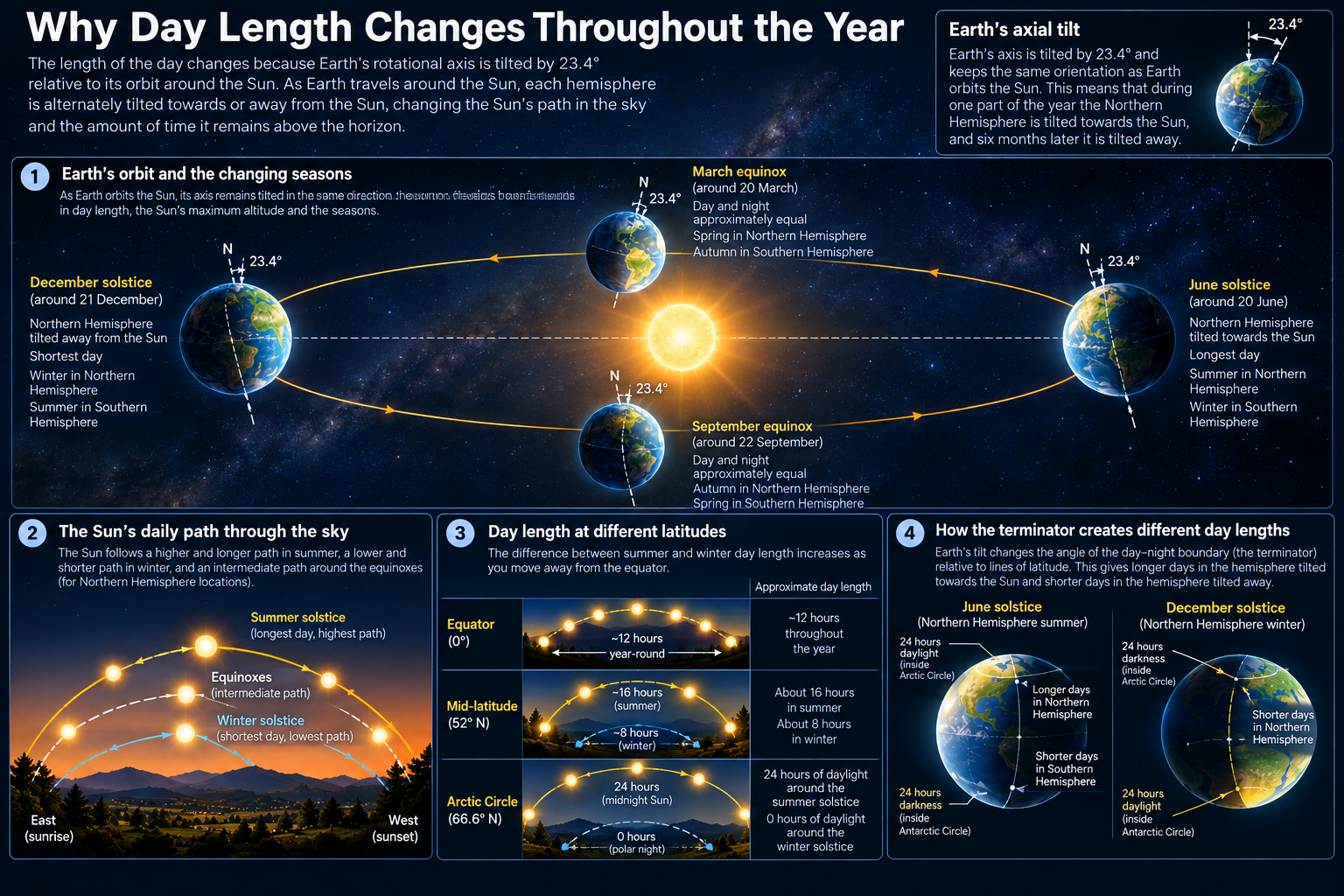
Earth's axis is tilted
Earth rotates once approximately every 24 hours.
But the axis around which it rotates isn't perpendicular to the plane of its orbit around the Sun.
It is tilted by approximately:
23.4°
This is known as Earth's axial tilt or obliquity.
Importantly, the direction in which Earth's axis points remains approximately fixed in space as Earth travels around the Sun.
That means that during one part of Earth's orbit, the Northern Hemisphere is tilted towards the Sun.
Six months later, it is tilted away.
The same thing happens in reverse for the Southern Hemisphere.
This simple piece of geometry is responsible for the annual cycle of changing solar altitude and day length.
Why does tilting towards the Sun make the day longer?
Imagine an observer in the Northern Hemisphere during northern summer.
The Northern Hemisphere is tilted towards the Sun.
As Earth rotates, the observer's location spends a greater proportion of each rotation on the sunlit side of the planet.
The Sun therefore rises relatively early and sets relatively late.
From the observer's viewpoint, the Sun follows a long, high arc across the sky.
Now consider the same observer six months later.
The Northern Hemisphere is tilted away from the Sun.
The observer's location spends a smaller proportion of each rotation on the illuminated side of Earth.
The Sun rises later and sets earlier.
Its apparent daily path is now shorter and lower.
The speed at which Earth rotates hasn't significantly changed.
What has changed is the orientation of the observer's path relative to the boundary between daylight and darkness.
The Sun follows a different path through the sky
The effect is easy to visualise by thinking about the Sun's daily arc.
For a typical observer at mid-northern latitudes:
- Summer: the Sun rises towards the north-east, follows a high and long path across the sky, and sets towards the north-west.
- Around an equinox: the Sun rises approximately due east, follows an intermediate path, and sets approximately due west.
- Winter: the Sun rises towards the south-east, follows a low and short path, and sets towards the south-west.
The longer the Sun's path remains above the horizon, the longer the daylight period.
This is why day length, solar altitude and sunrise and sunset position are all connected.
They are different ways of observing the same underlying geometry.
Why doesn't Earth's distance from the Sun cause the seasons?
This is one of the most common misconceptions about the seasons.
Earth's orbit isn't perfectly circular, so our distance from the Sun does change during the year.
But this isn't the principal cause of the seasons or changing day length.
One of the clearest pieces of evidence is that the Northern and Southern Hemispheres experience opposite seasons at the same time.
When it is summer in the Northern Hemisphere, it is winter in the Southern Hemisphere.
Both hemispheres are obviously the same distance from the Sun.
In fact, Earth reaches perihelion, its closest point to the Sun, during early January—when it is winter in the Northern Hemisphere.
It reaches aphelion, its farthest point from the Sun, during early July—when the Northern Hemisphere is experiencing summer.
The seasons are therefore governed primarily by axial tilt, not Earth's changing distance from the Sun.
What happens at the equinoxes?
Twice each year the Sun crosses the celestial equator.
These events are known as the equinoxes and occur around March and September.
At an equinox, neither hemisphere is tilted strongly towards or away from the Sun.
The dividing line between the daylight and night sides of Earth—the terminator—passes approximately through both poles.
As Earth rotates, most locations spend roughly equal amounts of time in daylight and darkness.
This is why the equinoxes are associated with days and nights of approximately equal duration.
The Sun also rises approximately due east and sets approximately due west.
But there is an interesting complication.
Are day and night exactly 12 hours at the equinox?
Not usually.
The word equinox comes from Latin roots associated with "equal night", but measured sunrise-to-sunset day length is generally a little more than 12 hours on the equinox itself.
There are two principal reasons.
First, sunrise and sunset are conventionally defined using the upper edge of the Sun's disc, rather than its centre.
Second, Earth's atmosphere refracts sunlight near the horizon, making the Sun appear slightly higher than its geometric position.
We therefore see the upper part of the Sun shortly before its centre would geometrically cross the horizon in the morning and continue seeing it slightly longer in the evening.
Together these effects make the measured sunrise-to-sunset period a little longer than a simple 12-hour geometric division would suggest.
The date on which daylight and darkness are closest to 12 hours each at a particular location is sometimes called the equilux, and it need not fall on the equinox itself.
What happens at the summer solstice?
As your hemisphere becomes increasingly tilted towards the Sun, the Sun's daily path becomes progressively longer and higher.
Eventually it reaches an extreme.
This is the summer solstice.
In the Northern Hemisphere it occurs around 20 or 21 June.
In the Southern Hemisphere it occurs around 21 or 22 December.
Around the summer solstice, the Sun reaches its greatest seasonal declination towards that hemisphere.
For observers away from the tropics, it follows its highest daily path through the sky and the daylight period reaches its annual maximum.
This gives us the familiar expression:
the longest day of the year.
After the solstice, the trend reverses.
The days gradually begin becoming shorter again.
What happens at the winter solstice?
Six months later the geometry is reversed.
Your hemisphere is tilted most strongly away from the Sun.
The Sun follows its lowest and shortest daily path.
This produces the winter solstice and the shortest daylight period of the year.
In the Northern Hemisphere this occurs around 21 or 22 December.
In the Southern Hemisphere it occurs around 20 or 21 June.
After the winter solstice, the Sun's daily path gradually becomes longer again and the amount of daylight increases.
The solstices therefore mark turning points in the annual cycle of day length.
Why does latitude make such a difference?
The amount by which day length changes depends strongly on your latitude.
Near the equator, the difference between summer and winter day length is relatively small.
As you travel towards either pole, the seasonal difference becomes progressively greater.
This happens because the tilt of Earth's axis has a much larger effect on how long high-latitude locations remain on the illuminated side of the planet during each rotation.
At mid-latitudes, this produces noticeably long summer days and short winter days.
Closer to the poles, the effect becomes extreme.
Day length near the equator
Near the equator, the Sun rises and sets at a relatively steep angle to the horizon throughout the year.
Day length therefore remains close to:
12 hours
throughout the year.
There is still some variation, and the Sun's exact path changes with the seasons, but the dramatic summer-versus-winter contrast experienced at higher latitudes is largely absent.
The concepts of summer and winter based on temperature can also work differently in tropical regions, where rainfall patterns may be more important than large changes in daylight duration.
Astronomically, however, Earth's axial tilt still determines the changing position of the Sun.
Day length at mid-latitudes
Move farther from the equator and the seasonal effect becomes much more obvious.
The United Kingdom provides a good example.
During summer, sunrise can occur very early and sunset very late, particularly in northern parts of the country.
During winter, the situation reverses.
The farther north you travel, the more pronounced the contrast becomes.
This is why two locations in the same country can experience noticeably different day lengths on the same date.
Longitude primarily affects when sunrise and sunset occur relative to a clock.
Latitude has a particularly strong influence on how far apart sunrise and sunset are.
What happens at the Arctic and Antarctic Circles?
The effect becomes especially interesting at approximately:
66.6° north — Arctic Circle
and
66.6° south — Antarctic Circle
Beyond them, there can be periods when the Sun doesn't set at all.
During the local summer, the Sun can remain above the horizon throughout an entire 24-hour rotation.
This is known as the midnight Sun.
During the local winter, the opposite can happen.
The Sun may remain below the horizon throughout the day.
This is known as polar night.
Travel still closer to a pole and these periods become progressively longer.
What happens at the poles?
At the geographic poles, the familiar daily pattern of sunrise and sunset becomes completely different.
Instead of the Sun rising and setting every day, it moves in a broad circle around the sky.
Near the North Pole, the Sun rises around the March equinox and remains above the horizon for roughly six months.
It reaches its greatest altitude around the June solstice and then gradually descends.
Around the September equinox it sets and remains below the horizon for approximately the next six months.
At the South Pole the cycle is reversed.
There aren't literally six months of bright day followed instantly by six months of complete darkness because long periods of twilight occur around the equinoxes.
Nevertheless, it demonstrates how dramatically Earth's axial tilt can affect the relationship between rotation and daylight.
The terminator explains day length
A useful way to understand the whole process is to look at Earth from space.
At any moment, roughly half of Earth faces the Sun and half faces away.
The boundary separating the illuminated and dark hemispheres is called the terminator.
Earth rotates beneath this boundary.
At an equinox, the terminator passes approximately through both poles.
Most locations therefore spend roughly half of each rotation on the illuminated side and half on the dark side.
Around a solstice, Earth's tilted axis means the terminator is oriented differently relative to lines of latitude.
One hemisphere then spends more than half of each rotation in sunlight while the other spends less.
The changing relationship between your latitude and the terminator is ultimately what determines the seasonal change in day length.
Why do the days change fastest around the equinoxes?
If you follow sunrise and sunset times throughout the year, you may notice that day length doesn't change at a constant rate.
Near a solstice, the change from one day to the next becomes relatively small.
The Sun's seasonal north-south movement has reached an extreme and is temporarily changing direction.
This is reflected in the word solstice, derived from Latin words associated with the Sun appearing to "stand still".
Around the equinoxes, the Sun's declination changes more rapidly from one day to the next.
At many latitudes, day length therefore changes more quickly during these periods.
This is why spring evenings can seem to lengthen remarkably quickly, while the change around midsummer is much less noticeable from one day to the next.
Why doesn't day length change at the same rate everywhere?
Latitude again plays an important role.
A small change in the Sun's declination can produce only a modest change in day length near the equator.
At high latitudes, the same change can substantially alter how much of a location's daily rotational path lies on the illuminated side of Earth.
This means that seasonal changes in daylight become increasingly sensitive to solar declination as you move towards the poles.
The same astronomical event can therefore have very different practical consequences depending upon where you live.
Sunrise and sunset don't change symmetrically
Another interesting feature becomes apparent if you examine the individual sunrise and sunset times rather than simply the total day length.
You might expect that as winter approaches:
sunrise becomes later by exactly the same amount that sunset becomes earlier.
In practice, the changes aren't perfectly symmetrical around 12:00 on the clock.
One reason is that solar noon itself moves relative to civil time during the year.
This happens because of the combination of Earth's elliptical orbit and axial tilt, producing what astronomers call the equation of time.
As a result, the earliest sunset and latest sunrise don't generally occur on the winter solstice.
Similarly, the earliest sunrise and latest sunset don't necessarily occur on the summer solstice.
Our What Is Solar Noon? guide explains why the apparent Sun and our clocks don't remain perfectly synchronised throughout the year.
The shortest day doesn't have the earliest sunset
This is particularly noticeable around the winter solstice.
In the Northern Hemisphere, the December solstice is the shortest day of the year.
But at many mid-latitude locations, the earliest sunset occurs some days before the solstice.
The latest sunrise occurs some days afterwards.
The solstice sits between them as the point at which the total interval between sunrise and sunset reaches its minimum.
This initially seems contradictory.
It makes sense once we realise that the entire daylight period is also shifting slightly relative to our civil clocks because solar noon isn't fixed at precisely 12:00.
Day length and the clock times of sunrise and sunset are related, but they aren't quite the same phenomenon.
Does daylight-saving time change the length of the day?
No.
Changing the clocks doesn't change the Sun.
When daylight-saving or summer time begins, sunrise and sunset may suddenly appear an hour later according to the clock.
But the actual interval between them hasn't gained an hour.
We have simply changed the way the astronomical events are labelled by civil time.
For example:
Sunrise: 05:30
Sunset: 18:30
gives 13 hours of daylight.
Move the clock forward an hour and the same astronomical events become approximately:
Sunrise: 06:30
Sunset: 19:30
The day is still 13 hours long.
Civil time has changed. Day length hasn't.
Does elevation affect day length?
Slightly.
From a high elevation, your geometric horizon is farther away and appears slightly lower relative to the horizontal plane around you.
This can allow you to see the Sun a little earlier in the morning and a little later in the evening than an observer at sea level.
The effect becomes more noticeable from mountains and particularly from aircraft.
Local terrain can have a much larger practical effect.
A mountain to the east can delay the moment you actually see sunrise, while a hill to the west can hide the Sun before astronomical sunset.
Sun Summary's calculated day length is therefore based on astronomical sunrise and sunset rather than the exact shape of the horizon outside your particular location.
Daylight and twilight are not the same thing
Day length usually refers to the interval between sunrise and sunset.
But useful natural light continues outside this period.
Before sunrise and after sunset, sunlight illuminating Earth's atmosphere produces twilight.
Civil, nautical and astronomical twilight extend the transition between daylight and night.
At high latitudes in summer, twilight can last for much or even all of the night.
A location may therefore have, for example, 17 hours between sunrise and sunset but never become completely astronomically dark during the remaining seven hours.
So day length and hours of darkness aren't simply opposite quantities.
Twilight lies between them.
Why does a longer day usually mean warmer weather?
Long summer days are part of the reason summer is warmer, but they aren't the whole explanation.
Two related effects occur when your hemisphere is tilted towards the Sun.
First, the Sun remains above the horizon for longer.
The surface therefore receives solar energy for a greater part of each day.
Second, the Sun generally reaches a higher altitude.
Its rays strike the surface more directly, concentrating solar energy over a smaller area and passing through less atmosphere.
In winter, the reverse occurs: fewer daylight hours and a lower Sun.
There is also a seasonal delay because oceans, land and the atmosphere take time to heat and cool.
This is why the hottest part of summer doesn't necessarily coincide with the longest day, just as the warmest part of an individual day usually occurs after solar noon.
You can observe the changing day length yourself
Day length is one of the easiest astronomical cycles to follow.
Choose a regular observation point with a view towards either sunrise or sunset.
Every week or two, note:
- the sunrise or sunset time
- where along the horizon the Sun rises or sets
and, if practical:
- the approximate solar altitude at the same time of day.
Sun Summary can provide the calculated values for comparison.
Over several months a clear pattern emerges.
- The sunrise and sunset points move along the horizon.
- The Sun's maximum altitude changes.
- The interval between sunrise and sunset grows or shrinks.
- The rate of change accelerates and slows as the equinoxes and solstices approach.
You are observing Earth's axial tilt through everyday changes in your local sky.
Observe safely
There is no need to look directly at the Sun to make these observations.
Never stare directly at the Sun, and never view it through binoculars, a telescope, camera optics or other magnifying equipment unless appropriate purpose-designed solar filtration is correctly fitted to the front of the instrument.
For more information, see our Safe Solar Observing guide.
A practical example
Consider an observer at a mid-northern latitude.
Around the March equinox, the Sun rises approximately in the east and sets approximately in the west.
Day length is close to 12 hours.
During the following weeks, the sunrise point moves northwards along the eastern horizon and sunrise becomes earlier.
The sunset point also moves northwards along the western horizon and sunset becomes later.
The Sun climbs higher at solar noon.
By the June solstice, it follows its longest and highest daily path and the observer experiences the year's longest daylight period.
After the solstice, the process reverses.
The daily solar path gradually becomes shorter.
Around the September equinox, day and night are again approximately equal.
The Sun then follows an increasingly short, low path until the December solstice produces the shortest daylight period.
After that, the cycle begins again.
Day length reveals Earth's movement
Sunrise and sunset can seem like events happening to the Sun.
From our everyday viewpoint, that is exactly how they appear.
But the deeper explanation is about Earth.
- Earth rotates beneath the Sun.
- Its axis is tilted.
- And the tilted Earth travels once around the Sun every year.
Those three facts create the changing daily path of the Sun, the progression of the seasons and the annual rhythm of long summer evenings and short winter days.
This is what makes day length such an interesting measurement.
A value such as:
Day length: 14 hours 37 minutes
isn't simply a piece of timetable information.
It describes the geometry between your location, Earth's tilted axis and the Sun at that particular point in Earth's orbit.
Follow that number throughout the year and you are effectively watching your position on Earth travel around the Sun.
That is one of the ideas behind Sun Summary: to connect familiar events such as sunrise, sunset and changing day length with the astronomical movements that cause them.
The length of the day changes gradually enough to be part of everyday life, but consistently enough to reveal one of the most fundamental characteristics of our planet:
Earth is a tilted, rotating world travelling around a star.
A practical example
Imagine checking Sun Summary shortly after sunrise.
It shows:
Altitude: 8°
Azimuth: 95°
The Sun is low and approximately towards the east.
A few hours later:
Altitude: 37°
Azimuth: 135°
Earth's rotation has changed your orientation towards the Sun. It appears higher and farther around the sky.
Around solar noon:
Altitude: 54°
Azimuth: 180°
The Sun has reached the local meridian and its greatest altitude for the day.
During the afternoon:
Altitude: 29°
Azimuth: 225°
It is descending towards the south-west.
Eventually:
Altitude: 2°
Azimuth: 275°
The Sun is close to the western horizon.
After sunset its altitude becomes negative.
Now repeat the same observations six months later.
The daily east-to-west progression remains, but the altitudes, azimuths, sunrise and sunset positions, and total time above the horizon can all be very different.
The first pattern reveals Earth's rotation.
The difference between the two seasons reveals Earth's orbit and axial tilt.
Observe the movement without looking at the Sun
You can investigate all of this without ever looking directly at the solar disc.
Try marking the end of the shadow cast by a vertical object once every hour.
The resulting sequence will show the Sun's apparent daily motion.
Repeat the experiment at the same location every few weeks and you will see the seasonal pattern change as well.
Alternatively, observe where sunset occurs relative to distant landmarks.
The changing position along the horizon provides another simple record of the Sun's annual movement.
Observe safely
Never stare directly at the Sun.
Looking directly at the Sun can cause permanent eye damage, and the risk becomes much greater when optical equipment is involved.
Never look at the Sun through binoculars, a telescope, camera optics or other magnifying equipment unless appropriate purpose-designed solar filtration is correctly fitted to the front of the instrument.
Ordinary sunglasses are not solar observing filters.
For methods of observing the Sun safely, see our Safe Solar Observing guide.
We are watching our own planet move
The most interesting thing about the Sun's apparent movement is that much of what we see isn't really a record of the Sun moving at all.
It is a record of us moving.
The Sun appears to rise because Earth's rotation carries our location towards it.
It climbs because our local horizon continually changes orientation as Earth turns.
It sets because rotation carries us away from it.
Its daily path changes through the seasons because our rotating planet has a tilted axis.
And the Sun appears to move gradually amongst the stars because Earth itself is travelling around the Sun.
This changes the way we can think about the information displayed by Sun Summary.
When the solar azimuth changes, you are seeing the consequence of Earth rotating.
When solar altitude increases during the morning, your location is turning towards its midday orientation.
When sunset gradually moves along the horizon over several weeks, you are seeing the consequences of Earth's progress around its orbit.
And when the Sun follows a high summer arc or a low winter one, you are seeing the effect of Earth's 23.4° axial tilt.
The Sun therefore provides us with something remarkable: an astronomical demonstration that takes place above us every day.
It may look as though the Sun is travelling across our sky.
But in many ways, what we are really watching is the movement of the Earth beneath our feet.
Find out more
Learn about the moment the Sun reaches its highest point in the sky in What Is Solar Noon?.
More Sun reading
See how day length changes week by week at your location on the Day Length page, read about the moment the Sun is highest in What Is Solar Noon?, the full chain of reasoning behind every sunrise and sunset figure on this site in The position of the Sun, or browse other reading on the Articles page.